IN Brief:
- Emitech has developed supplementary radiated-immunity testing for medical devices operating at frequencies beyond 6GHz.
- Its equipment reaches approximately 40GHz, with near-field scanning above 18GHz using a precision motorised mast.
- The methodology is intended to support risk-based FDA technical documentation; it is not itself an FDA-approved test standard.
Emitech Group has developed a radiated-immunity testing methodology for medical devices at frequencies beyond 6GHz, addressing wireless bands that fall outside the range covered by the standardised immunity tests cited for current medical electrical equipment.
The French testing group is applying the method to devices intended for the US market, particularly products incorporating 5G FR2, Wi-Fi 6E, and Wi-Fi 7 connectivity. Connected medical equipment can combine sensing, processing, radio communications, and power electronics within the same enclosure, leaving its EMC assessment dependent on both the conventional electromagnetic environment and newer radio-frequency exposures.
IEC 60601-1-2 provides the established collateral EMC framework for medical electrical equipment. Emitech says its radiated-immunity testing extends to 6GHz, while newer wireless technologies can operate above that limit. The resulting gap is not a new regulatory standard but an engineering question: how to provide evidence that a device will maintain its required performance when exposed to electromagnetic conditions outside the frequencies covered by the recognised test method.
The US Food and Drug Administration’s 2022 EMC guidance takes a risk-based approach, asking manufacturers to identify electromagnetic disturbances associated with the intended use environment and provide appropriate supporting evidence in premarket submissions. Emitech’s additional testing is intended to form part of that technical justification rather than replace IEC 60601-1-2 or establish a separate FDA-approved procedure.
The company has based its method on familiar medical EMC test principles, using similar modulation approaches and field strengths derived from IEC 60601-1-2. The announcement specifies fields from 10V/m to 28V/m, depending on the severity of the target environment, applied at frequencies associated with the higher-band wireless systems being assessed.
David Montaulon, EMC and Radio Expert at Emitech Group, said: “We cannot wait for a standard to be established to meet the FDA’s requirements: our role is to work with our clients to build a well-founded and traceable technical dossier.”
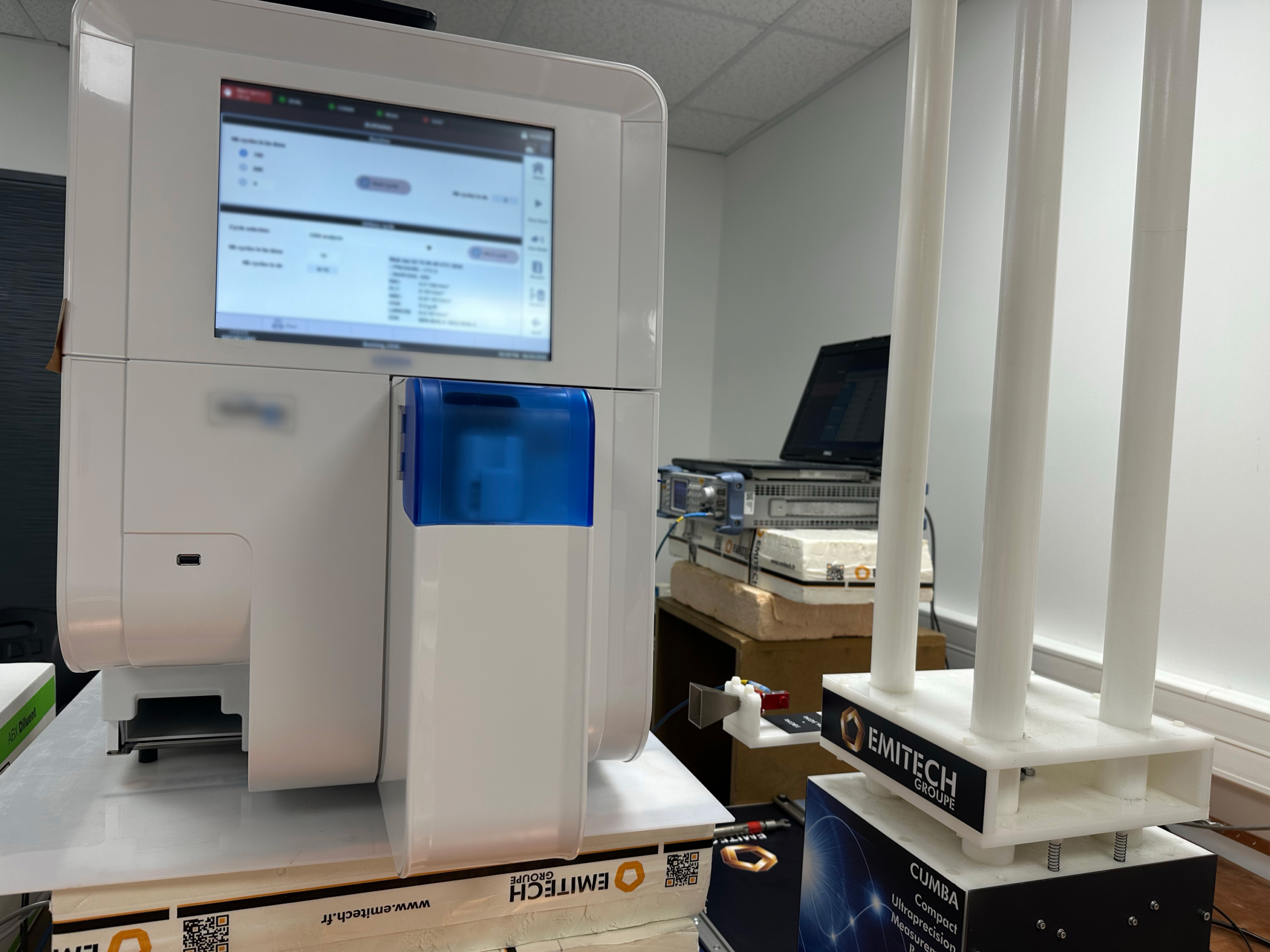
Some of the required RF equipment comes from Emitech’s defence testing activities. Its antennas and signal-generation resources cover frequencies to approximately 40GHz, allowing radiated-immunity work above the conventional 6GHz medical test range. For near-field measurements above 18GHz, the laboratory repurposes a precision motorised mast originally developed for RF measurements reaching 140GHz.
The mast can scan at a distance of around 5cm from the equipment under test, with the work carried out in an anechoic chamber. At millimetre-wave frequencies, the shorter wavelength and greater sensitivity to antenna geometry, enclosure shape, and local coupling make the spatial relationship between the field source and the device increasingly relevant.
Emitech previously followed a similar route when manufacturers had to address immunity to RFID readers before a standardised test method was formally recognised. The company developed an in-house approach for an enteral-feeding-pump manufacturer, with AIM Standard 7351731 subsequently recognised by the FDA for RFID immunity testing. The history provides a precedent for supplementary engineering work, but it does not imply that the current beyond-6GHz method will follow the same standardisation path.
Testing during development also gives hardware teams an opportunity to identify susceptibility before enclosure design, antenna placement, filtering, grounding, and PCB layout are frozen. Higher-frequency coupling can expose weaknesses that are difficult to correct late in a programme without reopening mechanical, RF, or safety verification work.
The FDA does not automatically require every medical device to undergo additional testing above 6GHz. The requirement is to identify credible electromagnetic risks and justify how they have been addressed. Emitech’s method provides a practical route for devices where 5G FR2 or newer Wi-Fi environments create such a risk, while the recognised standards continue to lag behind the radio technologies already being designed into medical electronics.