IN Brief:
- Dutch venture EpoQ has been identified as the winner of PhotonDelta's 2026 Global Photonics Engineering Contest.
- Its proposed trapped-ion atomic clock incorporates photonic integration to reduce the size and complexity of precision timing equipment.
- The prize includes up to €100,000 in development services and possible consideration for up to €2 million in investment, with no confirmed funding award or measured prototype performance.
EpoQ, a quantum technology venture led by researchers associated with the University of Amsterdam, has been named the winner of PhotonDelta’s 2026 Global Photonics Engineering Contest for a proposed trapped-ion atomic clock incorporating photonic integrated circuitry. The concept is intended to reduce the size and complexity of precision timing systems by replacing selected laboratory optical components with integrated photonic structures.
The result was reported on 21 October by Dutch electronics publication Bits&Chips. EpoQ has not yet been formally incorporated, and the project remains an engineering proposal rather than a completed commercial instrument. The available reporting does not establish the exact date on which the competition winner was selected or formally notified.
The award provides access to technology development services worth up to €100,000 from organisations within PhotonDelta’s photonics ecosystem. EpoQ may also be considered for investment of up to €2 million, subject to the organiser’s funding approval process. The maximum investment amount is an opportunity associated with the competition, not funding that has already been secured by the venture.
The proposed clock targets precision timing applications in satellites, defence systems, telecommunications and scientific equipment. These applications can require a stable frequency reference even when continuous access to an external synchronisation signal is unavailable or unreliable.
Atomic clocks use the frequency associated with a transition between defined atomic energy states to provide a reproducible timing reference. A measurement system interrogates that transition and uses feedback to control an oscillator, allowing the frequency of the oscillator to remain closely related to the underlying atomic behaviour.
Trapped-ion clocks use electrically charged atoms confined by electromagnetic fields. Light can be used to interact with the trapped ions and identify the relevant atomic transition, while electronic and optical feedback systems control the measurement process. The architecture must also maintain suitable operating conditions around the atomic reference.
High-precision implementations often require carefully stabilised lasers, optical paths, detection equipment and supporting electronics. The resulting installations can be relatively large and demanding to maintain, particularly where optical components need stable alignment and protection from environmental disturbances.
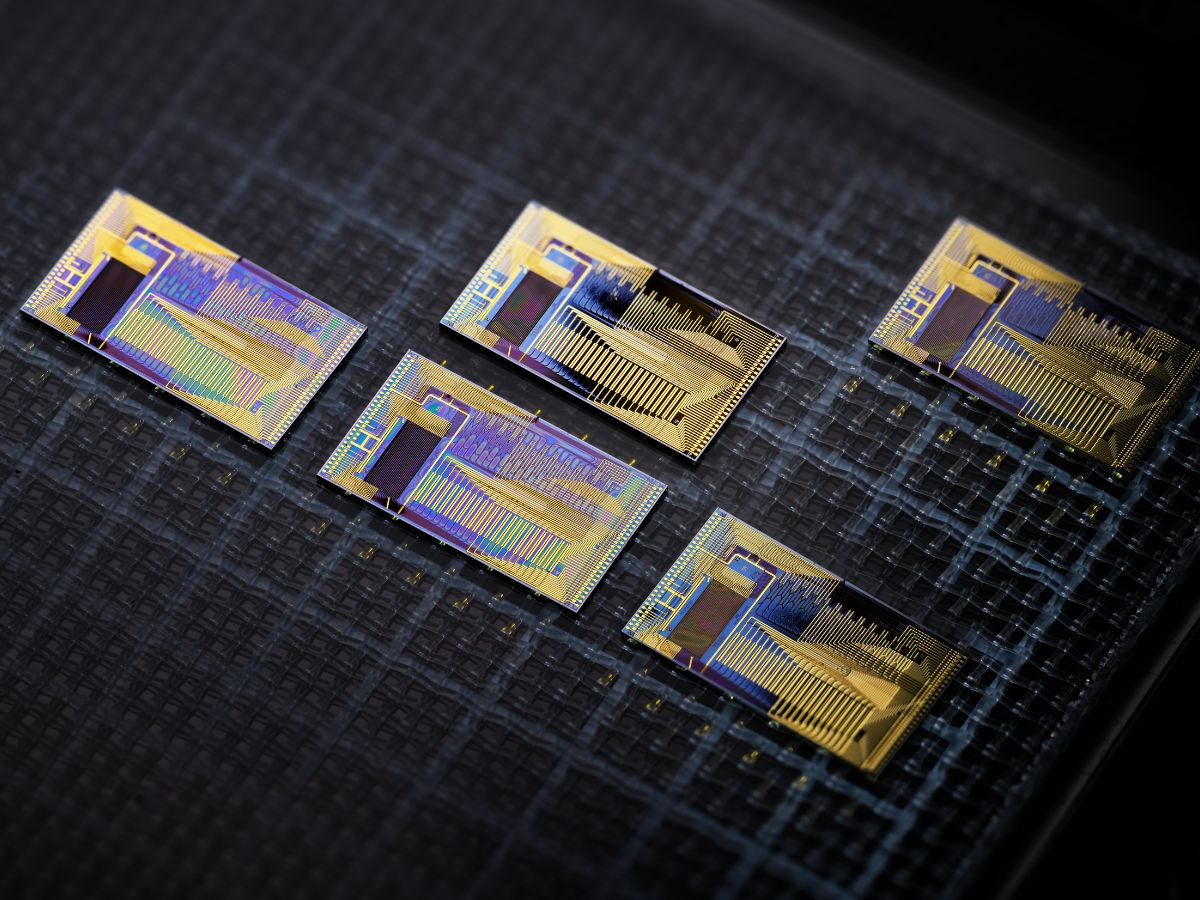
EpoQ’s proposed use of integrated photonics addresses part of this equipment challenge. Instead of building every optical path from separate laboratory components, an integrated circuit can guide and manipulate light through fabricated waveguides and related structures.
Optical splitters, couplers and other components can be incorporated into a common photonic platform, depending on the materials and manufacturing technology selected. This can create more repeatable component geometry and reduce some of the mechanical requirements associated with assembling discrete optical parts.
Integrating the optical functions does not eliminate the need for ion confinement, stable reference generation or control electronics. A practical trapped-ion clock still requires a complete system capable of maintaining the physical conditions needed for accurate interrogation and measurement.
The photonic architecture must also preserve sufficient optical performance. Light can be lost at connections between lasers, fibres and integrated waveguides, while fabrication differences and temperature changes can affect optical propagation. The resulting errors and losses must remain compatible with the clock’s frequency stability and accuracy requirements.
Packaging presents a further challenge because the photonic chip must be connected to the atomic reference and surrounding electronics. Optical alignment, thermal behaviour and mechanical stability can influence the reliability of those connections, particularly where the eventual equipment is expected to operate outside a laboratory environment.
The development services offered through PhotonDelta’s contest are intended to help selected photonic concepts progress towards practical implementation. The 2026 competition brings together businesses specialising in photonic circuit design, semiconductor manufacturing, assembly and related engineering services.
Those capabilities may support the transition from an initial optical design towards fabricated components that can be measured and tested. The competition result does not establish that EpoQ has completed that process, nor that it has qualified a specific photonic fabrication technology.
Satellite and navigation applications provide one possible use for compact atomic timing references. Satellite navigation systems distribute timing information, but received signals may be affected by interference, obstruction or deliberate disruption. A stable local reference can maintain timing during interruptions, provided its performance is sufficient for the equipment concerned.
An atomic clock does not independently replace all the functions of a satellite navigation system. Position determination normally requires additional measurements and information, while the clock contributes to the timing accuracy needed by the wider system.
Telecommunications equipment has related synchronisation requirements. Distributed radio and network systems may need to maintain precise timing relationships across separate installations, and a suitable local reference can help sustain those relationships between external synchronisation updates.
Whether an integrated trapped-ion clock can serve those applications depends on quantitative characteristics including frequency stability, systematic uncertainty, operating temperature, power consumption and package size. The appropriate balance will differ between satellite instruments, telecommunications hardware and stationary scientific equipment.
No measured stability, uncertainty, power consumption, physical dimensions or environmental qualification results have been disclosed for an EpoQ prototype in the available reporting. The specific ion species, optical control arrangement and photonic fabrication platform also remain unconfirmed.
PhotonDelta launched the second edition of its contest in January 2026, originally indicating that winners would be announced in August. The October reporting confirms EpoQ’s identified winner status but does not resolve that earlier schedule, so the award should not be described as having been conferred on 21 October.
The competition attracted submissions from eighteen countries, with entries increasing by approximately 18% compared with the previous edition, according to the reported results. Its first winner, Perceptra, developed a separate integrated photonic sensing concept for molecular analysis.
EpoQ’s next engineering work will involve translating the proposed photonic architecture into measurable components and establishing how they operate alongside the ion trap and timing electronics. The result is a current competition development with a defined technical proposal, while prototype performance, commercial funding and manufacturing readiness remain to be established.