IN Brief:
- Frankenburg Technologies has opened a Riga facility covering missile electronics assembly, fire-control integration, production testing, and quality control.
- The site supports Mark I guided air-defence missile production and forms part of a two-site Latvian FieldFoundry system.
- The expansion reflects Europe’s accelerating requirement for scalable, distributed defence-electronics manufacturing capacity.
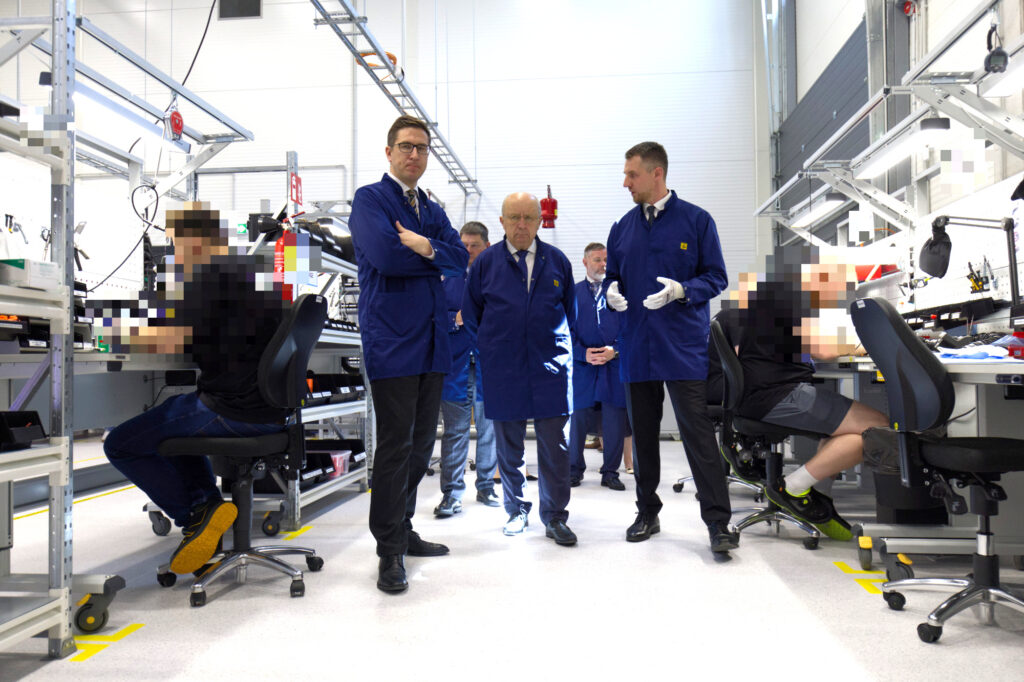
Frankenburg Technologies has opened its Riga Weapon System & Missile Assembly Factory, adding production capacity for Mark I guided air-defence missiles and bringing electronics assembly, fire-control integration, production testing, and quality control into the company’s first Latvian FieldFoundry site.
The Riga facility is the first operational element of a two-site production system that will also include a planned final assembly site in Ādaži. Together, the facilities are intended to support capacity of up to 100 missiles per day by the end of 2026, with the Riga site handling around 1,000m² of modular production space and up to 50 staff as the company moves from low-rate production to higher output.
Although the plant is described as a missile assembly facility, its production scope places electronics at the centre of the industrial model. Guidance, fire control, production test, and quality assurance all depend on repeatable electronic assembly and verification, particularly in a system designed to counter low-cost drones and aerial threats at scale. The factory has been built around modular production stations, lean processes, and standardised workflows that can be replicated in other locations.
Frankenburg plans additional FieldFoundry sites in Estonia, the United Kingdom, and Poland as part of a wider NATO-aligned manufacturing network. The model is intended to allow production to be deployed in existing industrial buildings, temporary structures, or containerised installations, reducing the dependence on large centralised plants and long replenishment cycles.
The Mark I system has already been drawn into broader European counter-UAS development. In March, Airbus demonstrated its Bird of Prey interceptor using a Frankenburg Mark I missile during a live engagement against a one-way attack drone, showing how lightweight guided effectors are being integrated into reusable air-defence architectures. The Bird of Prey engagement placed the missile inside a networked counter-drone concept where sensor input, guidance electronics, payload integration, and command-and-control links all have to work as a single system.
The Riga facility arrives as European defence manufacturing is being pulled away from slow, programme-specific production habits and toward higher-volume replenishment. Drone warfare has exposed a cost imbalance between cheap attacking systems and expensive interceptors, forcing manufacturers to compress development cycles while preserving reliability, safety, and field performance. That pressure is particularly acute in electronics, where every extra production site must still deliver traceable assembly, controlled test coverage, and consistent configuration management.
Missile electronics also carry a harsher qualification burden than many industrial systems. Boards, connectors, power stages, sensors, and processors must tolerate launch shock, vibration, storage, thermal cycling, electromagnetic stress, and demanding field handling. As production rates rise, the risk shifts from proving that a design works once to proving that every unit leaving the line meets the same operational standard.
Distributed defence production can shorten logistics paths and strengthen regional resilience, but it also demands disciplined process replication. A modular factory network only works if test procedures, operator training, component control, software configuration, and acceptance criteria are consistent across sites. Electronics assembly becomes one of the limiting factors because small deviations in build quality or test coverage can translate directly into system-level failures.
Frankenburg’s Riga plant therefore signals more than another increase in European missile capacity. It shows how air-defence production is becoming an electronics-led manufacturing problem, where guidance, sensing, fire-control integration, and verification need to scale as quickly as the mechanical assembly line around them.