
IN Brief:
- The CMI211-1005 uses Intel Core Ultra 200H processors with CPU, GPU, and NPU resources.
- Expansion includes PCIe, dual NVMe storage, 2.5GbE networking, serial ports, and camera connectivity.
- Sustained performance will depend on workload partitioning, cooling, software support, and industrial lifecycle requirements.
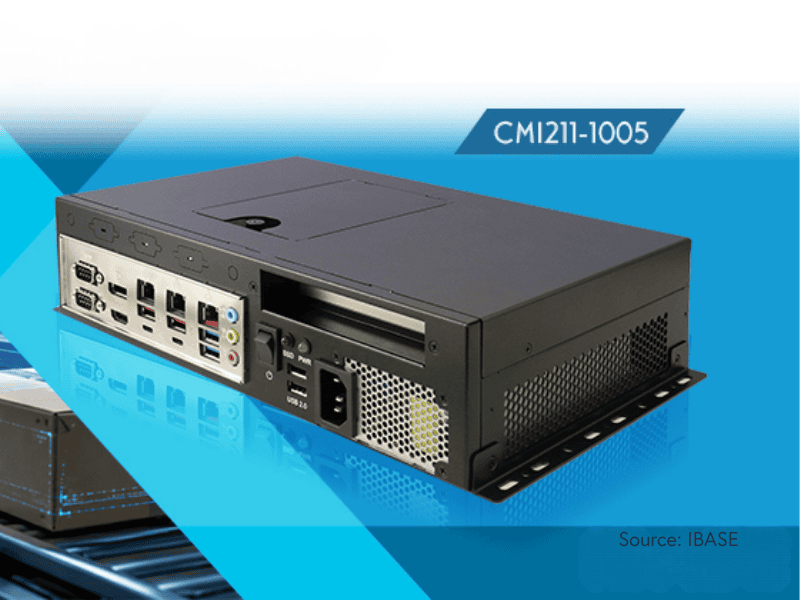
IBASE Technology has developed a compact industrial edge computer combining Intel Core Ultra 200H processing with expandable storage, high-speed networking, camera interfaces, and conventional industrial I/O.
The CMI211-1005 delivers aggregate artificial-intelligence performance of up to 99 TOPS across its CPU, integrated graphics, and neural processing unit. Application software, image processing, inference, visualisation, and operating-system workloads can therefore be divided among different compute engines rather than competing entirely for general-purpose processor time.
System memory can be configured with as much as 96GB of DDR5, providing capacity for larger vision and analytics workloads without continuous dependence on remote infrastructure. Two M.2 M-key sockets support NVMe storage, while an M.2 E-key connection accommodates wireless networking or other compact expansion devices.
A PCIe Gen 4 x4 slot allows frame grabbers, fieldbus interfaces, accelerator cards, or specialist communications hardware to be added. Three 2.5GbE ports are accompanied by USB-C, HDMI, DisplayPort, USB, and serial interfaces, creating a broader connection set than that offered by many sealed edge-AI appliances.
Machine vision, process inspection, factory automation, autonomous equipment, and local data analysis form the principal application areas. Such installations frequently combine cameras, encoders, programmable controllers, safety equipment, and legacy machinery using several generations of communications hardware.
Originally introduced on 2 July, the CMI211-1005 occupies the space between a fixed-function inference box and a larger industrial computer. Expansion capacity allows the same base system to be adapted for different acquisition, control, networking, or acceleration requirements.
Aggregate TOPS conceal architectural differences
Although TOPS provides a convenient comparison between edge systems, the figure combines resources that may support different numerical formats, software libraries, and operations. CPU, GPU, and NPU performance cannot always be added together as though each resource were interchangeable.
The NPU may execute supported neural networks efficiently, while the GPU handles image processing, larger models, or operations not available through the NPU toolchain. Application orchestration, industrial communications, and software that cannot be accelerated continue to occupy the CPU.
Useful throughput consequently depends on model compatibility, data movement, memory bandwidth, and the ability to keep each resource occupied. Copying images or tensors repeatedly between software domains can consume enough time and bandwidth to erode the advantage suggested by peak arithmetic performance.
Several high-resolution cameras can place substantial pressure on the platform before inference begins. Decoding, resizing, colour conversion, calibration, and synchronisation may occupy the GPU or CPU unless the application uses dedicated acquisition hardware or carefully optimised pipelines.
Industrial enclosures impose further constraints, particularly where equipment operates inside cabinets, vehicles, or dusty production areas with restricted airflow. Thermal design determines whether the processor can sustain its highest frequencies throughout a complete shift rather than reaching them briefly under laboratory conditions.
Axelera’s multi-camera inference platform demonstrates the alternative of tightly integrating dedicated acceleration, whereas IBASE retains PCIe expansion and conventional industrial connectivity. Neither architecture is universally preferable; acquisition rate, model complexity, interface requirements, and deployment conditions determine the appropriate balance.
Lifecycle support can outweigh initial performance in machinery expected to remain operational for many years. Consistent hardware configurations, controlled firmware, security maintenance, and replacement availability reduce the validation burden created by processor transitions or silent substitutions of network and storage devices.
Local inference lowers latency and reduces the volume of production data sent off site, but model maintenance then becomes part of the equipment owner’s responsibility. Version control, authenticated deployment, performance monitoring, rollback, and recovery all need to function within the same industrial environment as the application.
The CMI211-1005 provides a flexible hardware base for that work, with enough expansion to accommodate specialised interfaces and accelerators. Its practical performance will be determined by predictable operation under simultaneous camera, storage, network, control, and inference loads rather than by the maximum 99 TOPS figure in isolation.

