IN Brief:
- IBM has completed its acquisition of HRL Laboratories from Boeing and General Motors.
- HRL brings silicon spin-qubit, cryogenic control, semiconductor fabrication, packaging, interconnect, and sensing expertise.
- The acquisition gives IBM a second qubit architecture while broadening the manufacturing infrastructure supporting its quantum roadmap.
IBM has completed its acquisition of HRL Laboratories, adding silicon spin-qubit development, cryogenic control electronics, semiconductor processing, advanced packaging, interconnect, sensing, and materials expertise to its existing quantum-computing operation.
Financial terms have not been disclosed. HRL was previously jointly owned by Boeing and General Motors, which will continue collaborating with IBM and HRL on quantum applications and advanced technology following completion of the transaction.
The acquisition gives IBM access to a qubit architecture that differs substantially from the superconducting circuits at the centre of its current processors. HRL has been developing silicon spin qubits based on quantum dots formed in silicon-germanium semiconductor structures, creating another route towards scalable quantum hardware while retaining strong links with established semiconductor processing techniques.
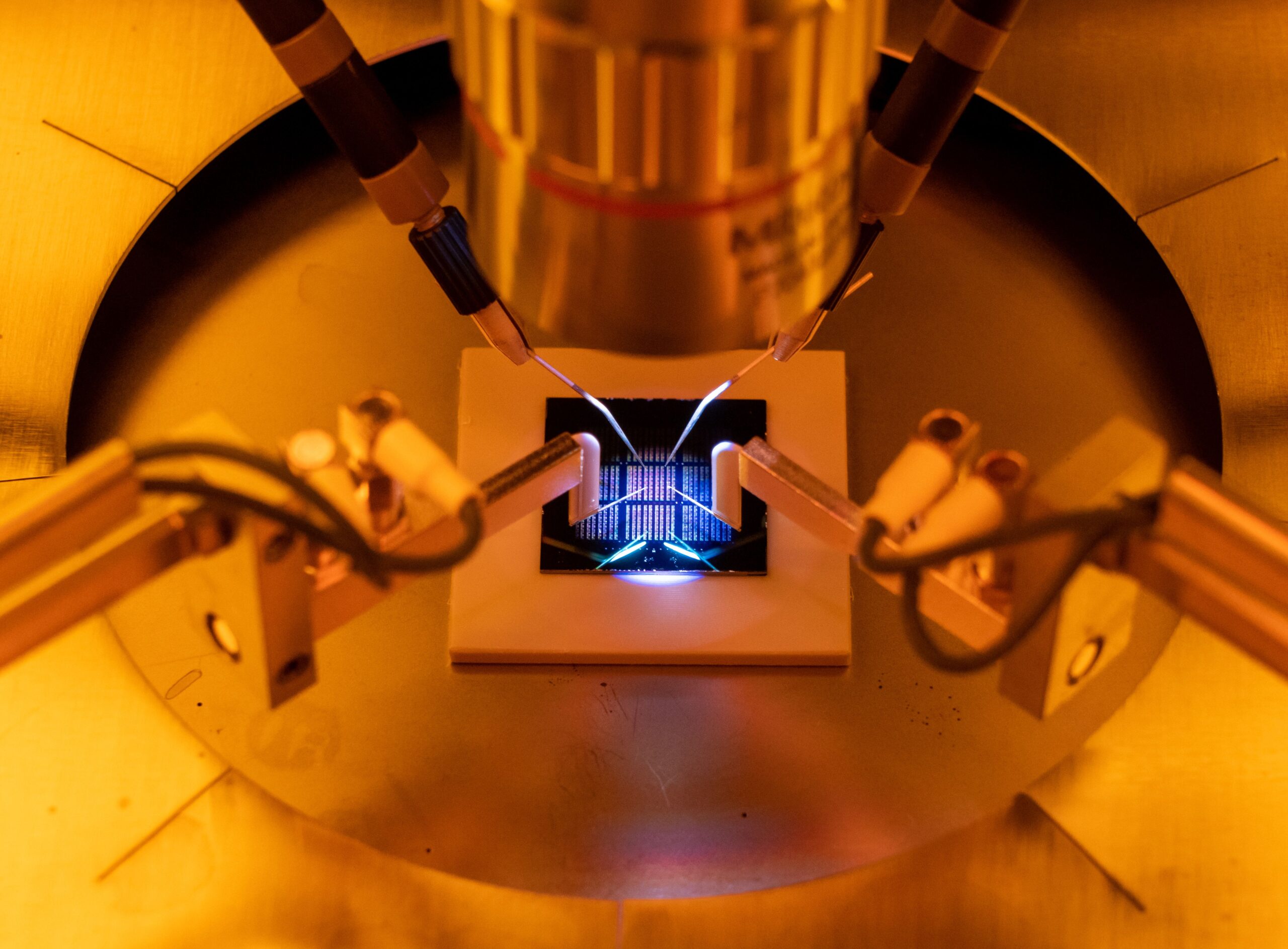
HRL’s exchange-only approach uses groups of three electrons confined within quantum dots. Electrical gate signals alter the interaction between those electrons to perform quantum operations, placing precise semiconductor fabrication, low-noise control electronics, and cryogenic operation at the centre of the architecture.
Spin qubits are physically compact compared with many superconducting structures, creating the potential for dense arrays if fabrication uniformity and control can be maintained. Their semiconductor basis also offers a possible route towards manufacturing methods derived from conventional wafer processing, although quantum devices impose tolerances and operating conditions far removed from mainstream CMOS production.
The difficulty shifts rapidly from demonstrating individual qubits to controlling large numbers of them. Quantum processors have to operate at extremely low temperatures, while the conventional electronics used to generate, route, and measure signals typically sits much further away at warmer stages or outside the cryostat entirely.
Every additional qubit can add wiring, connectors, thermal conduction, signal-routing requirements, and control hardware. A system that works with tens of devices does not necessarily scale cleanly to thousands if each qubit requires a dedicated electrical path between room-temperature electronics and the coldest stage of a dilution refrigerator.
HRL has been tackling that problem with cryogenic electronics designed to operate closer to the quantum hardware. Its recent silicon quantum processor work paired an 18-qubit system, built from 54 quantum dots, with a custom CMOS controller operating inside the cryogenic environment.
The controller reduces dependence on continuous signal generation from room-temperature equipment, while HRL has also developed dense superconducting ribbon interconnects intended to carry control signals between temperature stages without introducing excessive heat into the colder parts of the system.
IBM has been addressing the same scaling pressure through modular cryogenic infrastructure, increasing the physical volume available for wiring and future processor assemblies. HRL’s work attacks the problem from the electronics side, reducing the amount of control hardware and cabling that has to extend between temperature zones.
The two approaches are complementary. Larger refrigerators provide more space and cooling capacity, but they do not make unrestricted wiring practical. Cryogenic control can reduce that burden, although the electronics themselves have to operate with sufficiently low power dissipation and noise to avoid undermining the quantum devices they are intended to support.
IBM has not indicated that silicon spin qubits will replace its superconducting processors. Its published roadmap continues towards increasingly fault-tolerant superconducting systems, including the planned Quantum Starling platform later this decade. HRL instead gives the company another device architecture and a wider set of manufacturing and control technologies that can inform future processor development.
The acquisition also strengthens IBM’s position further upstream in the semiconductor process. HRL operates epitaxy equipment, nanofabrication facilities, materials laboratories, and cryogenic test infrastructure, giving researchers control over device development from semiconductor layer growth through patterning, packaging, and low-temperature characterisation.
That vertical capability is particularly valuable in quantum hardware because small process variations can translate into substantial changes in device behaviour. Interface roughness, dimensional variation, material defects, lithographic uniformity, gate structures, and packaging stress can all affect qubit characteristics and ultimately influence yield across a processor.
Manufacturability is consequently becoming as important as headline qubit performance. A device architecture may demonstrate long coherence or high-fidelity operation in a laboratory and still prove unsuitable for larger systems if its characteristics vary too widely across a wafer or if packaging and control requirements become impractical.
IBM has also identified HRL’s silicon technology as potentially complementary to its wider quantum semiconductor manufacturing activity. Bringing several qubit and control technologies into a common research and fabrication environment creates opportunities to compare processes, materials, packaging methods, and cryogenic electronics rather than developing each discipline separately.
Boeing and General Motors remaining as collaborators gives the acquired laboratory another connection to prospective applications outside IBM’s own computing services. HRL has historically worked across aerospace, automotive, sensing, communications, advanced materials, and US government programmes, leaving its engineering base broader than quantum computing alone.
The acquisition therefore adds more than another qubit design to IBM’s portfolio. HRL brings semiconductor fabrication, cryogenic electronics, interconnect, packaging, and test capabilities around the quantum device itself — precisely the disciplines that become harder to separate as processor size increases.
The value of the deal will ultimately be measured less by the number of technologies IBM can list than by whether those capabilities reduce the manufacturing and control overhead surrounding useful quantum processors. Individual qubits are no longer the only difficult part of the machine.