IN Brief:
- The expanded uEye FA camera range covers resolutions between two and 12.5 megapixels.
- Sony STARVIS 2 sensors add near infrared sensitivity, low noise imaging, and Clear HDR.
- IP69K housings support installations exposed to dust, moisture, high pressure cleaning, and temperatures down to minus 20°C.
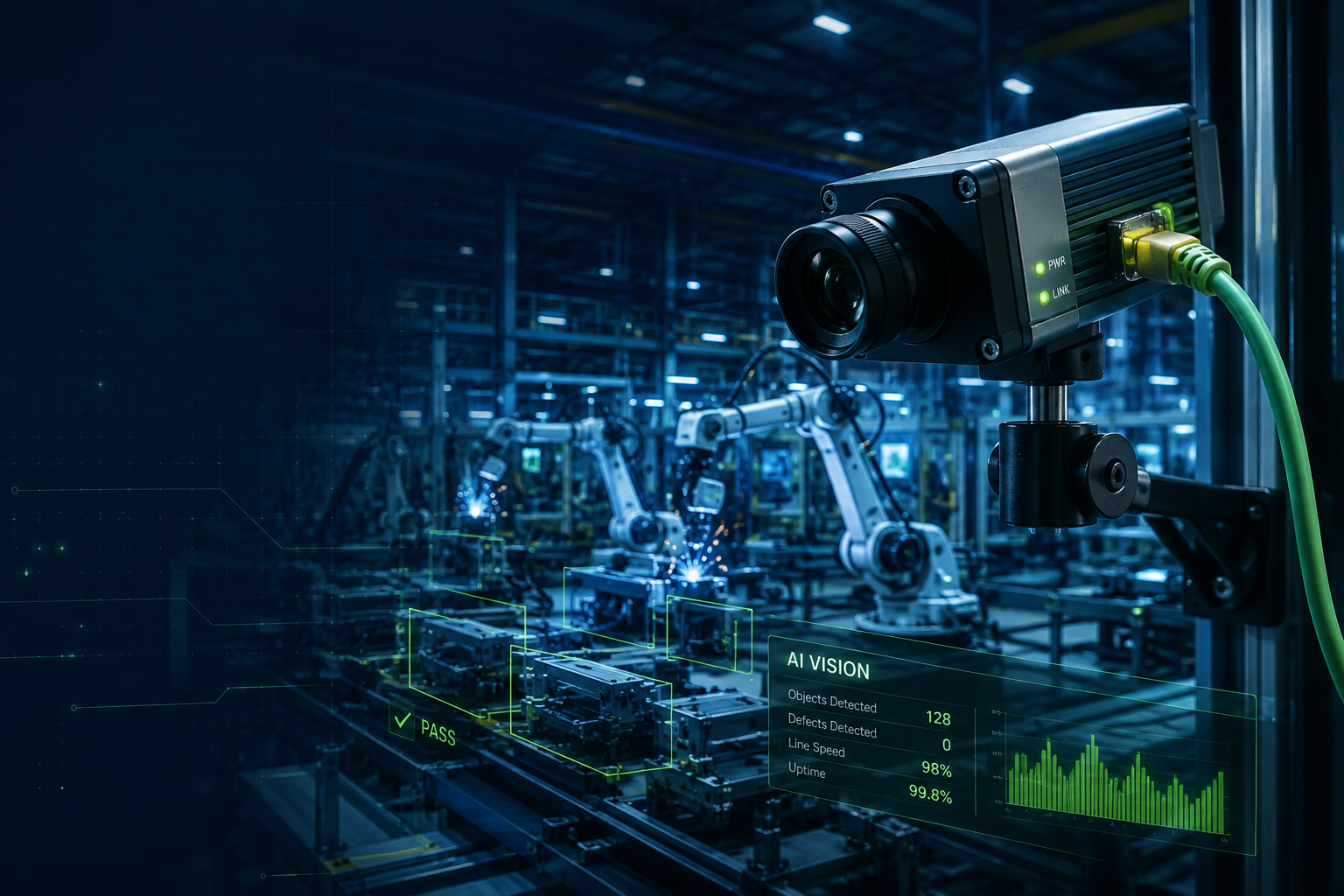
IDS Imaging Development Systems has expanded its uEye FA industrial camera range with five GigE Vision models that combine Sony STARVIS 2 sensors with IP69K protection for demanding production environments.
Available resolutions extend from two to 12.5 megapixels through the IMX662, IMX664, IMX675, IMX678, and IMX676 sensors. The selection allows system designers to balance image detail, field of view, sensitivity, frame rate, network traffic, and processing load without moving to a different camera platform.
Sony’s second generation STARVIS architecture provides high sensitivity across visible and near infrared wavelengths while limiting read noise, supporting inspection and monitoring where illumination is restricted or where near infrared light is used to distinguish materials and surface features. Clear HDR is also available for scenes that contain bright reflections and deep shadows within the same image.
Asynchronous exposure triggering enables image capture to be coordinated with moving machinery, strobed lighting, encoders, or external sensors. In applications where parts pass through an inspection point at speed, precise timing can be as important as nominal resolution because even a high quality sensor produces unusable data when exposure and motion are poorly synchronised.
The cameras use GigE Vision connectivity and retain the established uEye FA housing, allowing the new sensor options to enter existing software and integration environments. Protective lens tubes and sealed housings carry an IP69K rating, while operation down to minus 20°C extends deployment into unheated plants, outdoor equipment, logistics sites, and frequently cleaned production areas.
End of July availability turns the announcement into a series expansion rather than a separate hardware family. Existing users can therefore add higher sensitivity and dynamic range while retaining familiar interfaces, mounting arrangements, and software tools.
Imaging moves closer to production processes
Industrial cameras are increasingly installed beside machinery rather than inside isolated inspection enclosures, exposing them to coolant, dust, vibration, cleaning fluids, changing temperatures, and uncontrolled reflections. Environmental protection consequently becomes part of the measurement architecture, alongside the sensor, lens, illumination, trigger, and processing hardware.
An IP69K camera does not make the complete vision system washdown resistant on its own. Cables, connectors, lens tubes, lighting, mounting hardware, and external trigger devices need comparable protection, while water or residue on the optical window can degrade contrast even when the enclosure remains perfectly sealed.
Greater near infrared sensitivity gives designers more freedom to separate the inspection wavelength from visible production lighting. Infrared illumination can improve contrast between selected materials, reduce distraction to operators, and support monitoring in dark spaces, although the useful wavelength still depends on the spectral response of the target, background, lens, and protective window.
High dynamic range also involves compromise. Techniques that preserve detail across a wider brightness range can affect motion rendition, trigger timing, noise, or processing latency, so a rapidly moving reflective component may need a different capture mode from a stationary scene with slowly changing light.
Resolution produces a similar system level trade off because moving from two to 12.5 megapixels increases memory demand, network traffic, and inference workload. Several high resolution streams can saturate an otherwise capable edge computer, particularly when images must be retained as well as analysed, which is driving the use of industrial systems combining local AI acceleration with extensive expansion interfaces.
Processing beside the production line can reduce the volume of image data sent to central servers, yet local inference depends on stable and repeatable input. A model trained on clean, evenly illuminated images may become unreliable as lenses collect residue, illumination ages, exposure settings drift, or replacement cameras introduce a different response.
Calibration and maintenance therefore remain inseparable from sensor performance. Flat field correction, lens inspection, lighting checks, controlled firmware versions, and configuration records become especially important when a vision result determines whether a component is accepted, rejected, or used to adjust a manufacturing process.
Rolling shutter behaviour must also be considered across the STARVIS 2 options, since motion within the exposure can distort fast moving subjects even when the image appears sharp. Trigger design, exposure duration, object speed, and field geometry all influence whether that distortion remains acceptable for measurement or classification.
By combining current sensor technology with an established industrial enclosure, the new uEye FA models extend low light and high contrast performance without changing the wider platform. Reliable deployment still depends on treating optics, illumination, timing, networking, processing, sealing, and maintenance as parts of one measurement system rather than independent components.