IN Brief:
- Inelco Hunter is offering Amphenol Industrial Operations connectors for liquid-cooling systems.
- The range includes UQD, UQDB, SHQD, MQD, and manifold options for high-flow and compact installations.
- Liquid cooling is becoming central to high-density AI infrastructure, energy storage, EV charging, and industrial electronics.
Inelco Hunter is offering Amphenol Industrial Operations’ liquid-cooling connector range for AI data centres, energy storage systems, EV charging stations, and industrial machinery.
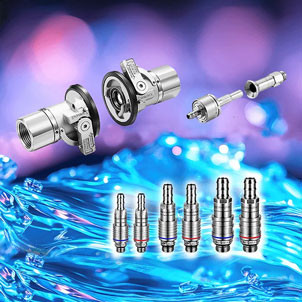
The connector range is designed for high-performance liquid-cooled environments where secure coupling, low pressure loss, leak control, and corrosion resistance are critical. It includes UQD, UQDB, SHQD, MQD, and manifold options, giving system designers choices across rack-level, tray-level, coolant distribution, and high-flow applications.
The UQD and UQDB connectors comply with OCP Rev 2.0 specifications. UQD devices use quick-connect technology, while UQDB products support blind mating for installation environments where manual alignment is constrained. The latest OCP specification supports a hybrid configuration in which a UQD plug can mate with a UQDB socket, creating additional flexibility across system designs.
The SHQD self-sealing connector series supports flow performance up to 800L/min and uses a dual interlocking safety mechanism. Large-diameter valve designs of 1in, 1.5in, and 2in support full-flow, low-resistance cooling between coolant distribution units and manifolds. The MQD range uses a compact push-pull locking mechanism for computer tray environments, with straight and 90° elbow versions for installation flexibility.
Manifold options are also part of the range, giving system builders a way to distribute coolant across multi-channel networks. Materials include stainless steel, copper, aluminium, and durable plastics, with termination options such as threaded, hose barb, and sanitary flange. EPDM rubber seals are standard for chemical and thermal resistance with glycol-based coolants, with alternative seal materials available for other fluids.
Cooling has moved from facility support into the electronics architecture. AI data-centre racks are becoming denser, power conversion is moving closer to compute loads, and heat flux is rising at board, package, and rack level. Air cooling remains useful in many systems, but direct-to-chip and liquid-assisted cooling are becoming increasingly important where power density exceeds the limits of conventional airflow.
That shift is also visible in Vertiv’s AI infrastructure manufacturing expansion in Johor, which includes power, cooling, integrated infrastructure, assembly, and witness testing for high-density digital infrastructure. Cooling hardware is no longer a secondary fit-out item. It is part of the validated infrastructure needed before high-density compute systems can be deployed reliably.
Liquid-cooling connectors carry a different risk profile from conventional electrical interconnects. They must preserve flow, prevent leaks, tolerate repeated service, resist corrosion, and maintain sealing integrity through temperature variation, vibration, pressure cycling, and maintenance events. In a high-density rack or charging environment, a connector fault can become a thermal, electrical, and serviceability problem at once.
OCP alignment reflects the growing demand for interoperable mechanical and cooling interfaces in AI infrastructure. Standardisation can reduce custom engineering, simplify maintenance, and improve supply options, although it does not remove the need for careful fluid compatibility, pressure-drop modelling, access planning, and validation. Cooling loops now influence rack layout, service procedures, telemetry, and fault isolation.
Energy storage and EV charging add further demands. These systems often combine high currents, outdoor or semi-controlled environments, limited service windows, and long operating lives. Liquid cooling can improve thermal control, but only when the connection system is robust enough for installation, maintenance, and field conditions. The connector becomes a reliability component, not a commodity fitting.
Inelco Hunter’s addition of the Amphenol range gives UK and European projects access to liquid-cooling interconnects across high-flow and compact system designs. As electronics power density rises, thermal design is being pulled earlier into electrical, mechanical, and service architecture, with coolant management becoming part of the core reliability model.