IN Brief:
- Infineon and SOLUM have signed an MoU extending cooperation on high-voltage DC power systems.
- Their work covers intermediate bus converters, battery backup units, and server power supplies.
- Infineon will contribute semiconductor technologies, reference designs, and technical support to future projects.
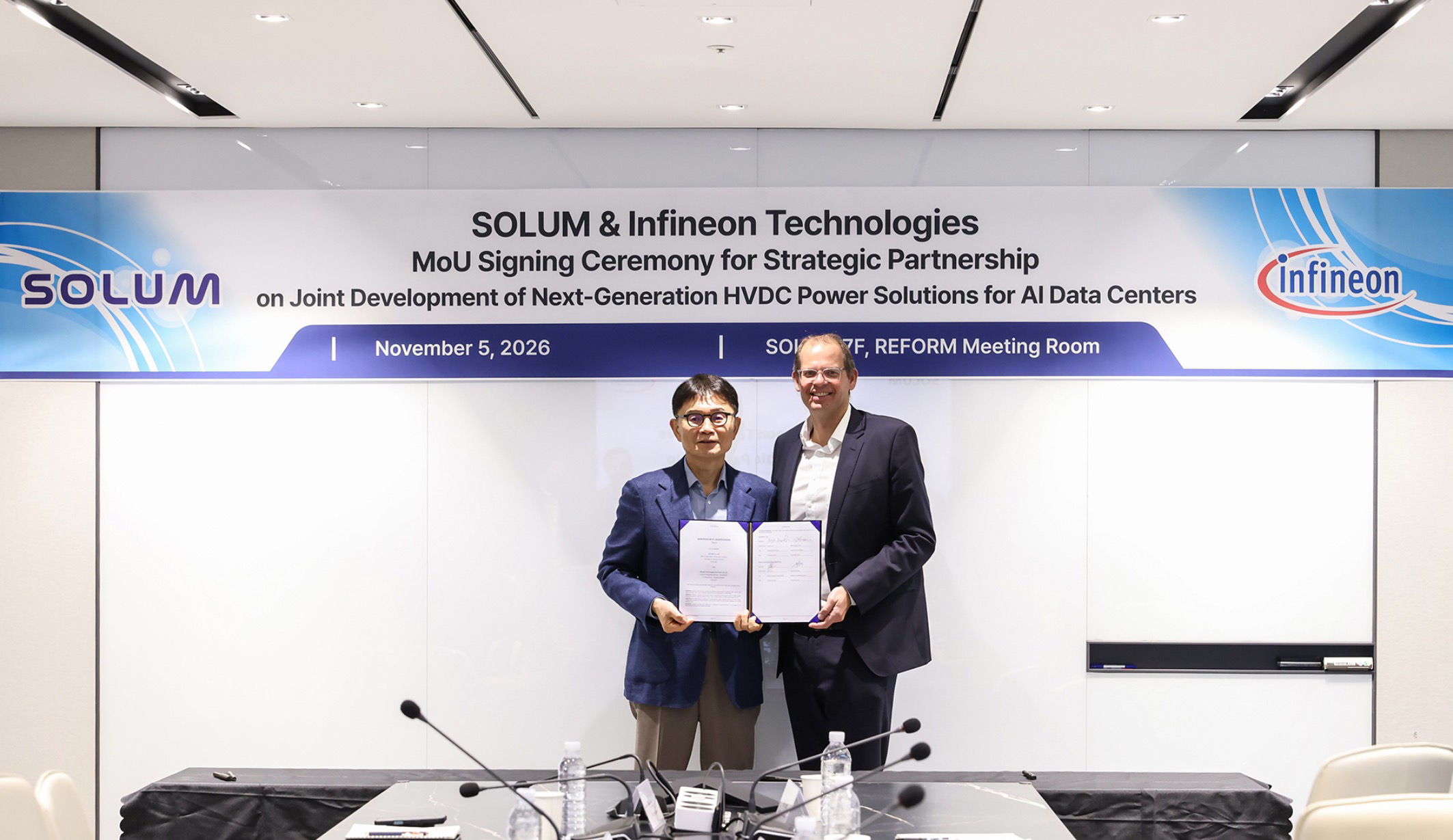
Infineon Technologies and South Korea’s SOLUM have agreed to expand their technical collaboration on high-voltage direct current power systems for AI data centres, bringing semiconductor development and power module engineering together across three applications.
The companies have signed a memorandum of understanding covering intermediate bus converters (IBCs), battery backup units (BBUs), and power supply units (PSUs). The agreement builds on existing cooperation and establishes a framework for developing power conversion technologies intended for increasingly demanding computing infrastructure.
Infineon will participate from the early stages of relevant projects, reviewing suitable semiconductor technologies and system architectures while providing reference designs and technical support. SOLUM contributes experience in server power supply design, power modules, and manufacturing.
The arrangement comes as higher accelerator power requirements are changing the electrical architecture of AI computing systems. Power must be distributed across increasingly dense installations and converted into the voltages required by processors, memory, communications equipment, and supporting electronics.
High-voltage DC distribution is being developed as an alternative to arrangements that rely on multiple conversion stages and lower-voltage distribution within the computing infrastructure. Raising the distribution voltage allows a given amount of power to be transferred at a lower current, reducing resistive losses in the conductors.
Because those losses increase with the square of current, conductor resistance becomes particularly important as the power carried by an electrical connection rises. The practical advantages of a higher-voltage architecture also depend on converter efficiency, electrical protection, insulation, and the physical arrangement of the distribution equipment.
Intermediate bus converters form one part of this system. They convert the higher distribution voltage into an intermediate level that can be regulated further before reaching the processor and other electronic loads.
The conversion stages must accommodate changing load requirements while controlling electrical and thermal losses. The choice of switching devices, control topology, magnetic components, and operating frequency influences both conversion efficiency and the size of the finished hardware.
Battery backup units serve a different function, maintaining electrical supply when the incoming power source is interrupted. Their converters must manage energy transfer between a battery system and the DC distribution bus, including the operating transitions associated with charging, discharging, and backup operation.
Power supply units also contribute to the performance of the complete system. Losses generated in these devices appear as heat, adding to the cooling requirements of an installation that already contains substantial computing hardware.
Infineon’s semiconductor portfolio provides several technologies for these conversion functions. Its silicon CoolMOS and OptiMOS devices address different power switching requirements, while CoolSiC silicon carbide and CoolGaN gallium nitride products provide further options for high-efficiency switching circuits.
The most appropriate device technology depends on operating voltage, current, switching frequency, thermal conditions, and the surrounding circuit. Wide-bandgap devices can offer advantages in suitable topologies, although their use also requires attention to gate driving, parasitic inductance, electromagnetic interference, and component protection.
Infineon will contribute microcontrollers and sensors alongside the power semiconductors. Digital control can coordinate switching behaviour, monitor operating conditions, and manage protection functions, while sensing circuitry provides the measurements required to regulate the converter.
The companies have not identified specific semiconductor devices or circuit topologies for a jointly developed production design. Those selections form part of the engineering activity covered by the agreement.
SOLUM has already been developing high-voltage power conversion hardware independently of the new memorandum. In August, the company detailed work on a 26kW DC-DC converter for an 800V DC architecture, with production targeted for the first quarter of 2027.
That converter provides context for SOLUM’s existing work in server power equipment, but the companies have not identified it as a completed product arising from the newly signed agreement. Its production timetable should likewise not be treated as a delivery commitment for every development covered by the memorandum.
Adam White, Division President Power Systems at Infineon, said: “AI data centers require power infrastructure with increasing levels of efficiency, reliability and power density.” He described SOLUM’s server power capabilities as complementary to Infineon’s semiconductor expertise.
Jun Sung-ho, CEO of SOLUM, said the collaboration would strengthen the company’s high-voltage, high-efficiency power design capabilities and support its expansion into next-generation AI data centre power markets.
The two businesses will maintain regular technical discussions as their work progresses. Infineon’s support will extend beyond supplying individual components to the evaluation of suitable technologies and reference architectures for the planned converter and power supply applications.
Neither company has announced a joint production contract, manufacturing volume, or performance specification for the products covered by the new agreement. Subsequent development milestones will establish which designs advance through evaluation and qualification towards commercial manufacture.