
IN Brief:
- MEAN WELL has introduced SPWM-75, SPWM-150, and SPWM-240 constant-voltage LED drivers for dimming and colour tuning.
- DALI-2 DT6 dimming and DT8 tunable white/colour control are supported, alongside push-button input on DALI-2 models.
- The series targets flicker-sensitive and emergency lighting use cases, with Class II design, protection functions, and a 5-year warranty.
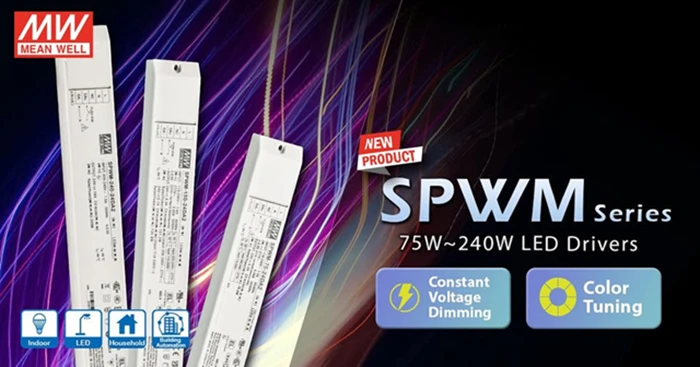
MEAN WELL has launched the SPWM series — SPWM-75, SPWM-150, and SPWM-240 — as constant-voltage LED drivers designed for dimming and colour tuning in building lighting systems. The company is positioning the range as a complement to its existing PWM driver portfolio, with a focus on tunable white and colour control functions that are increasingly specified in commercial interiors, retrofit programmes, and residential smart lighting installs.
The SPWM-75/150/240 series uses a light grey elongated plastic enclosure with terminal-style interfaces and is designed to support flexible configuration of dimming, colour temperature adjustment, and colour tuning in a single unit. MEAN WELL is initially shipping variants that support 3-in-1 dimming and DALI-2 dimming/colour tuning, with KNX and Matter dimming/colour tuning models slated to follow, which would extend compatibility into a broader set of building automation ecosystems.
From a controls standpoint, DALI-2 support remains a dominant specification in professional lighting — especially in projects where commissioning, interoperability, and long-term maintainability tend to win arguments over “it works in the demo”. MEAN WELL states that the SPWM range supports DALI-2 DT6 dimming and DT8 tunable white/colour control, with DALI-2 models also supporting PUSH dimming and colour control via a push-button input. For installers and OEMs, that combination gives a standards-based digital control path, plus a simple local override mechanism without adding separate modules.
Electrically, the drivers use a constant-voltage PWM output mode with selectable one to four output channels, targeting multi-channel lighting designs where luminaires blend channels to achieve a target CCT or colour point. MEAN WELL is also emphasising flicker-free design and compliance with the CE ErP Directive, a combination that aligns with growing scrutiny of flicker performance in professional environments and the steady tightening of energy-related product rules.
The series includes a Class II design with double insulation and protection functions covering short-circuit, overload, over-voltage, and over-temperature conditions, and MEAN WELL states the drivers are suitable for emergency lighting applications. Minimum dimming is specified down to 0.1%, a performance point that can make the difference between “mood lighting” and a visibly stepping, unstable low-end that users notice immediately.
The undercurrent here is that control protocol convergence is starting to reach the driver layer in a form that lighting OEMs can use without redesigning every luminaire around a proprietary ecosystem. If MEAN WELL follows through with KNX and Matter variants, the SPWM series could become a useful bridge between traditional professional controls and the next wave of networked building platforms.
Find out more about the SPWM series here.

