IN Brief:
- MediaTek has qualified Infineon’s 512Mb QSPI NOR Flash for its Dimensity Auto Cockpit C-X1 platform.
- The AEC-Q100 device supports safe and secure boot, MirrorBit technology, and operation at temperatures up to 125°C.
- Qualification gives automotive developers an approved external memory route for increasingly complex cockpit firmware.
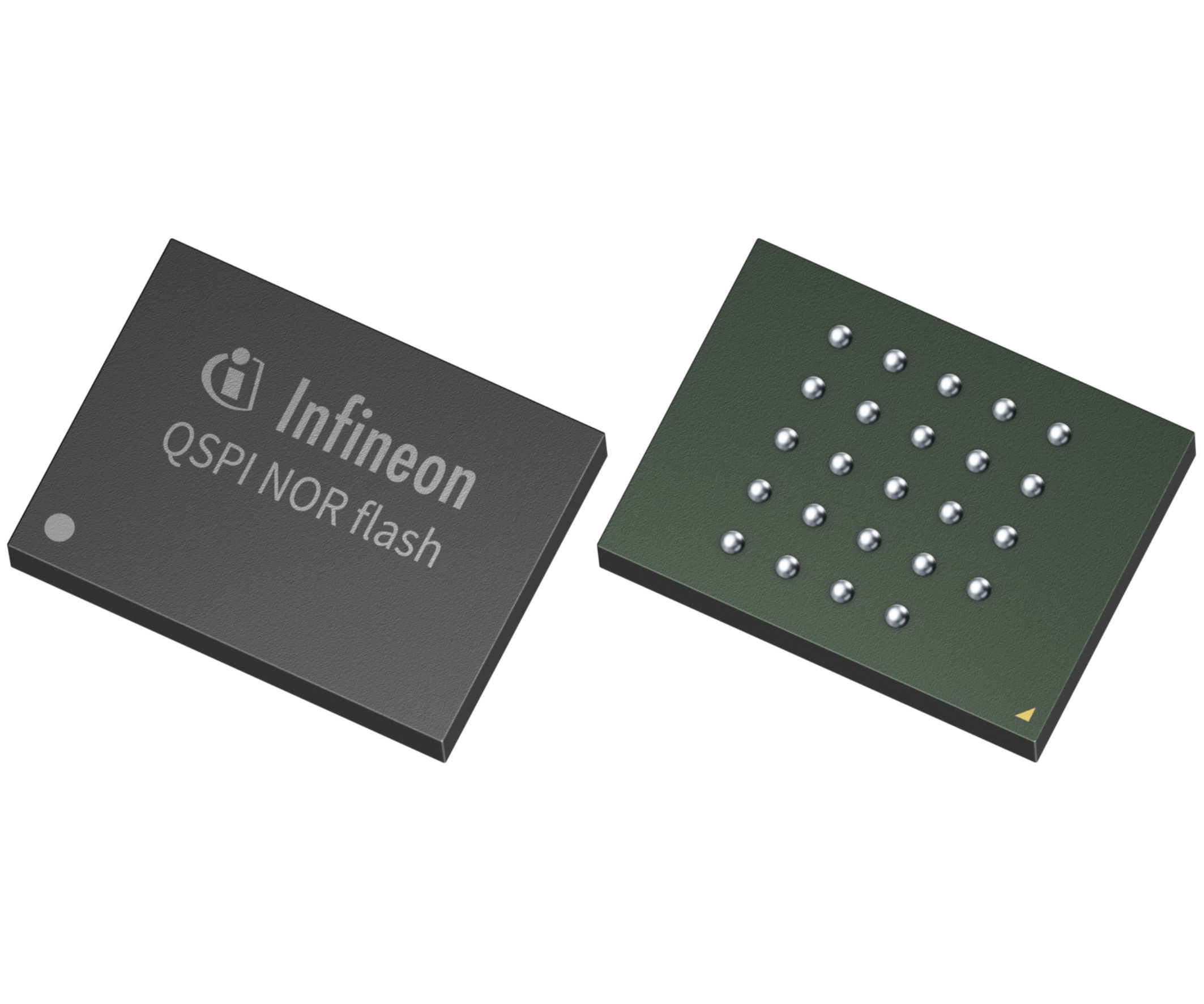
Infineon Technologies has secured MediaTek qualification for its 512Mb Quad SPI NOR Flash on the Dimensity Auto Cockpit C-X1 platform, giving vehicle manufacturers, Tier 1 suppliers, and design partners an approved external boot memory option for future cockpit systems.
The automotive-grade device stores the firmware and boot code used by the C-X1 system-on-chip. Infineon says it supports safe and secure boot, uses the company’s MirrorBit technology, carries AEC-Q100 qualification, and operates at temperatures up to 125°C.
The qualification covers more than a capacity figure. Cockpit processors now run digital instrument clusters, infotainment, driver monitoring, voice interfaces, navigation, and local artificial intelligence functions, while over-the-air updates require enough non-volatile storage for signed images, recovery code, and rollback procedures.
Rainer Hoehler, senior vice-president of Memory Solutions at Infineon Technologies, said: “Automotive memory is a strategic enabler of innovation as software-defined vehicles depend on high-performance Systems-on-Chip (SoCs), increasingly complex firmware, and large data stores. Cutting-edge digital cockpits and over-the-air update capabilities are driving the demand for higher density NOR flash.”
MediaTek’s C-X1 is built on a 3nm process and uses Arm v9.2-A processor cores, an NVIDIA Blackwell GPU, and deep-learning accelerators. The platform also supports hardware-based virtualisation and automotive safety requirements, allowing several cockpit functions to share a consolidated compute architecture.
That consolidation increases the importance of dependable start-up behaviour. A failure in the boot chain can affect several displays and services at once, so the external NOR device must provide predictable access across temperature, voltage, and repeated update cycles. Safe and secure boot functions also need to verify that the code being loaded is authentic before the main software environment starts.
NOR Flash remains suited to this role because it provides direct, deterministic access to code without the controller overhead associated with managed NAND storage. Higher-capacity devices may carry maps, media, and application data elsewhere in the system, but the first-stage boot code and recovery image need a tightly controlled memory path.
The 512Mb capacity gives designers room for larger firmware packages, redundant images, and update staging while retaining a serial interface. It does not remove the need for system-level validation, but MediaTek’s qualification means that timing, electrical behaviour, and compatibility have already been assessed against the C-X1 platform.
MirrorBit technology stores two bits in each memory cell by separating charge at either side of the cell. Infineon has used the architecture across its NOR portfolio to increase density while preserving the access characteristics required by embedded systems. In an automotive design, the relevant questions extend beyond density to retention, endurance, error handling, supply continuity, and the availability of qualified packages over a long production life.
AEC-Q100 qualification and operation up to 125°C address part of that requirement. Cockpit electronics may sit behind displays or within instrument panels where ambient temperature, self-heating, and restricted airflow place more strain on components than a consumer product would encounter.
An over-the-air update can fail because of interrupted power, communications loss, or a corrupted image. Designers therefore commonly retain a known-good software version and separate recovery code from the application image. The memory architecture must support those partitions without slowing normal start-up or exposing the recovery path to unauthorised modification.
Qualification by the processor supplier can also reduce procurement uncertainty. It does not guarantee availability for every programme, but it gives engineering teams an established component combination around which they can build reference hardware, safety documentation, and software releases before committing to vehicle-specific validation.
MediaTek’s approval also gives Infineon a defined position within the C-X1 ecosystem. Automotive programmes increasingly select processors, memory, networking, and security devices as a validated platform because changing one component late in development can trigger new board, firmware, electromagnetic-compatibility, and functional-safety work.
Neither company has identified a vehicle programme using the qualified memory or given a production timetable. The immediate development is a component-level approval: Infineon’s 512Mb QSPI NOR Flash is now a validated memory choice for the C-X1 platform, reducing one integration step while leaving final system qualification with each vehicle programme.