
IN Brief:
- MIKROE’s Spatial Anchor R1 and S1 modules support real-time 6-DoF tracking for physical accessories in visionOS applications.
- R1 uses an eight-point infrared constellation for larger objects, while S1 uses a compact four-point constellation for smaller tools and fixtures.
- The hardware combines infrared markers, BLE, IMU sensing, USB-C, battery management, and onboard control for spatial computing prototypes.
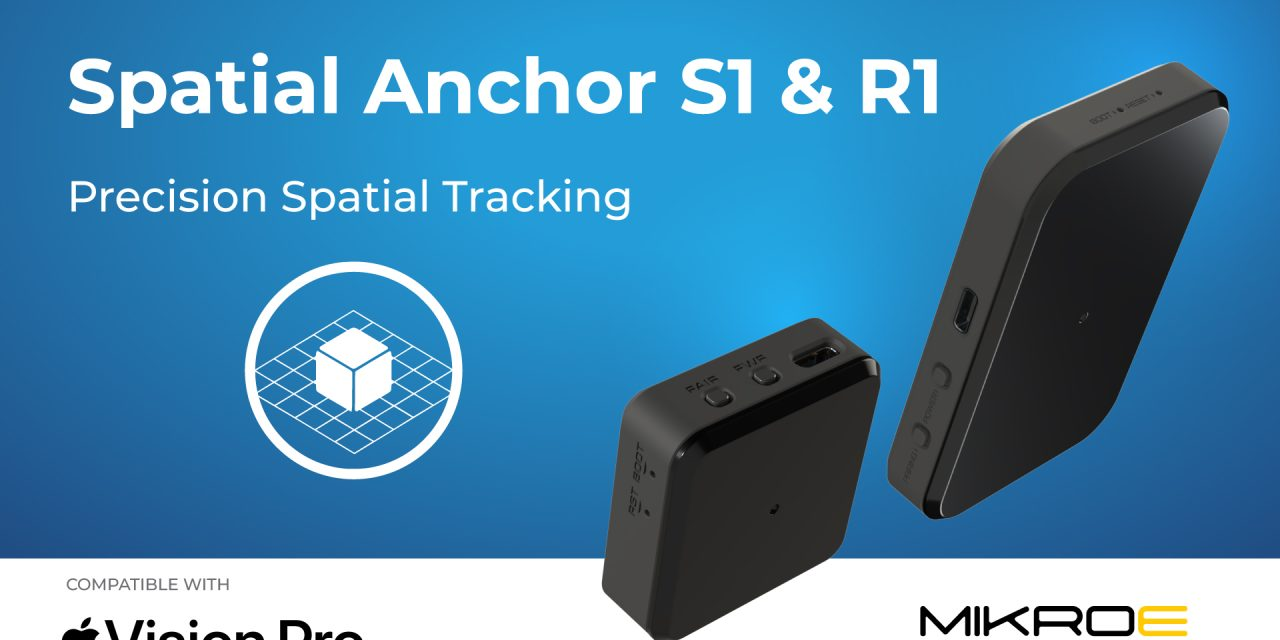
MIKROE has introduced Spatial Anchor R1 and Spatial Anchor S1, two accessory tracking modules that add real-time six-degree-of-freedom motion tracking to physical objects used with Apple Vision Pro applications.
The modules are designed to be mounted onto objects such as simulation controls, industrial prototypes, design fixtures, training rigs, and laboratory equipment. Once attached, the hardware allows the object to be tracked in three-dimensional space by visionOS applications using Apple’s Accessory Tracking API, with the embedded electronics providing the optical reference, motion sensing, radio link, and local power-management layer.
Spatial Anchor R1 is the larger device, using an asymmetric eight-point infrared LED constellation across an 85mm × 55mm footprint. The geometry is intended to give cameras a distinctive tracking pattern from multiple angles when the module is mounted on larger physical objects such as vehicle simulators, cockpit controls, medical training equipment, or industrial design props. The unit measures 85mm × 55mm × 15mm and weighs 50g.
Spatial Anchor S1 uses a smaller square format with a four-point infrared constellation. Its reduced size is intended for tighter mounting spaces and smaller accessories, where an eight-point layout would add unnecessary bulk. The two devices therefore give developers a choice between broader optical visibility and more compact mechanical integration.
Both modules include USB-C for charging, configuration, and firmware updates, alongside Boot, Reset, Power, and BLE Pairing buttons. A four-colour status LED array provides diagnostic feedback, while the onboard power system uses a 3.7V 250mAh lithium-polymer battery with charging and fuel-gauge circuitry. The R1 design incorporates eight 940nm infrared LEDs driven by an LP5569 LED driver.
Motion data is handled by a Bosch BMI323 six-axis sensor, combining a three-axis gyroscope and three-axis accelerometer with a sample rate of up to 6,400 readings per second. Bluetooth connectivity is provided by a BMD-340 module supporting Bluetooth 5 operation with at least 10m line-of-sight range. USB communication is handled through an FT230X bridge, supporting charging, updates, and development data logging.
MIKROE lists Spatial Anchor R1 under product ID MIKROE-6988, with a price of $195 and estimated availability in September 2026. The S1 module is listed as the smaller companion product, aimed at compact tools, handheld accessories, and fixtures rather than larger rig-mounted systems.
Spatial tracking hardware has become a practical embedded design problem as mixed-reality systems move beyond display and rendering performance. Vision systems can map the broader environment, but physical accessories require a known reference that is engineered into the object itself. Infrared marker placement, inertial sensing, local power, Bluetooth pairing, and firmware access all affect whether a real object remains aligned with its virtual representation.
Industrial spatial computing is already being pulled into workstation-class design and visualisation workflows. Vision Pro access to RTX-streamed engineering environments has opened another path for product visualisation, digital twins, and remote design review, with rendering handled by RTX workstations rather than the headset alone. Accessory tracking modules add the physical control layer needed when virtual scenes must respond to real tools, panels, rigs, or prototypes.
MIKROE’s embedded portfolio has also been moving toward modular hardware blocks that shorten integration work. Its ETH WIZ 3 Click board added compact Ethernet processing using WIZnet silicon, applying the company’s modular board approach to wired connectivity. Spatial Anchor applies the same principle to optical and inertial tracking, where mechanical placement, radio behaviour, firmware access, and application registration have to be considered together.
The constraints differ from conventional sensor modules. A tracker must be visible, stable in its mounting, repeatable under movement, and small enough not to distort the object it is tracking. Battery capacity, IR LED drive, Bluetooth behaviour, enclosure design, and the alignment between the tracker and the physical object all feed directly into system accuracy.
Calibration becomes part of the product design rather than a final software step. The offset between the module and the tracked object has to be known by the application, while any looseness in the mounting can appear as tracking error. Spatial Anchor R1 and S1 therefore sit in a space where embedded electronics, mechanical design, and spatial software registration are inseparable.
As simulation, training, digital twins, and design review become more interactive, accessory tracking is moving from XR novelty toward a normal hardware integration task. MIKROE’s modules give developers a ready-made route into that layer, using a compact combination of infrared markers, inertial sensing, BLE, USB-C, and onboard power management to connect physical tools with spatial applications.

