
IN Brief:
- MIKROE has launched ETH WIZ 3 Click, an Ethernet interface board for embedded and IoT systems.
- The board uses WIZnet’s W55RP20 SiP, integrating a W5500 Ethernet controller and Raspberry Pi RP2040 dual-core MCU.
- Compact wired networking modules remain central to industrial automation, gateways, and embedded controllers that need predictable connectivity.
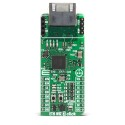
MIKROE has launched ETH WIZ 3 Click, a compact Ethernet interface board designed to add wired connectivity and onboard processing to embedded systems.
The board is based on WIZnet’s W55RP20 system-in-package, which combines a W5500 Ethernet controller with Raspberry Pi’s RP2040 dual-core microcontroller. The device integrates hardwired TCP/IP support, Ethernet PHY functionality, dual Arm Cortex-M0+ cores running up to 133MHz, Flash and SRAM, and host interfaces including SPI and UART.
ETH WIZ 3 Click also includes USB-C, TCP activity and status indicators, power-over-Ethernet magnetics centre taps, and debug test points. It is part of MIKROE’s Click board ecosystem and is designed to work with mikroBUS-compatible host systems, giving development teams a modular route to Ethernet connectivity during prototyping or low-volume system development.
ClickID support enables automatic board identification, while mikroSDK open-source libraries support software development across MIKROE’s environment. The board is aimed at IoT gateways, industrial automation equipment, smart devices, and network-enabled controllers that require reliable Ethernet connectivity without a full custom network interface design.
Ethernet continues to anchor many industrial and embedded systems, even as wireless modules take a larger share of connected product development. Factory automation, machine controllers, gateways, test systems, building control equipment, and edge devices often rely on wired networking because it provides predictable latency, stable operation in noisy RF environments, and straightforward integration into existing industrial networks.
The W55RP20 architecture gives the board a useful split between interface and processing. Hardwired TCP/IP support can reduce firmware load and simplify networking tasks, while the integrated RP2040-class MCU provides local processing resources that can handle network-related functions without placing every task on the host controller.
That modular connectivity trend has also been visible in Lantronix’s xPico 600 Wi-Fi 6 IoT module, which combined wireless connectivity, Ethernet, security, and lifecycle functions for industrial and commercial IoT systems. MIKROE’s new board approaches the problem from a prototyping and embedded development angle, but both products reduce the amount of custom connectivity work required before a system can be evaluated on a real network.
Wired networking is not disappearing from edge systems. In many industrial installations, Ethernet remains the practical default because cabling, determinism, maintenance practice, and interoperability are already established. Wireless connectivity adds flexibility, but wired interfaces continue to carry control, monitoring, and gateway traffic where interruption or variable performance is unacceptable.
Compact module-based designs also change the economics of embedded development. A discrete Ethernet controller design may still make sense in high-volume products, but boards such as ETH WIZ 3 Click reduce early-stage hardware risk and shorten development cycles. They also let engineers evaluate software, network behaviour, and host-controller interaction before committing to a final PCB layout.
With ETH WIZ 3 Click, MIKROE gives embedded designers a ready-made path into wired Ethernet using a system-in-package that combines connectivity and local compute. In industrial controllers and gateways, that blend of familiar networking and modular development remains a practical way to move connected hardware from bench testing into field-ready design.

