IN Brief:
- A July Miami-area demonstration detected and tracked drones using an existing Verizon 5G deployment without changing the cellular radios.
- NVIDIA AI Aerial, ODC RAN software, Keysight RF tools, and Lockheed Martin algorithms form the sensing and tracking chain.
- Pilot deployments are planned for late 2026 and early 2027, with general commercial availability targeted for 2027.
Lockheed Martin, Verizon, NVIDIA, Keysight Technologies, ODC, and Astris AI have demonstrated a system that uses existing 5G infrastructure to identify, track, and monitor unmanned aircraft. The NetSense platform analyses radio-frequency disturbances across a commercial cellular network, allowing the partners to add an airspace-sensing function without replacing the deployed radios.
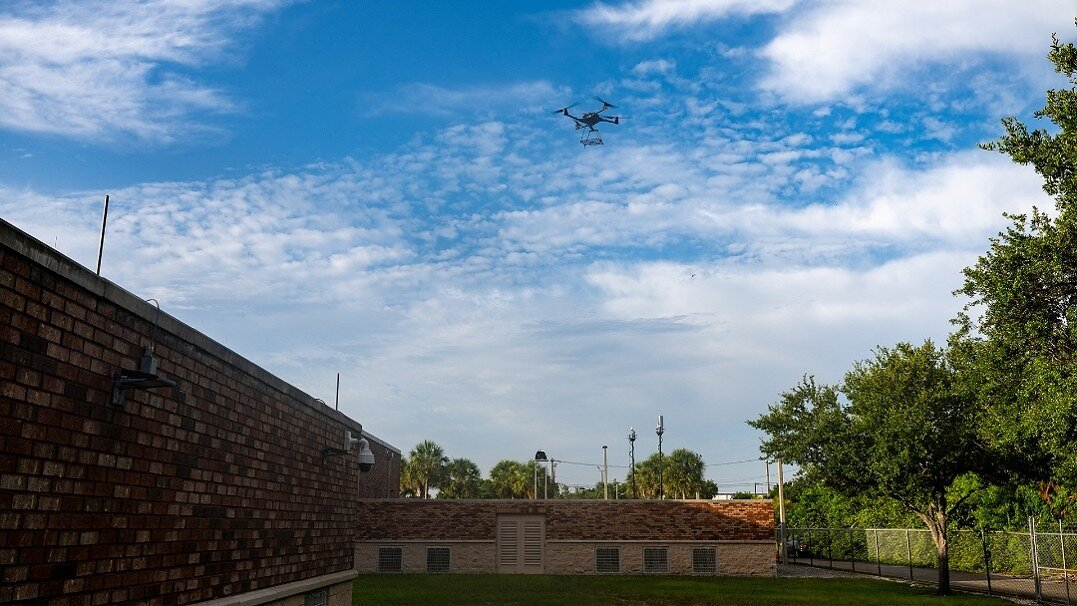
The July demonstration took place in the Miami area using Verizon 5G spectrum, ODC’s AI-native radio access network software, NVIDIA AI Aerial, and Keysight’s RF simulation platform. Lockheed Martin says the system detected drones, generated alerts, and maintained track custody during flight. The test used the existing cellular radio deployment rather than a modified network built specifically for sensing.
NetSense combines Lockheed Martin warning and tracking software with AI processing of changes in the RF environment. NVIDIA AI Aerial analyses signal disturbances in real time and passes the resulting information into Lockheed Martin algorithms used to estimate and follow an aircraft’s path. Keysight contributed RF modelling, simulation, digital-twin, emulation, and test tools across the engineering workflow.
The architecture is distinct from installing a dedicated radar alongside the mobile network. Cellular infrastructure is designed primarily for communications coverage, so its spectrum, antenna geometry, bandwidth, and site placement impose a different set of constraints on sensing performance. Extracting useful tracks from those signals depends on processing that can distinguish a moving object from clutter, network variation, and other changes in the radio environment.
That places substantial weight on the electronics and compute chain behind the service. Base-station hardware determines what RF information is available, while edge processing and accelerated computing determine how quickly the signal can be analysed and converted into a detection. Simulation is equally important because developers need to test different flight paths, network layouts, and interference conditions without relying entirely on repeated live drone flights.
Lockheed Martin says the demonstration showed that NetSense can sense unmanned aircraft without changing existing cellular radio deployments. The company positions the approach as complementary to future 6G integrated sensing and communication, rather than dependent on waiting for a new radio generation. Its current roadmap uses Verizon’s 5G spectrum and is intended to extend towards broader 5G and future 6G deployments.
The system also uses an open architecture intended to accommodate additional technologies without replacing the underlying sensing platform. That could allow a deployment to combine RF-derived tracks with cameras, other sensors, security software, or permitted counter-UAS systems supplied by different vendors. The practical engineering task is then to preserve timing, target identity, and data quality as information moves between systems designed for different purposes.
Commercial delivery is planned as a subscription that interfaces with customers’ existing security operations. Lockheed Martin says pilot deployments are scheduled for the second half of 2026 and early 2027, with general commercial availability planned for 2027. Initial pilots will be limited to selected customers with an immediate requirement for the capability.
The proposed applications include power plants, airports, hospitals, schools, large events, and government sites. Those environments broaden the design problem beyond specialist defence sensing, because the service has to work with commercial telecoms infrastructure and existing security systems while operating in RF conditions that vary considerably from one site to another.
Keysight’s involvement is particularly relevant to qualification because the sensing chain has to be characterised before it reaches operational sites. RF modelling and digital twins can expose the system to repeatable scenarios, while emulation and test equipment allow engineers to measure how changes in signal conditions affect detection performance. That work becomes more important as deployments move from one urban trial to multiple network configurations.
The Miami test established that the partners could detect and maintain tracks using an existing 5G deployment. The next engineering measure is repeatability: whether pilot installations can achieve useful detection and classification across different cell layouts, traffic loads, terrain, and interference without extensive network reconfiguration. Those deployments will determine how far a communications network can be pushed towards a second role as a distributed sensing platform.