IN Brief:
- A validated PikeOS BSP is now available for Kontron’s Intel-based VX3060 rugged VPX computing card.
- The package supports Ethernet, UART, monitoring sensors, and storage, with TPM and Secure Boot available as options.
- PikeOS allows real-time and general-purpose workloads to share one platform while remaining separated by the hypervisor architecture.
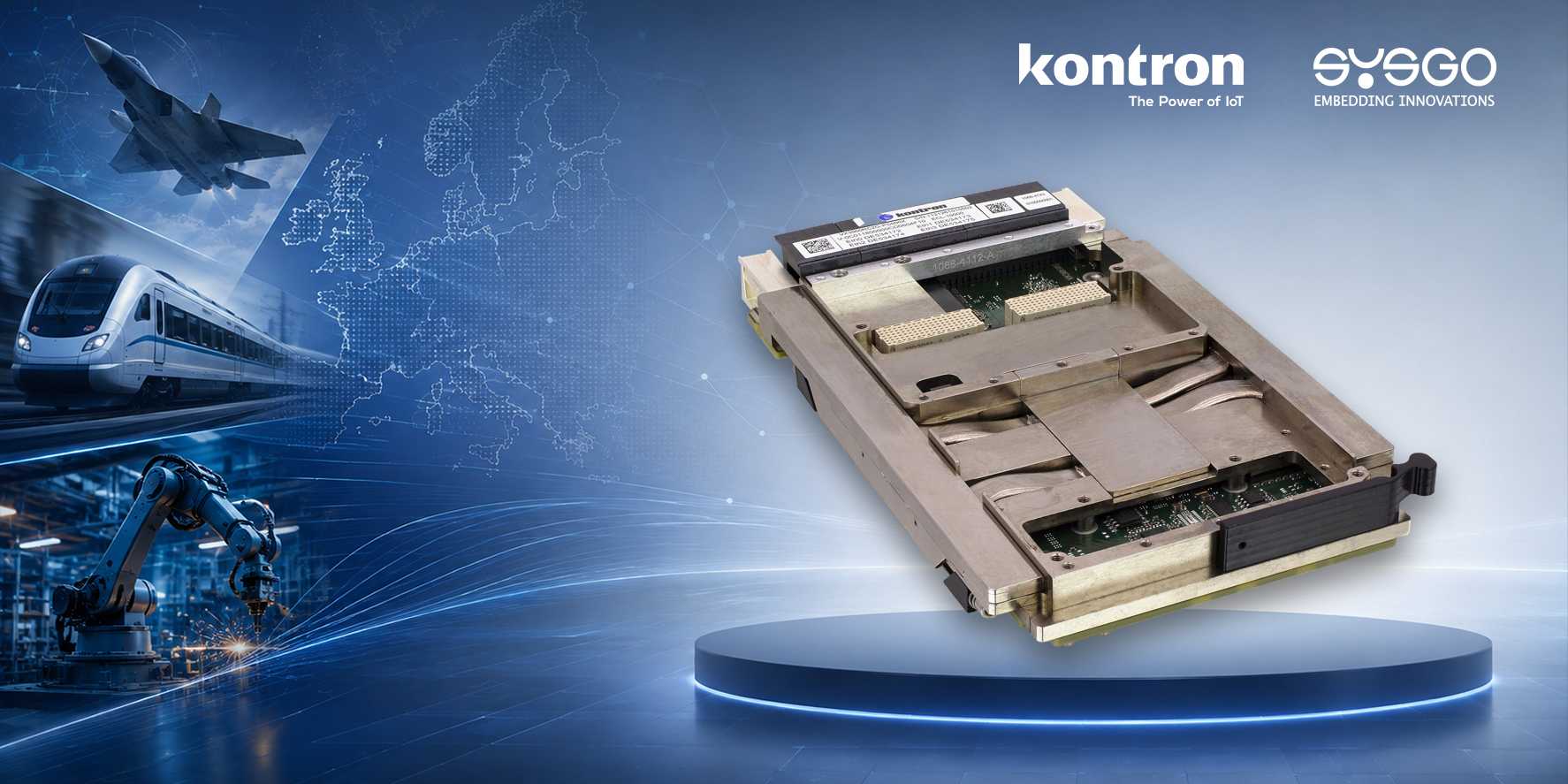
SYSGO and Kontron have introduced a validated PikeOS board support package for the Kontron VX3060 rugged VPX computing card, giving developers a supported software base for mixed-criticality systems built around 11th Generation Intel Core processors. The package is aimed at defence, transportation, and industrial automation applications where real-time, security-sensitive, and general-purpose workloads may need to share the same hardware.
The VX3060 is a 3U VPX single-board computer designed for harsh operating environments. PikeOS can now be deployed directly on the card or on Kontron systems containing it, including the HARAKAN-F2, without requiring customers to create the low-level hardware enablement layer from scratch.
The validated BSP covers Ethernet, UART, thermal sensors, voltage-monitoring sensors, and mass-storage interfaces. Kontron and SYSGO also offer Trusted Platform Module integration and Secure Boot as customer-specific options where platform-integrity and cyber-resilience requirements extend beyond the standard configuration.
Board support is a less visible part of embedded-system development than the processor or application software, but it often determines how quickly a new platform can be brought into a controlled engineering environment. Drivers, boot sequences, monitoring functions, and peripheral interfaces have to behave predictably before higher-level real-time or safety-related software can be integrated and tested.
PikeOS can operate as a separation-kernel hypervisor or as a combined hypervisor and real-time operating system. The architecture allows workloads with different criticality levels to run on one computing platform while remaining separated, so a deterministic real-time application can coexist with Linux, middleware, or another application environment without treating them as one undifferentiated software stack.
That consolidation can reduce hardware count, cabling, power consumption, and the number of replaceable computing modules inside an embedded system. It also transfers more responsibility into the software architecture because workload isolation, timing behaviour, boot integrity, and fault containment have to remain predictable when several functions occupy the same processor platform.
The BSP does not certify a completed system. Final assurance still depends on the target application, its configuration, software-development process, safety or security standard, and the evidence produced during system integration. What the validated package removes is part of the repeated board-level work that would otherwise have to be completed before those application-specific activities could begin.
VPX hardware is widely used where environmental robustness, long product lifecycles, and modular system construction are more important than adopting the newest mainstream computing platform at every processor generation. Defence electronics and transportation systems can remain deployed for many years, making software support, secure boot behaviour, monitoring, and reproducible hardware interfaces important parts of the platform specification.
The VX3060 also supports a broader set of rugged-computing requirements around health monitoring and system management. Combining those hardware functions with a supported separation-kernel environment gives system designers a more defined basis for workload consolidation than simply installing a general-purpose operating system on a rugged board.
Earlier PikeOS work with Intel safety-capable processors established support at processor level, while the VX3060 announcement moves that relationship into a specific board configuration with validated peripheral support. The distinction is important because processor compatibility alone does not verify Ethernet, storage, monitoring, boot, and board-specific interface behaviour.
The new BSP is available immediately. TPM-based trusted computing and Secure Boot can be added according to customer requirements, leaving developers with a supported platform on which the more difficult application work — workload partitioning, timing analysis, certification evidence, and lifecycle maintenance — can begin.