IN Brief:
- Power Integrations has introduced TOPSwitchGaN flyback ICs rated up to 440W.
- The new family combines PowiGaN switching with the established TOPSwitch architecture.
- The release targets simpler, smaller, and higher-efficiency power designs at higher output levels.
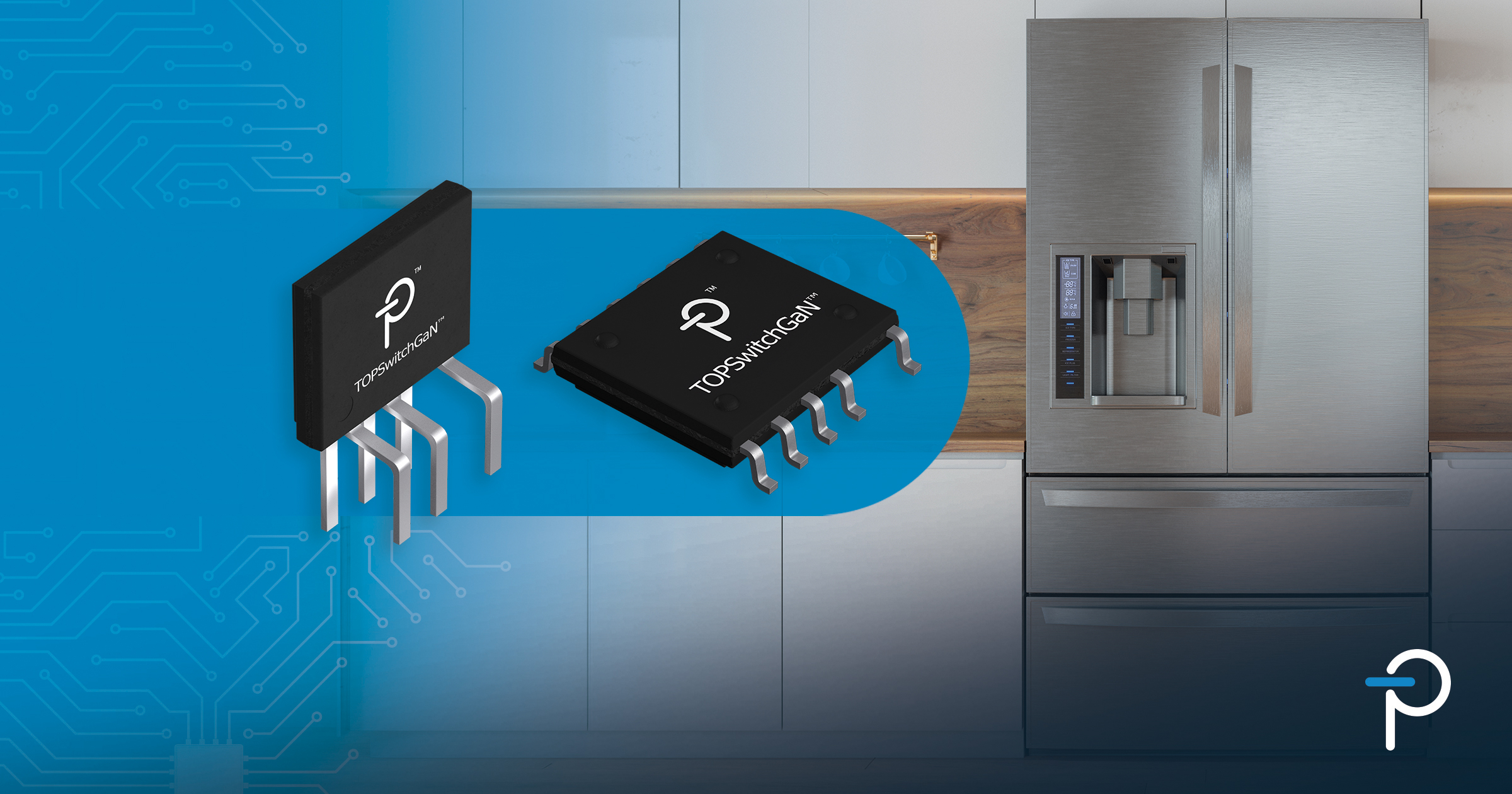
Power Integrations has introduced its TOPSwitchGaN family, extending the practical range of flyback converters to 440W and challenging the point at which designers have traditionally moved to more complex resonant and LLC topologies.
The new family combines the company’s PowiGaN switching technology with its long-established TOPSwitch architecture. The pitch is straightforward: achieve higher output power with a simpler isolated topology, reduce design complexity, and cut both component count and overall system cost. Power Integrations says the new devices can also eliminate heatsinks in many cases while improving manufacturability and shortening development time.
Electrically, the company is quoting 92% efficiency across a 10% to 100% load range, together with standby and off-mode consumption of less than 50mW. That level is achieved without synchronous rectification, which is central to the product’s simplification argument. The devices integrate 800V PowiGaN switches, offering lower conduction losses and stronger surge capability than comparable silicon implementations, while supporting switching frequencies up to 150kHz to reduce transformer size.
The practical consequence is that flyback can now be considered in a set of applications that would previously have been handed over to more elaborate conversion schemes. Power Integrations is targeting high-end appliances, e-bike chargers, and industrial designs, all of which sit in a power range where topology choices quickly shape BOM count, thermal behaviour, and enclosure design.
The release is a reminder that wide-bandgap switching is not only about chasing absolute efficiency figures. It also changes the trade-offs around architecture. When higher power can be delivered from a simpler topology, designers get more room to optimise for cost, size, and design effort without giving away performance.