
IN Brief:
- Qorvo has introduced the QPF5012 X-band transmit/receive front-end module.
- The module operates from 8.5GHz to 10.5GHz with 10W transmit power and a 2.1dB noise figure.
- Integrated RF front ends reduce component count, thermal load, and SWaP pressure in phased-array radar.
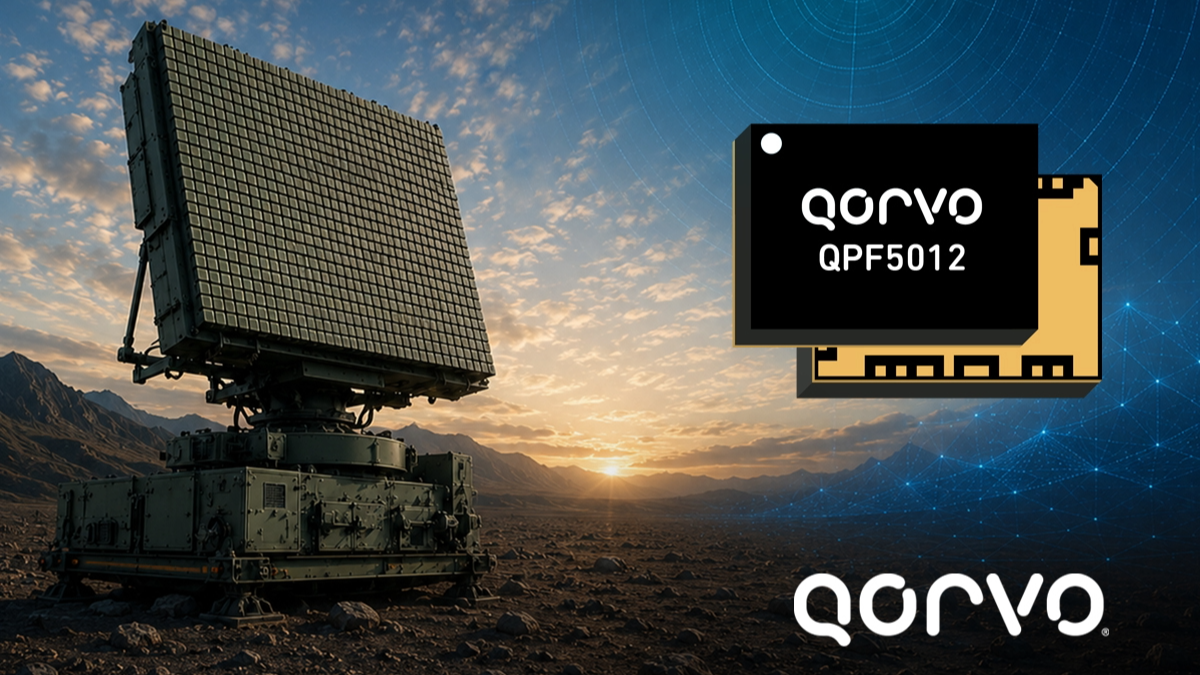
Qorvo has introduced the QPF5012, an X-band transmit/receive front-end module for phased-array and multifunction radar systems.
The module operates from 8.5GHz to 10.5GHz and delivers 10W of transmit power. It combines 42% power-added efficiency with a 2.1dB noise figure in a 7mm x 5mm plastic over-mould QFN package.
QPF5012 integrates the power amplifier, low-noise amplifier, limiter, and transmit/receive switch functions needed in an X-band radar front end. Qorvo uses GaN-on-SiC for the power amplifier and transmit/receive switch, while the limiter and LNA use GaAs.
The multi-die module is designed for applications where size, weight, power, and thermal performance are constrained. It is intended to reduce component count, simplify RF design, and maintain output power and efficiency across changing antenna loads, including AESA scan-angle variation.
Samples are available, with the device shown at IMS2026 in Boston. Target applications include communications, electronic warfare, commercial radar, and military radar.
RF front-end integration is becoming more important as phased-array systems increase channel counts while platform envelopes remain tight. In a dense array, small reductions in component count, package size, power consumption, and heat generation scale across many transmit and receive paths.
Discrete RF chains still offer design flexibility, but they also increase layout complexity, matching effort, assembly burden, and validation work. Integrated front-end modules move more of that engineering into the package, improving channel repeatability and reducing the number of board-level variables that can affect RF performance.
Qorvo’s use of GaN-on-SiC and GaAs inside the same module reflects the mixed-technology direction of advanced RF design. Power handling, switching, receive sensitivity, protection, and efficiency each benefit from different device characteristics, while the system-level goal is a smaller and more predictable signal chain.
Component-level integration is advancing alongside higher-speed RF processing and antenna validation. Faster electronically steerable antenna testing, including Rohde & Schwarz and Greenerwave’s ESA work, reflects the same shift towards denser, more capable beam-steered systems. The QPF5012 sits at the front end of that architecture, where power, protection, receive sensitivity, and thermal performance are multiplied across every channel.
X-band remains important for defence and aerospace radar because it provides a useful balance between resolution, range, antenna size, and atmospheric behaviour. As multifunction sensors combine surveillance, tracking, communications, and electronic support roles, the RF front end has to support more operating modes without consuming more platform resource.
By integrating GaN and GaAs functions in a compact module, Qorvo is addressing the physical constraints that shape modern radar hardware. Fewer parts, tighter RF integration, lower thermal burden, and improved channel consistency all contribute to more practical phased-array implementation.

