
IN Brief:
- RECOM has launched a discrete power portfolio spanning driver ICs, rectifiers, and low-profile SMD transformers.
- The range targets isolated DC/DC designs using flyback, push-pull, and full-bridge topologies.
- Power suppliers are responding to demand for more control over layout, cost, thermal behaviour, and customisation.
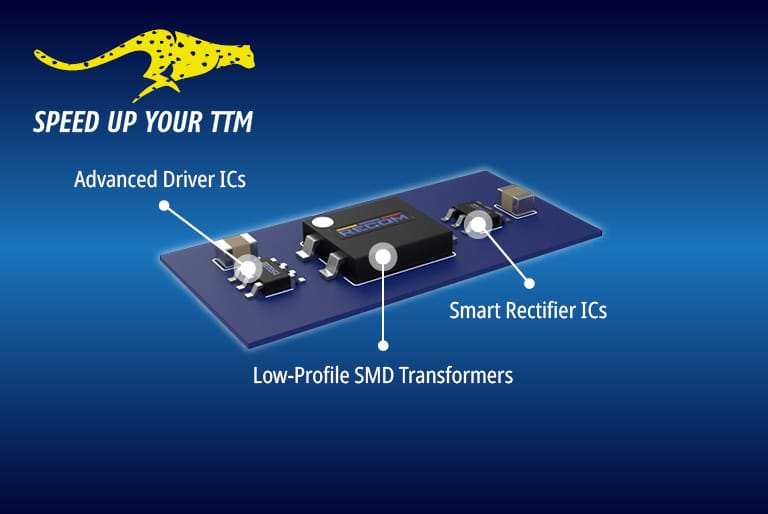
RECOM has moved deeper into component-level power design with a new discrete portfolio covering power ICs, secondary-side rectification devices, and low-profile SMD transformers for isolated DC/DC converters. The launch widens the Austrian supplier’s scope beyond its long-established module business and gives engineers a choice between prequalified converter blocks and more configurable discrete solutions built around standardised subassemblies.
The new line-up is aimed at several familiar isolated converter topologies. RECOM’s RVPW series covers flyback designs, with versions offering integrated switches or gate-drive outputs for an external MOSFET. The company is also introducing push-pull and full-bridge transformer drivers in compact DFN2x2 packages for open-loop isolated converters, as well as secondary-side rectification options that include integrated full-bridge rectifiers, self-powered MOSFET-based rectifier solutions, and a bidirectional integrated rectifier aimed at battery charging and discharging functions.
Alongside the ICs, RECOM is offering a standard SMD transformer range with isolation levels running from 1.5kVDC/min up to 5kVAC/min, covering common input and output combinations. For engineers that still need something less standard, the company is also offering custom transformers on relatively short lead times. Taken together, the message is clear enough: the supplier wants to sit on both sides of the design decision, supporting teams that want drop-in modules and teams that need more control over layout, magnetics, cost scaling, or thermal performance.
That dual-track strategy makes sense. Power design has become awkwardly polarised. At one end, modules remain attractive because they trim development time, certification effort, and the risk of unstable behaviour in compact designs. At the other, a module can be too rigid on cost, board space, or electrical optimisation when volumes rise or when the application is unusual enough to justify a more tailored converter stage. RECOM is effectively trying to reduce the penalty of going discrete by supplying matched building blocks rather than forcing engineers to assemble every detail from scratch.
The timing is notable because isolated DC/DC design is under pressure from several directions at once. Power density keeps climbing, available board area rarely gets any larger, and the spread of applications has become broader rather than narrower. Industrial automation, medical equipment, test systems, datacom hardware, and mobility electronics all have their own demands on isolation, efficiency, EMI control, thermal behaviour, and component sourcing. A supplier that can offer both modules and discrete paths is better placed to follow customers as a programme evolves from prototype through to higher-volume refinement.
There is also a supply-chain and lifecycle angle. Designers have become more wary of locking entire subassemblies into a single package when the same function might later need a lower-cost bill of materials, a different thermal footprint, or a custom transformer profile. Discrete power solutions do not remove that complexity, but they can give teams more room to tune a design around the product rather than around the module catalogue. RECOM’s new portfolio will not suit every engineer — many teams will still prefer a qualified module and move on — but it reflects a broader market reality. Power conversion is not becoming simpler. It is becoming more application-specific, and suppliers that want to stay relevant are being forced to support that complexity rather than hide it.

