IN Brief:
- PFE1500FB modules deliver 1500W from an 85-305 Vac input range, including 277 Vac nominal operation.
- The design combines PMBus telemetry, parallel capability, a metal baseplate, and reduced radiated EMI.
- Applications span industrial, semiconductor, RF, laser, LED display, and building automation power architectures.
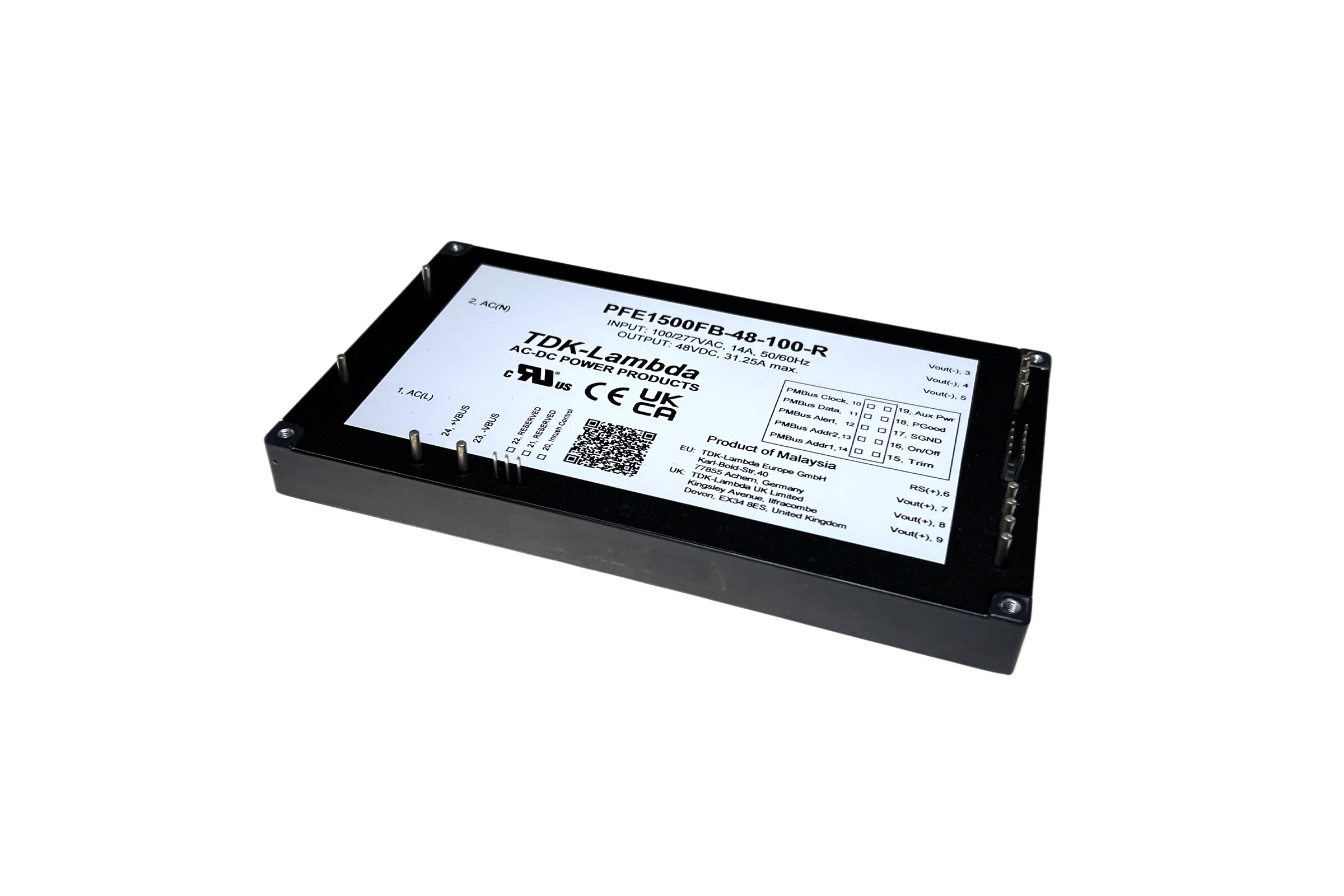
TDK-Lambda has introduced its third-generation PFE1500FB AC-DC power modules, extending the line to 1500W and targeting equipment designers working in industrial, lighting, and building automation applications. The new series accepts an 85-305 Vac input range, allowing operation from a nominal 277 Vac supply, and is built around a compact enclosed form factor intended for systems where power density, thermal control, and remote management all matter at the same time.
The module uses a metal baseplate rather than relying on conventional open-frame airflow, which broadens the set of enclosure options available to system designers. That matters in equipment expected to operate in sealed outdoor cabinets, dust-prone industrial plant, or liquid-cooled assemblies where forced air is either impractical or undesirable. TDK-Lambda has also pushed thermal handling and EMC considerations together in the mechanical design, using a five-sided case structure to simplify heat extraction while helping reduce radiated EMI.
On the electrical side, the PFE1500FB includes a PMBus interface with read and write capability, enabling remote monitoring and adjustment of output voltage, overvoltage, overcurrent, and undervoltage thresholds. Droop-mode current sharing allows multiple modules to be paralleled for higher current designs, while additional control and status functions include remote on/off, a power-good signal, and an auxiliary 9.5-14 V output. TDK-Lambda quotes typical efficiency of 92% at 230 Vac, an output adjustment range of 38.4-57.6 V, and no-load power consumption of 2 W with the output disabled.
The module is aimed squarely at power subsystems that sit in the awkward gap between standard rack supplies and fully custom conversion stages. TDK-Lambda lists test and measurement equipment, semiconductor fabrication tools, LED displays, lasers, and RF power amplifiers among the intended uses, which is a useful indicator of where the product sits in the design stack: close enough to the end application for thermal, compliance, and serviceability issues to matter, but still modular enough to shorten development time. Safety approvals to IEC/UL/CSA/EN62368-1, together with CE and UKCA marking and EN55032-A compliance with external filtering, give the series a fairly direct route into international industrial platforms.
The launch also lands at a time when higher-voltage AC distribution, digital power telemetry, and sealed or fanless equipment architectures are pushing power-supply design in the same direction. A wider input window reduces the need for regional variants, while PMBus control reflects the growing expectation that power conversion should sit inside the wider system-management layer rather than behave as a black box. There is nothing exotic about that shift now, but it is increasingly difficult to avoid. Power subsystems are being asked to deliver more monitoring, more configurability, and more predictable thermal behaviour without expanding board area or forcing a full custom design. In that context, the PFE1500FB looks less like a niche module and more like a practical answer to a problem that keeps recurring across industrial electronics.