IN Brief:
- A UK-led payload has launched to the ISS to study biology under microgravity and radiation.
- The Petri Pod combines miniature cameras, fluorescence imaging, and environmental sensing in a 3kg instrument.
- The project points to wider demand for compact, ruggedised electronics in life-science payloads and remote instrumentation.
University of Exeter researchers, working with the University of Leicester at Space Park Leicester, have launched a miniature life-science payload to the International Space Station in a project that brings a distinctly electronics-led angle to deep-space biology. The experiment, flown on NASA’s Northrop Grumman CRS-24 mission, is designed to study how microscopic worms respond to microgravity, radiation, and the vacuum environment as space agencies prepare for longer crewed missions beyond low Earth orbit.
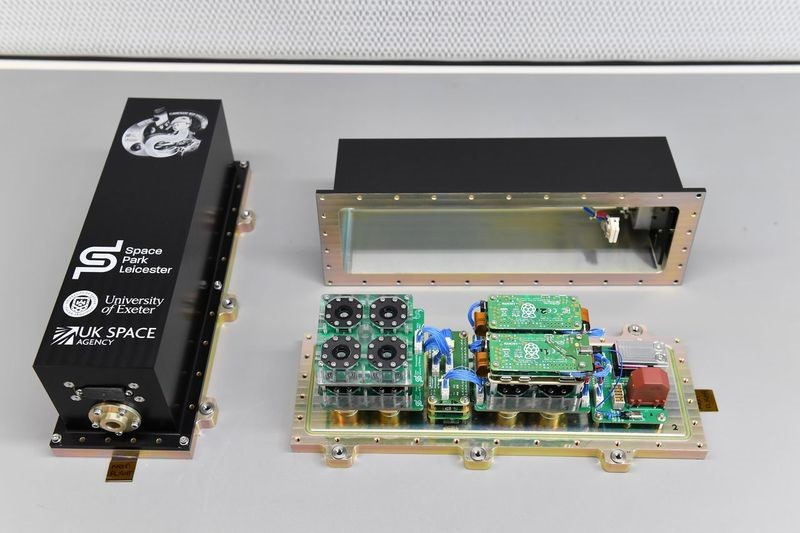
At the centre of the mission is the Petri Pod, a self-contained laboratory measuring roughly 10 x 10 x 30cm and weighing around 3kg. It houses 12 experimental chambers, four of which can be actively imaged using fluorescent and white-light optics. The platform is built to maintain temperature, pressure, and a breathable trapped air volume while feeding the specimens through an agar carrier, turning what would once have required a large biology rack into a compact instrument package that can be mounted and monitored remotely.
The payload will initially remain inside the ISS before being deployed outside on an experimental platform for up to 15 weeks, where it will be exposed to microgravity, vacuum, and radiation. During that period, miniature cameras will capture stills and time-lapse video, while the system records temperature, pressure, and accumulated radiation dose for transmission back to Earth. That combination of optical monitoring, environmental sensing, and remote control is what gives the project real relevance beyond the biology itself. The engineering challenge is not only to keep an organism alive in orbit, but to do so with electronics compact enough, stable enough, and efficient enough to survive extended exposure in a constrained payload envelope.
That matters because the hardware requirements for space life-science experiments are moving in the same direction as many other advanced instrumentation markets: smaller optical engines, tighter power budgets, more integrated sensing, and a greater need for autonomous operation when physical access is impossible. Payload designers now need imaging subsystems, environmental monitoring, data logging, and communications in a form factor that can tolerate launch loads, orbital thermal cycling, and long unattended runs. The Petri Pod is a useful example of how those requirements are converging into a single embedded platform.
There is also a wider design lesson here. Space biology is increasingly becoming a proving ground for compact instrumentation that can later inform terrestrial medical and industrial systems. A miniature platform able to maintain stable micro-environments, image specimens, track dose exposure, and relay data over long periods has obvious parallels with remote diagnostics, hazardous-environment sensing, and distributed monitoring systems where human intervention is limited. The value is not only in what the worms reveal about human health in space, but in the way the payload architecture brings sensing, optics, and control electronics into a tightly integrated package.
For the UK space engineering base, the mission also shows how smaller research instruments can be built around highly focused electronics rather than large bespoke spacecraft hardware. If lunar and deep-space programmes are to support more frequent biological, medical, and materials experiments, the sector will need more platforms of this kind: compact, remotely configurable, data-rich systems that can be manufactured at lower cost and deployed more often. In that sense, the Petri Pod is less a one-off science payload than a sign of where ruggedised scientific electronics are heading.