IN Brief:
- Related transceiver patents have been granted in Canada, China, Israel, Japan, and Korea, with a European application pending.
- The protected Vantage NXT architecture supports high-power, high-frequency arbitrary-waveform transmission with monitoring through the receive path.
- A new US provisional application covers active-clamp techniques intended to protect receiver electronics during high-voltage transmit events while retaining measurement capability.
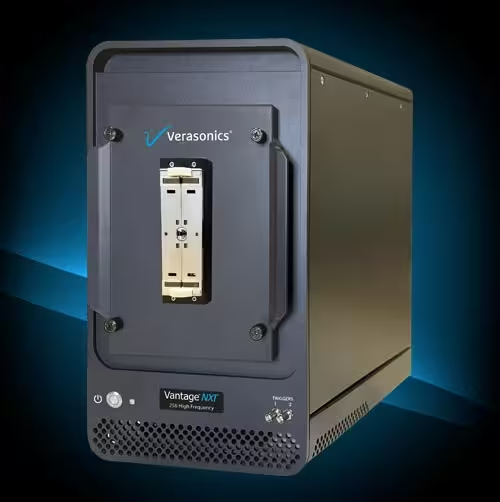
Verasonics has secured patent protection in five additional countries for the ultrasonic transceiver architecture used in its Vantage NXT research platform, while filing a new US provisional application covering active-clamp techniques around high-voltage transmission. The development extends an intellectual-property programme that began with a US patent issued in 2024 for high-power, high-frequency arbitrary-waveform transmission with concurrent monitoring through the receive path.
The latest grants cover Canada, China, Israel, Japan, and Korea, with a related application still pending in Europe. They extend protection around US Patent No. 12,089,991, “Ultrasound Transmitter with Low Distortion and Concurrent Receive”, which was issued by the US Patent and Trademark Office in September 2024 and protects a transceiver architecture incorporated into the Vantage NXT platform.
The engineering problem sits at the boundary between the transmitter and receiver. Ultrasound systems may have to produce comparatively high-voltage electrical waveforms to drive a transducer while the receive circuitry connected to the same channel is designed to detect signals many orders of magnitude smaller. Protecting that sensitive analogue path during transmission without compromising subsequent measurement requires fast switching, carefully controlled parasitics, and predictable recovery.
Verasonics’ patented architecture is designed to support high-power and high-frequency arbitrary-waveform transmission with low distortion while allowing the transmitted signal to be monitored through the receive path during the transmit interval. That capability gives researchers another measurement point for examining the waveform actually delivered by the electronics rather than relying only on the signal requested by the control software.
The distinction matters in experimental ultrasound because the electrical path between a waveform generator and the resulting acoustic field contains several opportunities for distortion. Power devices, protection circuits, cable impedance, transducer loading, frequency response, and voltage limits can all alter the signal. Measuring the transmit event through the receive path can help engineers characterise those effects when developing unusual excitation sequences or validating an experimental system.
The new provisional filing extends that area of work through active-clamp circuitry. Verasonics says the applications use active clamps to protect sensitive receiver electronics during high-voltage transmit events while continuing to extract useful measurement information. The company has not disclosed the circuit topology, clamp thresholds, bandwidth, voltage ratings, or measured improvement associated with the filing, so its eventual scope cannot yet be judged from the patent announcement alone.
Clamping and transmit-receive protection are established requirements in ultrasound electronics, but implementation becomes more difficult when designers also want high bandwidth, arbitrary waveforms, and accurate measurement. A protection element with excessive capacitance or slow recovery can load the signal path, introduce distortion, or obscure weak echoes immediately after transmission. Conversely, insufficient protection can expose low-noise receiver stages and analogue-to-digital converters to voltages far outside their normal operating range.
That trade-off is especially relevant to a programmable research platform. Vantage NXT is designed to give researchers unusually broad control over transmit and acquisition behaviour rather than restricting operation to the predefined imaging modes of a clinical scanner. Greater waveform flexibility increases the range of electrical conditions presented to the analogue front end and therefore places more emphasis on protection circuits that can operate without unnecessarily limiting the experiment.
The platform itself supports applications extending beyond conventional diagnostic imaging. Verasonics positions Vantage NXT for biomedical ultrasound, focused ultrasound, photoacoustics, materials research, and non-destructive testing, where required frequency, transmit power, waveform shape, channel count, and acquisition timing can vary considerably. Its current specifications include programmable transmit amplitudes and arbitrary-waveform capability across several system configurations.
The company’s intellectual-property strategy also has a commercial dimension because Verasonics licenses technology for use in third-party products. International protection can therefore matter beyond sales of its own research hardware if elements of the transceiver architecture are incorporated into commercial systems developed by customers or technology partners.
The current development remains an IP milestone rather than a new product release. No new Vantage NXT model has been introduced with the provisional filing, and Verasonics has not published improved distortion, recovery, protection, or measurement figures associated with the active-clamp work. The existing patented transceiver was already part of the Vantage NXT architecture before these additional international grants.
The engineering interest lies instead in the direction of the additional patent work. Protecting a receiver during high-voltage transmission is routine in principle; maintaining meaningful measurement access during the same event is a more specialised analogue-design problem. The next useful evidence will be technical data showing whether the active-clamp implementation changes recovery time, waveform fidelity, protection margin, usable bandwidth, or another measurable parameter.
Until those figures emerge, the five new grants broaden the geographic protection around an established transceiver while the provisional application signals the next area Verasonics intends to protect. Patent coverage says little by itself about electrical performance, but it identifies where the company continues to invest engineering effort: the difficult interface where a high-voltage ultrasound transmitter and a sensitive broadband receiver have to occupy the same signal path without getting in each other’s way.