IN Brief:
- 5 V-capable MCUs remain a practical fit for noisy, cost-sensitive control nodes.
- PIC32CM PL10 combines an Arm Cortex-M0+ core with familiar AVR-style peripherals.
- Migration-focused pin compatibility could shorten redesign cycles for high-volume products.
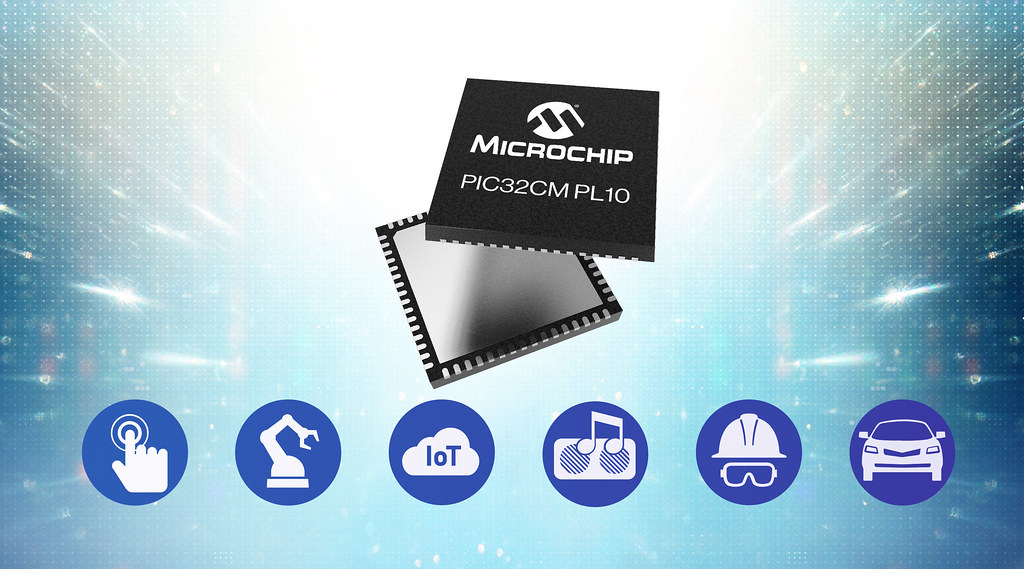
Microchip has launched the PIC32CM PL10 family of 32-bit microcontrollers, extending its Arm Cortex-M0+ portfolio with devices designed to run in 5 V environments while keeping a migration path open from 8-bit platforms. The company is positioning PL10 as a bridge product for designs that have outgrown 8-bit performance headroom but still need the electrical robustness and analogue behaviour that 5 V rails can make easier to manage.
At the core is an Arm Cortex-M0+ CPU running at up to 24 MHz, with the family supporting a supply range of 1.8 V to 5.5 V across multiple pin-count options. Microchip is pitching the range at high-volume embedded control, including industrial control, building automation, appliances, power tools, and sensor-heavy subsystems where analogue measurements have to survive electrically noisy surroundings.
A key part of the proposition is continuity — both in hardware and in day-to-day development. Microchip says the PL10 devices are pin-to-pin compatible with its AVR Dx families, with the intent of letting engineers lift an existing footprint, keep much of the surrounding circuitry intact, and concentrate redesign effort on firmware and system-level verification rather than a ground-up board spin. That will be particularly relevant where the MCU sits in a tightly costed control board, and where changes in voltage domains or connector placements ripple through mechanical and safety approvals.
On the peripheral side, PL10 includes Multi-Voltage I/O, Configurable Custom Logic, and an event system — features that will be familiar to developers coming from recent AVR devices, and that can help offload deterministic, time-critical functions from the CPU. For human-machine interface work, the family includes a Peripheral Touch Controller supporting up to 29 channels, alongside a 12-bit ADC with differential and single-ended modes. Microchip is also explicit that the analogue front end is designed to maintain noise immunity in real systems, rather than looking good on a lab bench.
Microchip is additionally linking PL10 to functional safety use cases. The company says the family was designed in compliance with ISO 26262 and is recommended for safety-critical applications up to ASIL B, with supporting safety documentation available on request. For product teams working on appliances, drives, or vehicle subsystems that sit adjacent to safety-related functions, that positioning matters less as a marketing badge and more as an early signal about documentation availability during audits and customer qualification.
For developers, Microchip is pushing its established toolchain support, including MPLAB X, MPLAB Extensions for VS Code, and third-party environments. The overall pitch is straightforward: maintain 5 V resilience, keep peripheral familiarity, and buy enough 32-bit headroom to extend the lifecycle of a design platform that would otherwise need a more disruptive rebuild.