IN Brief:
- HFE3500 delivers 3500W per 1U module, with four modules per rack.
- Internal ORing MOSFETs and current sharing support hot-swap and redundancy.
- 24V and 48V variants include PMBus as standard, plus wide-range AC input.
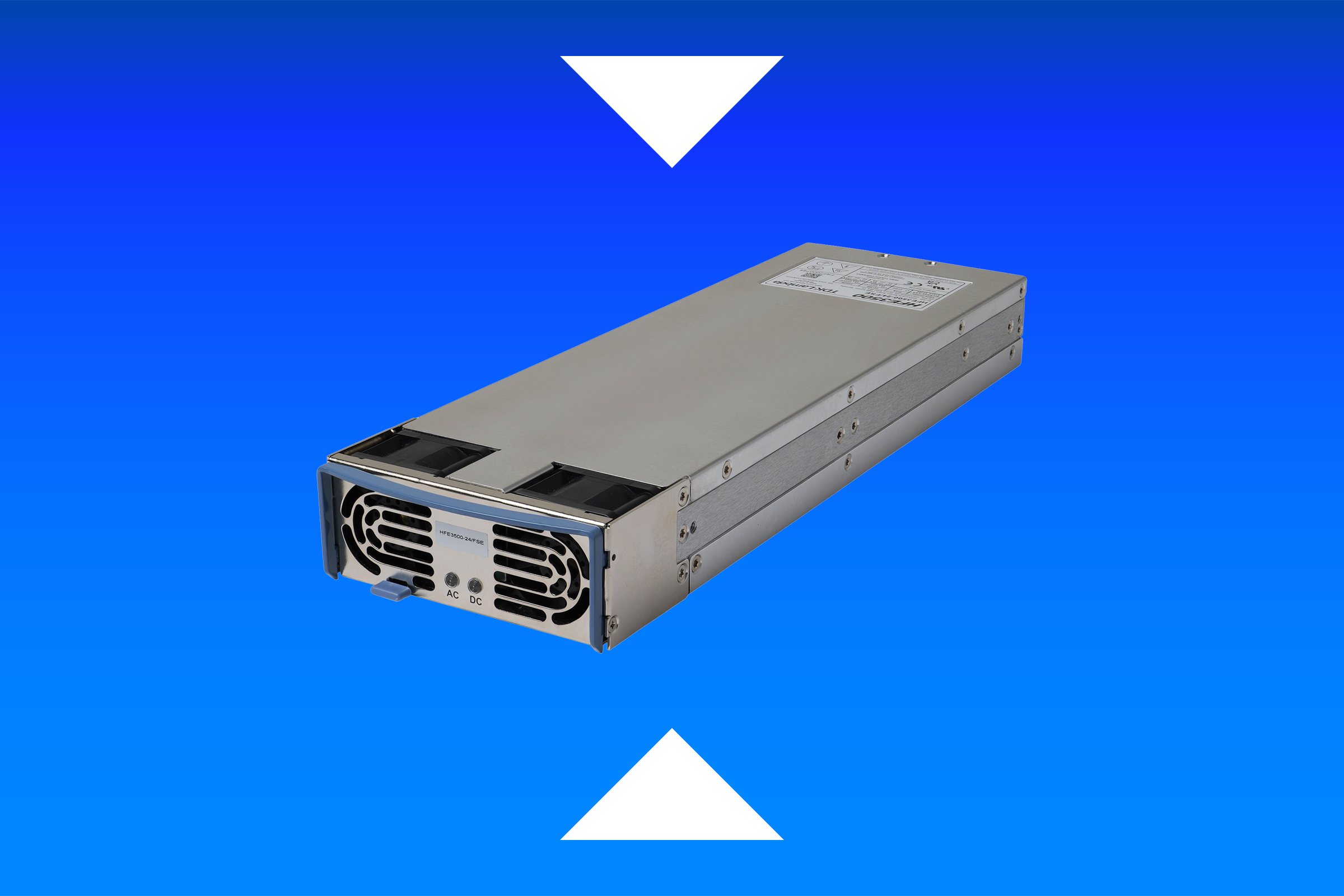
TDK-Lambda has expanded its front-end AC-DC portfolio with the HFE3500 series, a 3500W hot-swap power supply designed for 1U rack systems where redundancy and serviceability drive architecture decisions as much as output power does.
The HFE3500 approach is modular: a 1U, 19-inch rack can accommodate up to four supplies, delivering up to 13.3kW of bulk power, or operating as a hot-swap redundant system. TDK says up to 12 HFE3500 units — effectively three racks — can be connected in parallel, supported by internal ORing MOSFETs and a current-sharing function intended to make insertion and removal survivable in live systems. For engineers, that combination is the practical toolkit for N+1 design: decouple failure domains, keep the bus stable during module changes, and avoid turning routine maintenance into a planned outage.
TDK is targeting applications that routinely hit awkward peaks and require predictable behaviour under load: factory automation, additive manufacturing, industrial printing, RF transmission, base stations, servers, and automatic test equipment. These are exactly the environments where a few percentage points of efficiency, or a cleaner monitoring interface, quickly translates into less heat, fewer fans, and easier fault isolation.
Electrically, the HFE3500 supports an 85–264Vac input range, with power derating below 170Vac. The series is offered in 24V and 48V models, with stated adjustment ranges of 24.0–27.6V and 48.0–55.2V. A built-in isolated PMBus (I2C) interface is standard, alongside signals and controls including AC fail, DC good, remote output adjustment, and remote on/off. TDK also specifies a 5V or 12V auxiliary output as standard, with an option for dual AC input fuses for deployments that prioritise ruggedness and protection coordination.
Mechanical and thermal details are unusually explicit for a rack supply announcement, which is helpful because integration failures in this class of power tend to be physical rather than theoretical. TDK lists the power supply at 107mm x 40.1mm x 330mm, with a rack dimension of 444.5mm x 43.7mm x 428mm. Cooling is handled by two internal variable-speed fans, and the company quotes 94% efficiency at 230Vac input and 92% at 115Vac.
Compliance coverage spans both IT and industrial lab contexts: safety certifications include IEC/UL/CSA/EN62368-1 and EN/UL61010-1, with CE and UKCA marking, and conducted and radiated EMI compliance statements covering EN55011/EN55032 and FCC Part 15 class limits. TDK also provides isolation ratings between input, output, and ground, and says the HFE3500 series carries a five-year warranty.
For integrators building high-availability automation or test systems, the headline is straightforward: this is a dense, serviceable bulk-power building block with modern comms and a clear redundancy story, designed to be multiplied without making the backplane a science project.