
IN Brief:
- Environmental monitoring is increasingly constrained by battery life, bandwidth, and maintenance overhead.
- A Cortex-M55 plus Ethos-U55 design uses quantised inference to classify events at the node.
- Event-triggered LoRaWAN reporting cuts transmissions, supporting denser, longer-lived deployments.
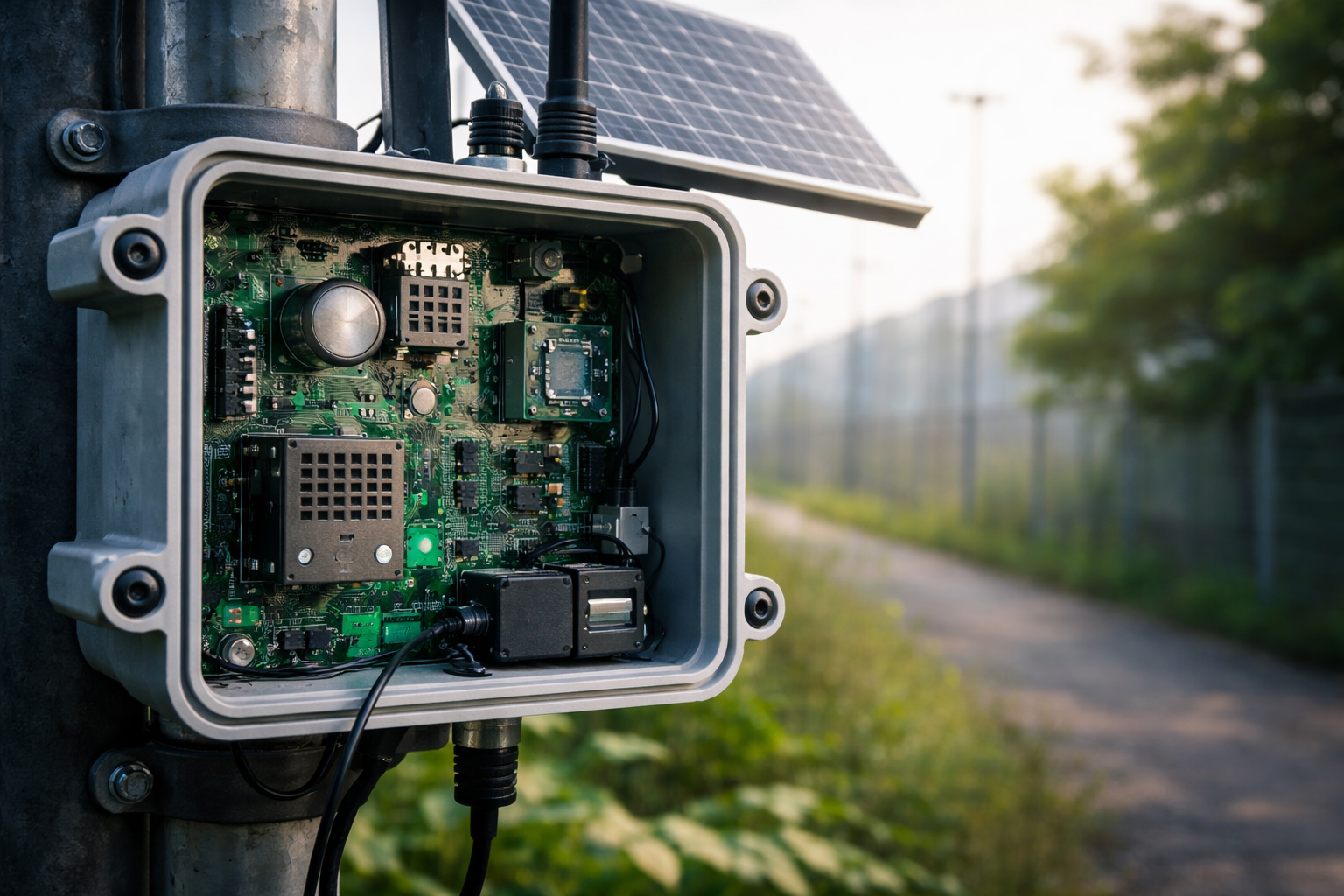
Researchers have detailed a low-power sensor-node architecture intended to push environmental monitoring closer to “deploy and forget” operation, with on-device machine-learning inference used to reduce radio time and cloud dependency. The work centres on a modular embedded platform that combines air-quality and ambient sensing with a low-power microcontroller and an energy-efficient neural inference accelerator, aiming to keep actionable decisions at the edge rather than streaming raw data upstream.
At the system level, the architecture is built around heterogeneous sensing for parameters including temperature, humidity, gas concentration, and particulate matter. Instead of treating the sensor node as a dumb endpoint, the embedded inference layer runs lightweight, quantised neural models using fixed-point arithmetic to classify conditions into normal, anomalous, or critical states. The intent is straightforward: transmit less, and transmit only when there is something worth transmitting.
Energy management is treated as a first-order design constraint rather than an afterthought. The researchers describe end-to-end optimisation via adaptive duty-cycling and hierarchical power domains, with the system shifting aggressively between low-power sleep and short active bursts for sensing, inference, and transmission. A hybrid solar–battery subsystem, controlled via maximum power point tracking, is positioned as the enabler for energy-autonomous operation in unattended deployments where battery swaps are the real operating cost.
Connectivity is handled through LoRaWAN Class A, paired with an adaptive data-rate strategy to limit airtime and preserve link budget as conditions vary. A secondary local interface via Bluetooth Low Energy is included for maintenance and calibration, acknowledging the practical reality that even “autonomous” nodes eventually need a technician with a handset. The adaptive communications approach is designed to align network usage with local classification outcomes, rather than a fixed periodic schedule.
Performance figures in the paper point to the trade-offs behind that approach. The authors report inference accuracy of 94%, with latency of 0.87 ms, and an average energy consumption figure of approximately 2.9 mWh under the evaluated operating conditions. In parallel, the adaptive LoRaWAN strategy is reported to reduce data transmissions by around 88% relative to periodic reporting. In practice, those reductions matter because radio time is often the dominant energy cost in wide-area sensor deployments, and it scales badly when organisations try to move from pilots to city-scale rollouts.
The immediate applications are familiar: smart-city air-quality mapping, industrial perimeter monitoring, and climate and environmental sensing in locations where mains power and reliable backhaul are absent. The more interesting implication is architectural. By treating inference as a routine embedded workload — and designing power, sensing, and comms as a single optimisation problem — the work reflects how “edge AI” is gradually becoming an engineering default, rather than an optional add-on reserved for higher-end gateways.

