
IN Brief:
- Containerised battery storage is being segmented by risk profile as deployments broaden beyond pilot scale.
- S Jones has introduced a “Green” entry tier with ventilation, fire-resistant linings, and HVAC in 8’6″ to 40 ft formats.
- Higher tiers add explosion venting, fire-rated compartmentalisation, and gas detection for more demanding use cases.
UK container conversion company S Jones Conversions has expanded its battery storage offering with a new entry-level product, the Green Battery Store, designed for lower-risk applications where battery inventories are categorised as “green” or low risk through Dangerous Substances and Explosive Atmospheres Regulations (DSEAR) assessment.
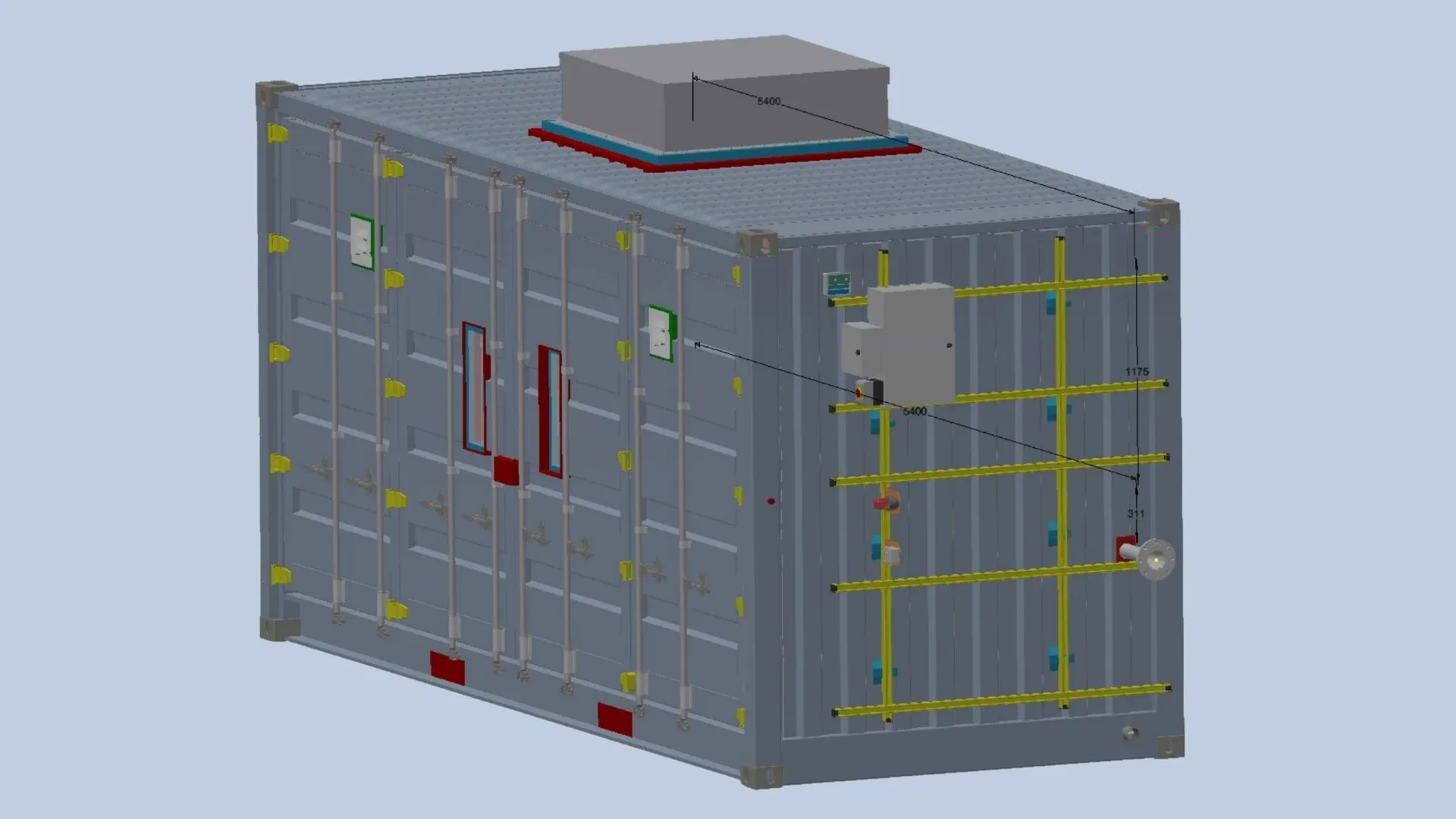
The Green Battery Store is positioned as a baseline enclosure for storing smaller quantities of batteries, providing environmental protection and basic electrical safety features without the heavier mitigation systems typically specified for higher-hazard lithium-ion storage. The company says the unit is available in sizes from 8’6″ to 40 ft and includes aluminium louvre vents, fire-resistant board linings, an HVAC system, and an anti-vandal, multi-locking personnel door. The configuration is aimed at sites where risk assessment indicates minimal fire or explosion hazard, or where facilities already have supporting safety infrastructure in place.
Alongside the new Green tier, S Jones is formalising its range as a tiered selection process intended to map more directly onto risk profiles and compliance demands. Bronze is described as targeting moderate-risk applications, combining fire-retardant passive protection with active environmental controls, explosion venting, and thermal management intended to mitigate hazards during normal operation and minor thermal events. Silver builds on that foundation with 60-minute fire-rated compartmentalisation, automated fire detection, and integrated sprinkler capability. The top tier, Gold, is aimed at the most demanding scenarios, including destructive battery testing, with additional gas detection, temperature monitoring, automated mechanical ventilation response, hermetically sealed access doors, and further fire and explosion risk reduction features.
“Over the last few years we’ve established our reputation as a ‘go to’ partner for containerised battery storage and testing units,” said Andrew Nicholls, head of conversions at S Jones Containers. He added that the tiered approach is intended to make it easier to select an enclosure matched to project requirements, including budget constraints, while keeping safety measures aligned to the assessed hazard.
The tiering reflects how battery storage projects are increasingly being treated as engineered infrastructure rather than generic storage — with decisions influenced by insurer expectations, local fire authority guidance, battery chemistry and volume, and proximity to other assets. For electronics and energy storage integrators, enclosure specification feeds directly into thermal strategy, monitoring architecture, and how much mitigation is required at the system level versus at the facility level. The Green tier, in particular, signals an attempt to standardise a lower-cost route for deployments that sit below the threshold where full fire-rated compartmentalisation, suppression integration, and gas monitoring are mandated.
S Jones has also positioned its broader battery storage and testing conversions as supporting high-risk environments with features such as thermal management, explosion relief, and fire detection in bespoke builds, but the new structure is intended to reduce the friction in specifying a container platform that matches the outcome of DSEAR assessment rather than starting from a one-size-fits-all design brief.

