
IN Brief:
- Marvell has added 1.6T and 800G coherent parts aimed at AI scale-across links between campus, metro, and regional data centres.
- The new COLORZ 1600, Electra, and Libra parts combine MACsec, multi-standard interoperability, C- and L-band support, and lower power per bit.
- Sampling is set for the second half of 2026 as hyperscalers push harder on optical capacity, security, and manufacturable pluggable designs.
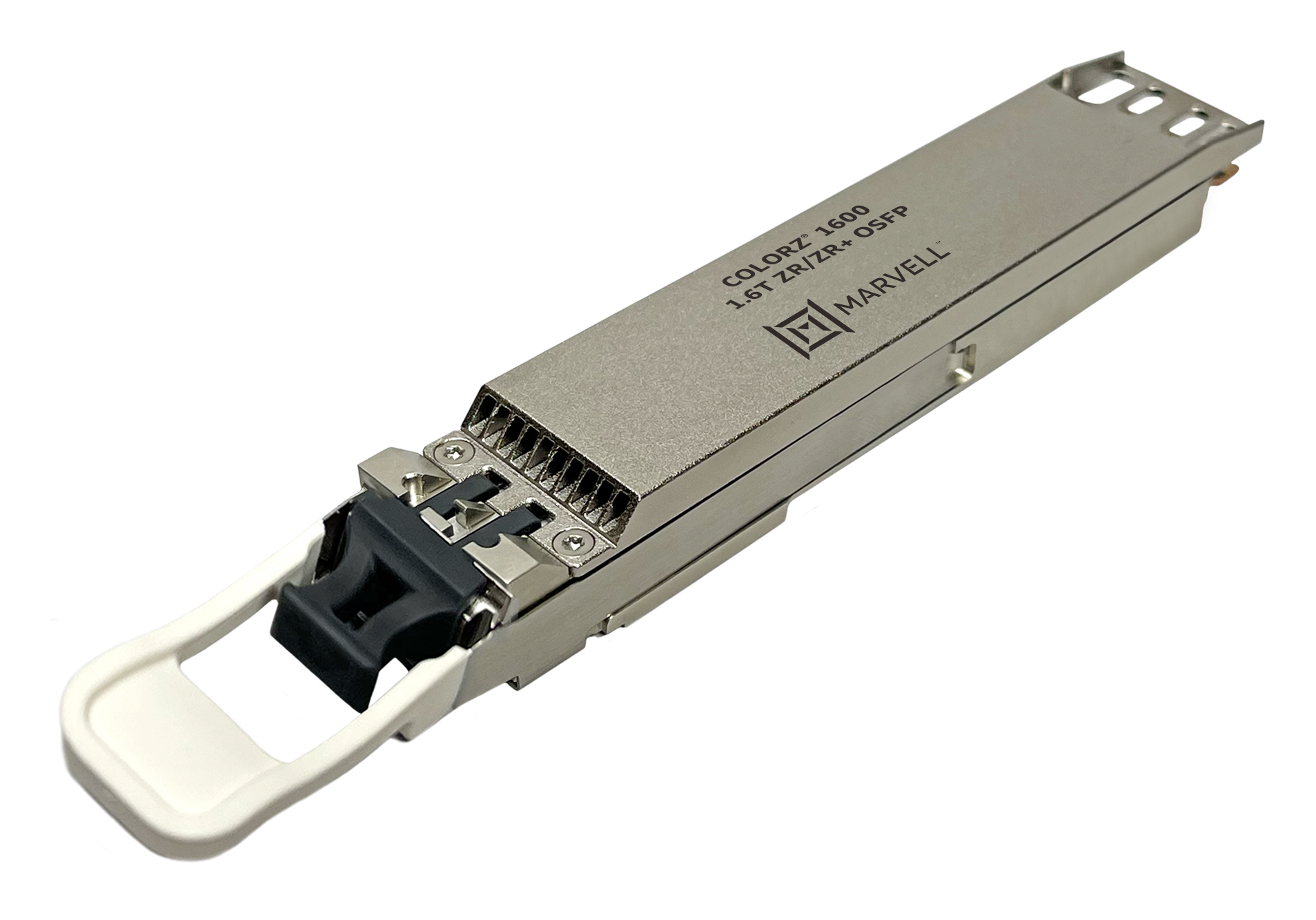
Marvell has expanded its coherent optical portfolio with a 1.6T ZR/ZR+ pluggable module and two 2nm coherent DSPs, sharpening its focus on the interconnect bottlenecks emerging around distributed AI infrastructure. The new line-up includes the COLORZ 1600 module, powered by the Electra DSP, and a refreshed COLORZ 800 pluggable based on the new Libra DSP.
1.6 Tb/s in a pluggable form factor. The more important detail is where Marvell wants that bandwidth to land. COLORZ 1600 is aimed at links from 20 km campus interconnects through 120 km metro spans and out to 1,000 km regional connections, all while staying within the ZR/ZR+ model that hyperscale operators increasingly favour for simpler, denser deployments. It also brings in-chip MACsec, support for OIF, OpenZR+, and OpenROADM modes, plus both C- and L-band operation in OSFP.
AI traffic is no longer contained neatly inside a single building. Training clusters, inference capacity, storage, and networking are spreading across sites, and once those sites need to behave like a single pool of infrastructure, optics stop being a transport afterthought and start acting like a hard system constraint. Bandwidth, latency, power, and security all land in the same engineering conversation.
Marvell’s second move is just as telling. Libra targets 800G ZR/ZR+ applications and underpins a lower-power second-generation COLORZ 800 module. That part is positioned for 800G links up to 1,000 km, 600G connections up to 2,000 km, and 400G links reaching 3,000 km. In practice, that gives operators more room to tune cost, reach, and transport mode without abandoning pluggables for heavier, more traditional coherent systems.
Coherent pluggables have moved from specialist hardware into a volume problem, and volume is where plenty of ambitious optics roadmaps become rather less elegant. Marvell is leaning hard on manufacturing capacity and yield as part of the pitch, which makes sense in an AI market now spending aggressively on interconnect as well as compute.
Sampling for Electra, Libra, COLORZ 1600, and the updated COLORZ 800 is scheduled for the second half of 2026. The underlying direction is already clear enough: AI infrastructure is forcing coherent optics further into the mainstream of data centre design, and the winning parts will be the ones that combine reach, security, density, and power discipline without becoming an integration nuisance.

