IN Brief:
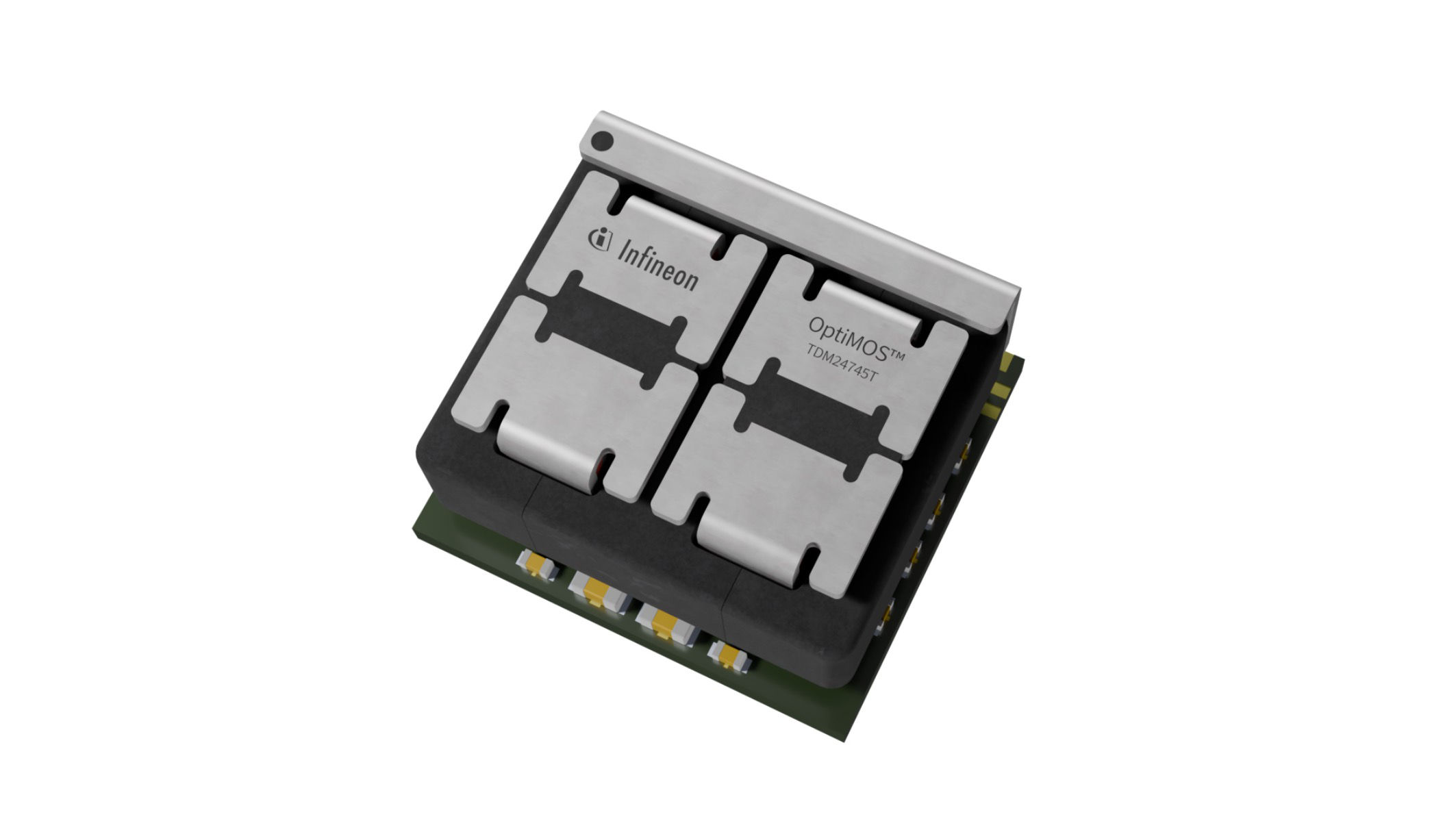
- Infineon has launched the TDM24745T, a TLVR quad-phase power module for next-generation AI compute.
- The 9 x 10 x 5 mm package integrates four power stages, a TLVR inductor, and decoupling capacitors, with current density above 2 A/mm² and peak current up to 320 A.
- The broader play is tighter board layouts, lower capacitance demand, and support for vertical power delivery in denser AI server designs.
Infineon Technologies has unveiled a quad-phase power module aimed squarely at one of AI hardware’s least glamorous bottlenecks: getting more current to ever-hungrier processors without surrendering board area, thermal headroom, or efficiency.
The new TDM24745T combines four power stages, a trans-inductor voltage regulator, and decoupling capacitors in a 9 x 10 x 5 mm package, delivering current density above 2 A/mm² and peak current capability up to 320 A. That makes it one of the sharper responses yet to a server design problem that is becoming harder with each accelerator generation, as core rails draw more current and transient response requirements tighten.
Infineon is positioning the module as the first TLVR quad-phase device in this compact form factor. Athar Zaidi, senior vice president and general manager for power ICs and connectivity at the company, said: “With the TDM24745T, we are redefining what is possible in high-current voltage regulation.” The point is well made, because the contest in AI infrastructure is increasingly being fought at the point-of-load stage rather than only at rack level.
The technical attraction is not just peak current. Infineon said the TLVR architecture can cut required output capacitance by up to 50%, easing layout pressure and helping designers reclaim PCB space for additional compute resources. The module is also built for both lateral and vertical power delivery topologies, which matters as server architectures move regulators closer to the processor package in an effort to shorten power paths and manage increasingly aggressive transient loads.
That board-level gain sits inside a much larger power story. Electricity demand from data centres is forecast to rise sharply through the end of the decade, with AI as the main growth driver, and that is forcing efficiency improvements all the way from the grid connection to the last few millimetres of processor delivery. Infineon is clearly trying to position the TDM24745T as one of those last-mile building blocks, tying it into a wider AI server power portfolio spanning silicon, silicon carbide, gallium nitride, digital multiphase controllers, and telemetry-enabled point-of-load devices.
The result is a reminder that AI compute is now being shaped as much by power packaging as by processor roadmaps. In a market chasing denser racks and faster platform bring-up, components that trim capacitance, improve thermals, and make vertical power delivery practical are starting to look less like support circuitry and more like enablers of the next server generation. For further technical detail, Infineon has published additional material on its AI power modules platform.