
IN Brief:
- Panasonic’s FX-250 targets reflective, transparent, and small-part sensing in tight machine spaces.
- The sensor combines 35 µs response, OLED-based setup, and automated threshold teaching.
- Lower energy use and dense installation support are built into the new range.
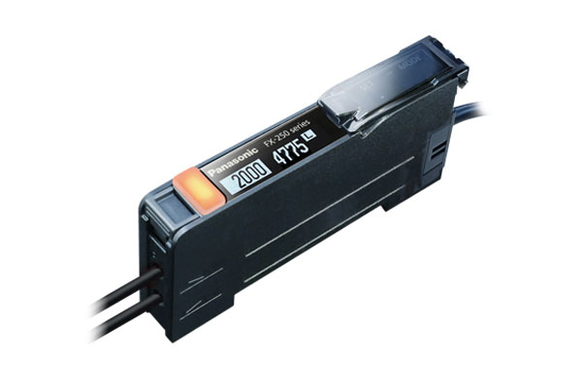
Panasonic Industry has introduced the FX-250 digital fibre sensor, extending its sensing portfolio with a unit designed for compact machinery, awkward detection conditions, and faster setup on automated lines. The device is aimed at applications where small, reflective, transparent, or irregular targets can make stable detection difficult, particularly in high-speed handling and assembly systems.
The FX-250 combines a response time of up to 35 µs with a setup scheme intended to reduce commissioning time. A large OLED screen shows full text rather than abbreviated parameter labels, and the interface can display both the threshold value and current light intensity at the same time. That gives technicians a clearer view of operating conditions during setup, changeover, and fault-finding.
Panasonic has also built in two-step limit teaching, removing the need for manual light adjustment in many common setups. In practice, that simplifies deployment where the sensor must distinguish subtle differences in reflected light from targets that are glossy, translucent, or physically small. Those conditions are common across packaging, electronics assembly, material handling, and precision manufacturing, where sensing hardware is often judged by repeatability rather than headline specification alone.
The optical system includes automatic power control to stabilise emission, alongside a four-element LED arrangement intended to maintain consistent detection performance. The mechanical design is compact enough for dense mounting, and the units can be installed side by side with interference prevention measures in place. Panasonic is offering both NPN and PNP variants, with a supply range of 12V to 24V DC, output current up to 100mA, and IP40 protection.
Energy management has also been built into the device. ECO modes allow the display to dim or switch off after inactivity, and the output indicator can also be disabled. In larger installations, those small reductions in power draw and heat become more relevant, particularly in 24-hour operations where sensors are deployed in large numbers.
Factory sensing has been changing in parallel with automation layouts. Equipment is becoming more compact, lines are being reconfigured more often, and product variation is rising across sectors that once depended on longer, more stable production runs. In that environment, setup speed and detection stability sit much closer together than they used to. A sensor that performs well but takes too long to teach or adjust can still slow the line down.
That has pushed usability further down the component stack. Features that once sat mainly in higher-level control systems — clearer interfaces, faster setup routines, and more visible operating status — are now appearing in field devices that would previously have been judged almost entirely on speed, range, or cost. Fibre sensors are a good example, because they are often deployed in places where access is limited and changeovers happen under time pressure.
The FX-250 also sits within a broader move toward more transparent field-level devices. Operators increasingly expect live values, clearer threshold behaviour, and faster diagnosis without relying on external tools or specialist menus. Those expectations are spreading across sensors, drives, and compact control hardware, especially where installation time and maintenance efficiency are becoming cost factors in their own right.
Panasonic’s latest sensor fits that direction closely. It is compact, fast, easier to configure, and built for difficult optical conditions rather than ideal ones. In factory automation, that is usually where new sensing hardware earns its place.

