
IN Brief:
- HEITEC’s new concept board is built for OpenVPX system architectures.
- The design combines Intel Arria V FPGA processing with optional Hailo-8 acceleration.
- Modular rugged compute remains central to defence edge electronics development.
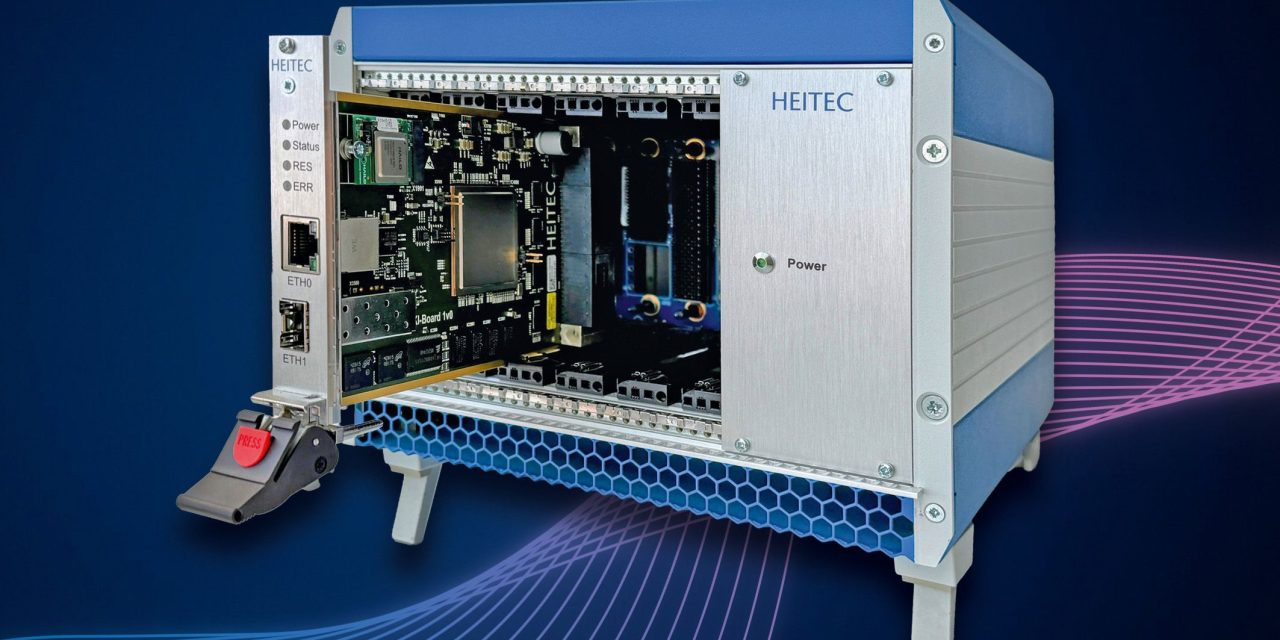
HEITEC has unveiled an OpenVPX board concept designed for AI-capable edge applications in defence and other rugged deployment environments, adding a new modular processing option to a market that continues to rely on standards-based architectures and upgradeable compute blocks. The board is intended for OpenVPX systems aligned with the VITA 65 framework and combines FPGA-based processing with optional AI acceleration and backplane connectivity.
At the centre of the design is an Intel Arria V FPGA running Linux as the main processing platform. HEITEC has also provided for optional Hailo-8 acceleration over M.2, with up to 26 TOPS available for workloads such as image processing, AI inference, environmental monitoring, and security-related detection functions. The board is intended for edge deployment, where compute demand is rising while power, thermal, space, and certification limits remain fixed.
The design includes a front-panel SFP slot for copper or fibre modules, an Ethernet interface, and status LEDs, with data routed through PCIe via the rear VPX connector into the backplane. HEITEC has also highlighted a defence-oriented backplane design that can be customised to fit system requirements, reinforcing the board’s role within a modular enclosure-based architecture rather than as a stand-alone accelerator card.
That modular approach continues to define much of the defence compute market. Processing demands are shifting too quickly, and programme timelines run too long, for many integrators to commit to tightly fixed hardware. OpenVPX remains attractive because it allows systems to evolve board by board, with compute, storage, networking, and I/O functions upgraded or rebalanced without discarding the full platform.
Edge AI is now spreading well beyond high-profile ISR use cases. It is showing up in lower-latency signal interpretation, predictive maintenance, autonomous subsystem support, environmental sensing, and local inference tasks that cannot rely on external links or remote compute. That is pushing board designers toward architectures that can host AI acceleration without abandoning established military-electronics standards.
The choice of an FPGA-centred design is also notable. FPGAs remain well suited to defence and aerospace systems because they combine flexibility, determinism, and mixed-I/O handling in a way that maps cleanly to rugged embedded platforms. Adding Linux broadens the available software environment, while the Hailo path provides a route to AI inference without turning the whole design into a GPU-led platform that may not fit the size, weight, and power envelope of the target system.
Support for smaller language models and low-speed on-board training points to a wider change in edge compute requirements. Full model development still sits elsewhere, but more deployed systems are expected to host trimmed or domain-specific AI workloads locally. That affects board design at several levels, from memory bandwidth and data movement to upgrade planning and thermal design margin.
HEITEC’s emphasis on development and production in Germany also fits the current direction of European defence electronics. Trusted manufacturing, qualification discipline, and local lifecycle support are carrying more weight as programmes place greater importance on supply chain control and sovereign industrial capability. In rugged electronics, compute performance alone is rarely enough.
As AI becomes another embedded function inside defence systems, the strongest platforms are likely to be the ones that extend established architectures rather than trying to replace them outright. HEITEC’s OpenVPX concept does exactly that, adding more processing headroom and a clearer AI path to a format the sector already knows how to deploy.

