
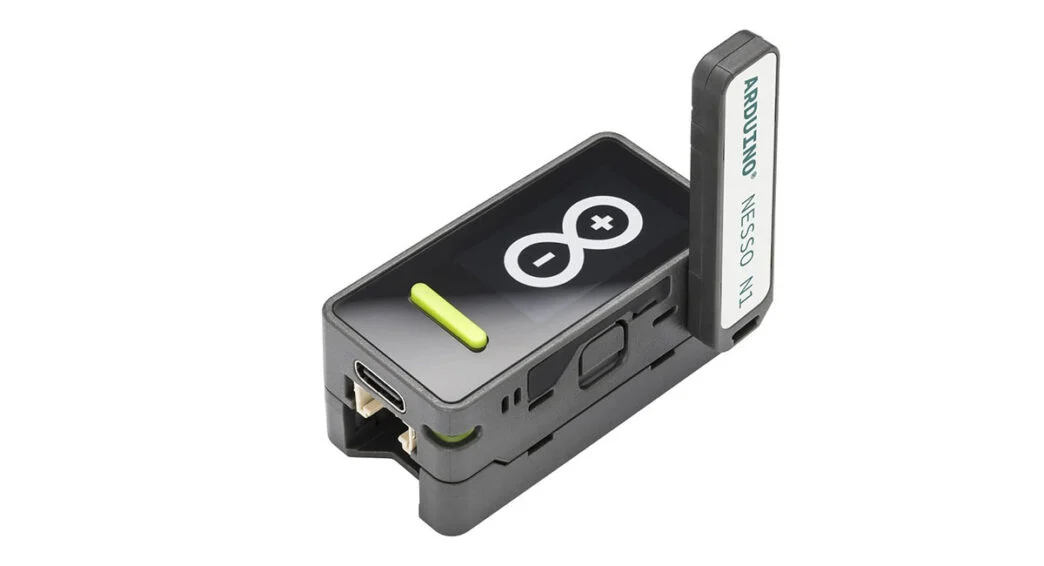
IN Brief:
- Mouser has added Arduino’s Nesso N1 IoT development kit to stock.
- The kit combines ESP32-C61 processing, multi-protocol wireless connectivity, onboard sensors, expansion connectors, and cloud support.
- Multi-radio development platforms are becoming more useful as connected devices move from prototype boards into managed industrial fleets.
Mouser Electronics is now stocking Arduino’s Nesso N1 IoT development kit, a compact platform for connected device prototyping, remote monitoring, edge nodes, wearable sensors, and industrial automation projects.
The Nesso N1 is built around Espressif Systems’ ESP32-C61 SoC microcontroller, which combines Wi-Fi 6 and Bluetooth 5.3 LE connectivity with a single-core 32-bit RISC-V CPU running at up to 160MHz. The device also supports external PSRAM, giving developers more headroom for larger data buffers, firmware expansion, and connected applications that need more than a minimal microcontroller memory footprint.
The kit supports Wi-Fi 6, Bluetooth 5.3, Thread, and LoRa, giving developers several wireless routes from one hardware platform. It includes a 1.14-inch touch display, a rechargeable 250mAh battery, 16MB NOR Flash, and 512kB SRAM. Onboard hardware includes a 6-axis IMU, passive buzzer, and infrared transmitter, with expansion provided through Grove, Qwiic, and M5StickC HAT-compatible connectors.
The development kit can be programmed through the Arduino IDE, MicroPython, or UIFlow 2.0. It also integrates with Arduino Cloud for remote device management and data visualisation, supporting a workflow that can move from local prototype to connected test deployment without changing the basic development environment.
Connected industrial products increasingly need more than one wireless option during early development. A device may use Wi-Fi for commissioning or high-bandwidth local links, Bluetooth LE for setup and mobile interaction, Thread for low-power mesh networking, and LoRa for long-range telemetry. A single development kit with multiple radios allows teams to test installation assumptions before committing to a final connectivity architecture.
This is especially relevant for products that will be deployed across different buildings, sites, or geographies. A sensor platform that works well on Wi-Fi inside a facility may need LoRa in an outdoor installation, while a low-power building product may favour Thread for mesh networking. Evaluating those choices early can reduce the risk of redesign once antenna placement, battery life, data rate, commissioning, and gateway availability are tested in real environments.
The use of Espressif’s RISC-V-based ESP32-C61 also reflects the continued movement of RISC-V into commercial wireless microcontroller platforms. RISC-V is no longer confined to academic designs or specialist evaluation boards. It is appearing in low-cost, wireless, security-capable edge devices where software ecosystem, tool support, and module availability can be as important as the processor architecture itself.
Development kits that combine display, battery, sensors, expansion connectors, and cloud integration reduce the amount of board-level assembly needed during proof-of-concept work. Teams can start earlier on power behaviour, sensor fusion, firmware update flows, user interaction, range testing, and data handling. Production hardware will still need its own design and qualification path, but the early architecture work can move faster when the main interfaces are already present.
Mouser’s availability of the Nesso N1 gives Arduino and ESP-based developers an off-the-shelf platform for evaluating connected device designs that need more than a single wireless interface.

