IN Brief:
- Microchip has opened a new Tuscaloosa facility to expand production of its MHM-2020 Active Hydrogen Maser.
- The facility supports hydrogen masers, Auxiliary Output Generator systems, and ultra-high-performance OCXO products.
- The investment supports resilient timing infrastructure across power, telecoms, GNSS, science, and defence systems.
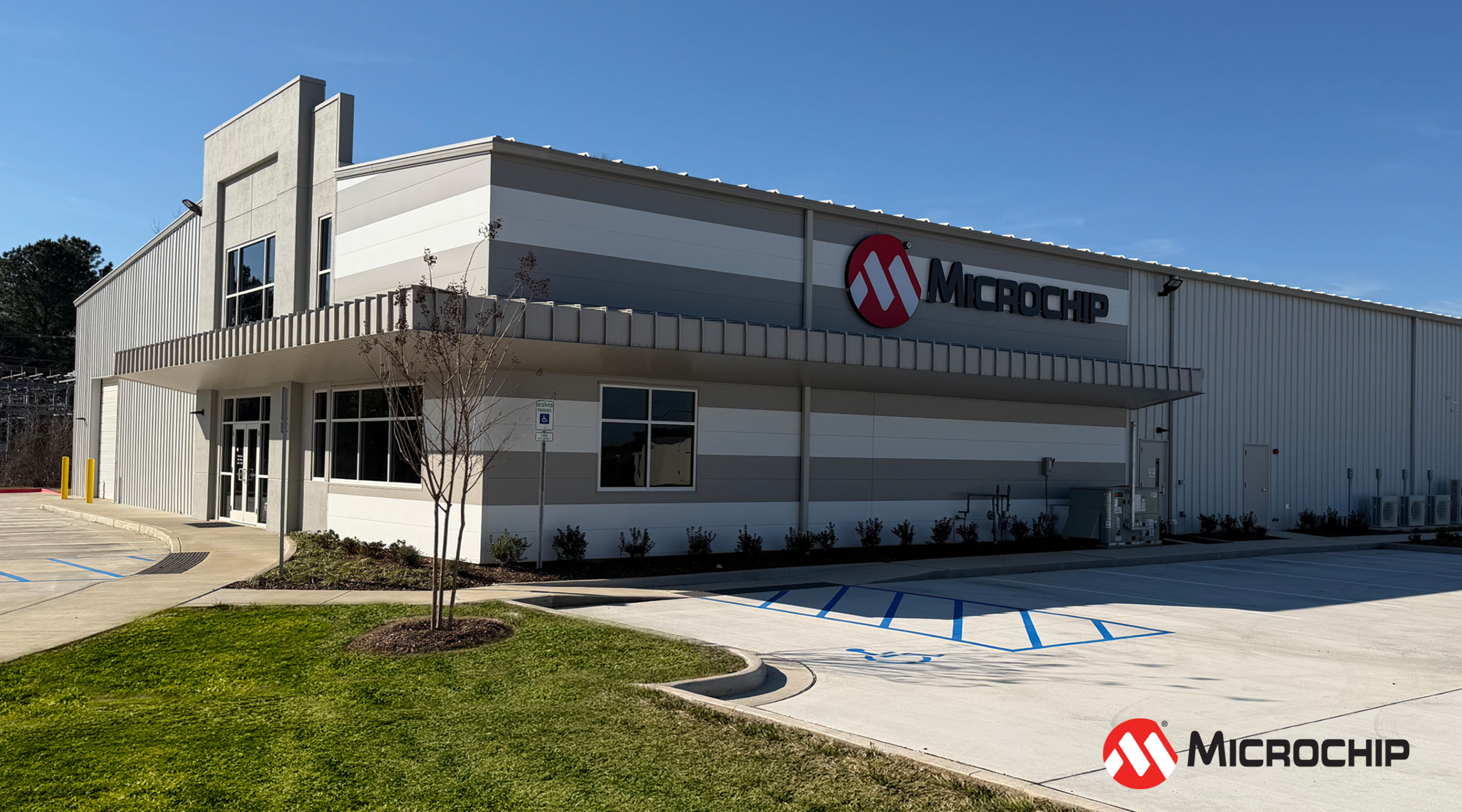
Microchip Technology has opened a new facility in Tuscaloosa, Alabama, to increase production of its MHM-2020 Active Hydrogen Maser and reduce lead times for precision timing systems.
Hydrogen masers are atomic clocks that use the properties of hydrogen atoms to generate highly stable microwave frequencies. They contribute to Coordinated Universal Time and are used in applications where long-term frequency stability, low phase noise, and precise synchronisation are critical.
The MHM-2020 Active Hydrogen Maser is designed for scientific research, national timekeeping services, radio astronomy, deep-space tracking networks, and GNSS/GPS ground stations. Microchip says the system offers 1ps synchronisation for precise calibration to GNSS and has demonstrated more than 20 years of continuous operation with minimal maintenance.
The new Tuscaloosa site expands production across Microchip’s frequency and time systems portfolio, including the MHM-2020, the AOG-110 Auxiliary Output Generator, and the 1000C-OCXO ultra-high-performance crystal oscillator. The facility is approximately 15,000ft² and includes temperature-stability testing areas and a research and development laboratory.
Microchip’s Alabama presence traces back through acquisitions beginning with Frequency Time Systems in 1996. The company has also formed a collaboration with the University of Alabama, including equipment use, student training and employment, and advisory board participation linked to precision navigation and timing work.
Resilient timing has moved from a metrology speciality into critical infrastructure. Power grids, telecoms networks, financial systems, satellite communications, data centres, defence platforms, and navigation systems all depend on accurate and trusted time. GNSS remains central to many of these systems, but reliance on satellite timing creates exposure to jamming, spoofing, outages, and geopolitical risk.
Governments and infrastructure operators are increasing attention on independent or backup time-scale systems. Hydrogen masers sit at the high-performance end of that landscape, supporting national laboratories, observatories, deep-space networks, and ground infrastructure where stability over long periods is essential.
Modern systems often treat synchronisation as a software or network function, but the underlying hardware remains decisive. Oscillators, time servers, GNSS-disciplined systems, distribution amplifiers, and atomic clocks define whether downstream systems can maintain coherence when external references are interrupted.
The requirement is becoming more complex as distributed infrastructure expands. Telecoms networks rely on precise time for 5G coordination, power systems depend on synchronised measurement for grid protection and monitoring, and defence systems require timing resilience when satellite navigation is contested. Scientific and aerospace systems add even tighter requirements around phase noise, long-term drift, and calibration.
Precision timing products are specialised and difficult to scale quickly. Reducing lead times for hydrogen masers requires more than additional floor space; it depends on specialist testing, environmental control, skilled labour, and deep process knowledge.
As timing resilience becomes a policy and engineering priority, the supply chain for high-stability frequency systems is likely to receive closer scrutiny. Microchip’s Tuscaloosa expansion strengthens one of the manufacturing bases behind systems where a timing failure can propagate far beyond the clock itself.