
IN Brief:
- Amphenol RF has expanded its non-magnetic MCX connector series with additional plug and jack configurations.
- The connectors use non-ferrous materials and plating for medical, quantum, and wireless systems exposed to magnetic fields.
- The launch supports specialised interconnect demand in precision instrumentation and high-sensitivity electronics.
Amphenol RF has expanded its non-magnetic MCX connector series with additional coaxial connector configurations for applications where magnetic interference can affect system performance.
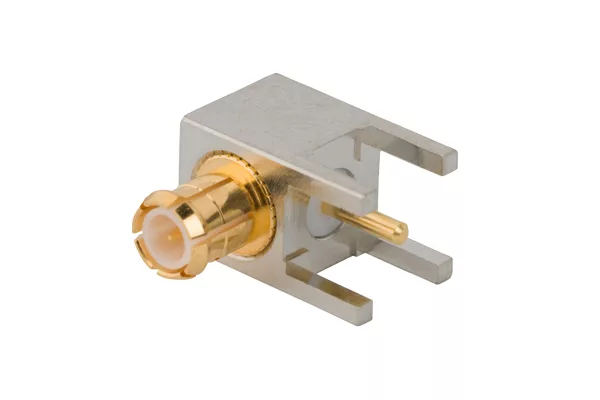
The new devices are available in straight and right-angle plug and jack configurations, with through-hole and surface-mount options. They are manufactured using beryllium copper bodies and contacts with gold or white bronze plating, and include an “NM” marking to identify them as non-magnetic components during assembly and installation.
The connectors are intended for medical equipment, quantum computing components, wireless modules, and other systems operating in or near strong magnetic fields. The non-magnetic MCX devices are designed to provide the same electrical performance as standard options while using non-ferrous construction to reduce magnetic interference.
MCX connectors are widely used where compact RF interconnects are required, including instrumentation, communications equipment, embedded wireless modules, and space-constrained assemblies. The non-magnetic variant addresses a more specialised design requirement: maintaining signal integrity in environments where conventional connector materials can disturb magnetic fields or be affected by them.
Medical imaging is a clear application. MRI systems and associated patient monitoring or signal-routing electronics demand strict material discipline because ferromagnetic components can create safety risks, image artefacts, or measurement errors. Even small passive parts can become problematic if material selection is not controlled across the full assembly.
Quantum computing systems add a different set of constraints. Many quantum platforms are highly sensitive to magnetic fields, thermal conditions, vibration, and electromagnetic noise. Interconnects used around cryogenic or magnetically sensitive assemblies must preserve signal paths without introducing unwanted disturbance. As quantum hardware development moves from laboratory builds toward engineered systems, component repeatability and documentation become more important.
The expansion also has relevance for RF modules in industrial and scientific equipment. Wireless modules used in test systems, sensor networks, and precision instruments increasingly sit close to other sensitive electronics. Where space is tight and electromagnetic behaviour is critical, the connector forms part of the RF design and environmental compatibility strategy.
Active RF devices, antenna layout, board materials, and filtering often receive most of the design attention, but connector material and geometry can determine whether a system maintains performance after integration. Reflection, insertion loss, mechanical stability, plating choice, mating cycles, and environmental exposure all influence the final signal path. In magnetic-field environments, material composition adds another constraint.
The “NM” marking helps reduce assembly errors where standard and non-magnetic variants may look similar. Clear identification can prevent incorrect installation and late-stage compliance failures in mixed builds.
Amphenol RF’s broader non-magnetic portfolio includes other standard interfaces such as MMCX, SMB, SMP, and SMPM. The addition of more MCX configurations gives designers greater freedom to retain familiar RF interfaces while meeting magnetic neutrality requirements. That balance is increasingly valuable as high-sensitivity electronics move into compact, modular, and production-oriented formats.

