
IN Brief:
- Murata has begun mass production of MRMS166R and MRMS168R AMR sensors.
- The MRMS166R combines 20nA average current with operation from 1.2V.
- The devices target contactless switching in healthcare, wearables, and IoT systems.
Murata Manufacturing has started mass production of two anisotropic magnetoresistance sensors for healthcare, wearable, and IoT devices.
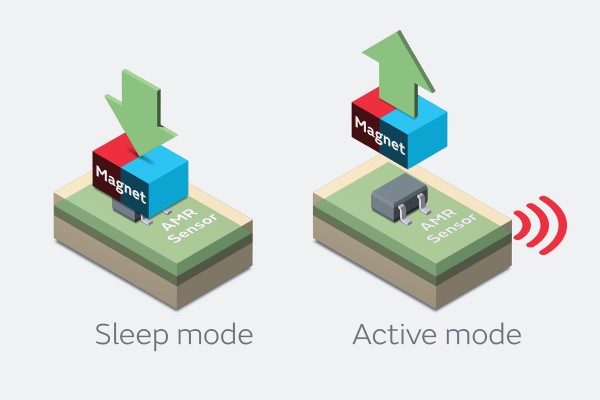
The MRMS166R and MRMS168R are solid-state magnetic sensors designed for switching applications. They detect the presence or absence of a magnetic field and generate an output signal that can be used by system logic to control functions such as transitions between active and sleep modes.
The devices support contactless switching without mechanical contacts, helping designers create sealed, miniaturised products with fewer wear-related failure points. Murata identifies capsule endoscopes, medical patches, AR glasses, wireless earbuds, door open and close detection systems, and smart locks among the target applications.
The MRMS166R operates from a 1.2V to 3.6V supply, with 1.5V typical operation, 20nA average current consumption, and 1mA maximum current output. Murata says it is the first AMR sensor to combine 20nA average current with operation from a 1.2V supply.
The MRMS168R operates from 2.0V to 3.6V, with 3.0V typical operation, 80nA average current consumption, and a 12mA maximum output current for designs requiring a higher output drive capability. Both devices are housed in a compact 1.0mm x 1.0mm x 0.4mm package.
Battery-powered products increasingly spend most of their operating life waiting for a user action, magnetic trigger, enclosure movement, or state change. A magnetic switch with nanoamp-level current consumption can extend operating life without requiring a mechanical button, exposed contact, or continuously powered sensing circuit.
Low-voltage operation gives the MRMS166R a particular role in compact devices using silver oxide coin batteries and other small cells with limited voltage margins. Components that continue operating at low voltage allow more of the battery’s discharge curve to be used, reducing wasted residual energy at end of life.
Healthcare devices place additional pressure on switching design. Sealed products are often preferred where devices are exposed to bodily fluids, skin contact, cleaning, or strict hygiene requirements. Contactless magnetic switching can support activation, wake-up, and mode control while preserving enclosure integrity.
The production start shows how low-power sensing is being shaped by miniaturisation, reliability, and power management. The switching function is simple, but its implementation at nanoamp current levels, in a 1mm package, with two output-drive options, gives designers more room to manage battery life and mechanical sealing in compact medical, wearable, and IoT systems.

