IN Brief:
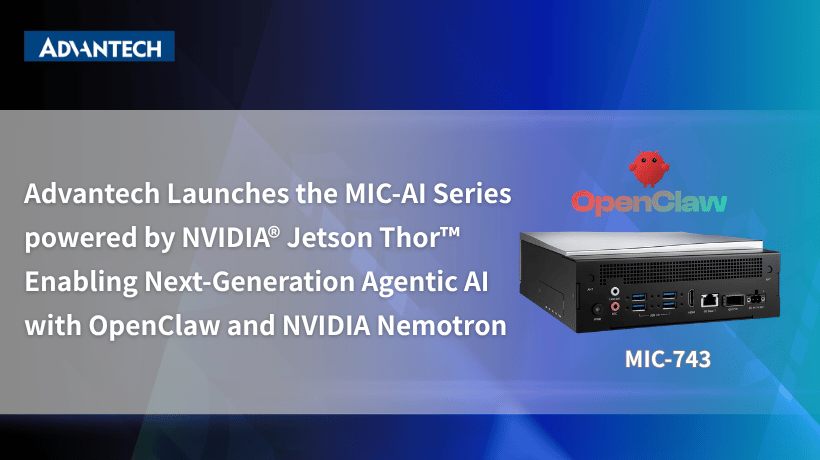
- Advantech’s MIC-AI series supports NVIDIA Jetson T4000 and T5000 modules.
- The portfolio includes MIC-743, MIC-742, MIC-741, MIB-741, and MIB-742 platforms.
- The launch targets physical AI, industrial automation, multi-sensor processing, and low-latency edge decision-making.
Advantech has launched its MIC-AI series based on NVIDIA Jetson Thor, extending its edge AI portfolio for autonomous systems, industrial automation, and physical AI workloads.
The new portfolio includes the MIC-743, MIC-742, and MIC-741 systems, alongside MIB-741 and MIB-742 development boards. The platforms support NVIDIA Jetson T4000 and T5000 modules, with the T5000 series already in mass production and the T4000 series entering phased production at the end of April.
Advantech says the MIC-743, MIC-742, and MIC-741 systems deliver up to 2,070 FP4 TFLOPS, while the development boards deliver up to 1,200 FP4 TFLOPS. The systems are designed to support NVIDIA Nemotron models, OpenClaw, and the OpenShell secure runtime within NemoClaw, enabling agentic AI functions at the edge.
The systems are intended for AI applications that move beyond isolated model inference and into local task execution. In manufacturing, an edge system could retrieve standard operating procedures, maintenance records, and spare-parts information, then adjust production sequencing, generate work orders, or trigger supplier communications within authorised access rules.
The hardware includes high-bandwidth sensor interfaces and industrial connectivity for real-time perception, synchronised multi-sensor processing, and low-latency decision-making. Those functions are central to robotics, automated inspection, autonomous machines, and industrial systems that must process data locally and act without waiting for cloud round trips.
Edge AI deployments are becoming more integrated. Early systems often focused on a single inference task, such as identifying a defect on a conveyor or recognising an object in a camera feed. Newer platforms combine perception, reasoning, policy control, workflow execution, and machine interaction close to the physical process.
That change places heavier demands on embedded hardware. Systems need accelerator performance, rugged I/O, sensor timing, thermal control, security, lifecycle support, and deployment tools. A robotics controller or inspection node cannot be specified on AI throughput alone, because performance must be sustained inside an enclosure, on a factory floor, and alongside industrial networks.
The use of FP4 performance figures also shows the direction of deployed AI models. Lower-precision inference is becoming more common as models are optimised for field deployment rather than training. Running those models locally reduces latency and bandwidth use, while keeping operational data inside the facility.
Advantech’s Jetson Thor systems sit at the boundary between embedded computing and industrial automation. The hardware is not simply an accelerator carrier. It is part of a shift towards machines that can interpret local conditions, make bounded decisions, and coordinate actions across production, inspection, and maintenance systems.