
IN Brief:
- Toshiba’s TDS5C212MX and TDS5B212MX support high-speed differential interfaces including PCIe 6.0 and USB4 v2.
- The devices offer typical differential bandwidths of 34GHz and 29GHz.
- Industrial operation from -40°C to 125°C supports testers, robots, servers, and embedded systems.
Toshiba Electronic Devices & Storage Corporation has launched two high-speed 2:1 multiplexer / 1:2 demultiplexer switches for next-generation differential signal routing in compact electronics systems.
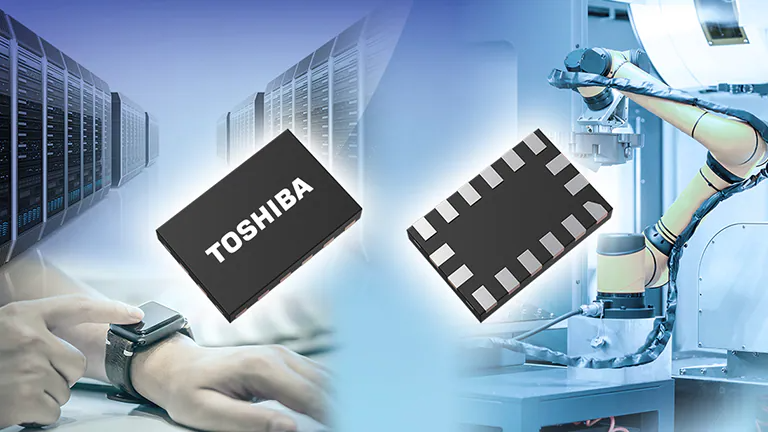
The TDS5C212MX and TDS5B212MX are designed for interfaces including PCIe 6.0, PCIe 5.0, CXL 3.0, USB4 Version 2.0, Thunderbolt 5, and DisplayPort 2.0. Volume shipments have started, with the devices aimed at servers, industrial testers, robots, PCs, mobile devices, wearables, and systems where high-bandwidth switching must be fitted into limited board space.
The devices use Toshiba’s TarfSOI silicon-on-insulator CMOS front-end process. Toshiba lists typical differential -3dB bandwidth of 34GHz for the TDS5C212MX and 29GHz for the TDS5B212MX. The wider bandwidth is designed to limit signal waveform distortion and maintain transmission reliability when routing fast differential interfaces across dense boards.
Both parts can operate as two-input/one-output Mux switches or one-input/two-output De-Mux switches. This allows one high-speed interface to be shared between multiple devices, or a signal path to be switched depending on system configuration. The TDS5C212MX also uses a pin layout intended to minimise signal path length, reducing reflections and losses in high-speed routing.
The devices are housed in XQFN16 packages measuring 2.4mm by 1.6mm, with maximum package thickness of 0.4mm. They support a supply voltage range from 1.6V to 3.6V, differential signal pin voltage up to 1.8V, and common-mode signal pin voltage up to 2.0V. Typical operating current is listed at 70µA.
The -40°C to 125°C operating temperature range gives the devices an industrial role beyond consumer high-speed interfaces. Industrial testers, robotics controllers, and embedded compute platforms are adopting high-speed data links first associated with PCs and servers. Those interfaces now need components that can maintain electrical performance in harsher temperature and operating conditions.
High-speed interface routing has become a board-level constraint in its own right. PCIe, CXL, USB4, Thunderbolt, and DisplayPort are no longer limited to conventional peripheral links. They are part of system architectures for accelerators, storage, displays, sensors, data acquisition, and modular compute platforms.
As lane speeds increase, routing decisions can quickly reduce channel margin. Losses, impedance discontinuities, crosstalk, return loss, package parasitics, and placement limits all affect whether a design reaches compliance with sufficient headroom. Switching components therefore need to support the channel rather than simply provide functional path selection.
Toshiba’s new switches occupy that practical design space. They do not alter the underlying interface standards, but they support the increasingly complex board architectures needed to route those standards across dense systems. The combination of multi-interface support, compact packaging, and high-temperature operation gives the devices a role in next-generation compute, test, robotics, and industrial electronics platforms.

