
IN Brief:
- ROHM has developed a configurable automotive SoC power solution combining BD968xx-C PMICs with the BD96340MFF-C DrMOS.
- The platform targets ADAS, driver monitoring, sensing cameras, and domain-controller systems requiring low-voltage, high-current rails.
- Scalable power design is becoming more important as vehicle electronics move toward centralised compute and software-defined architectures.
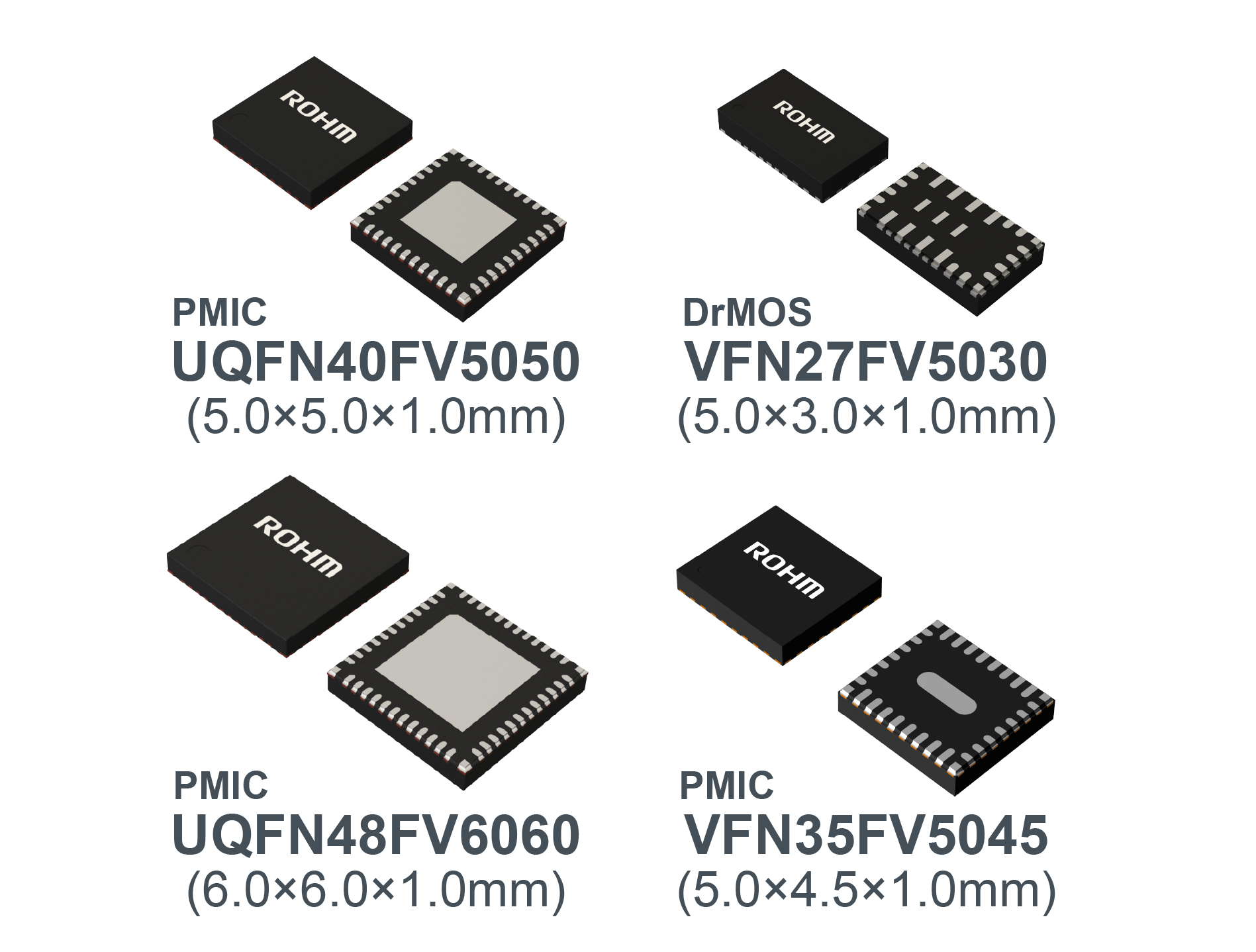
ROHM has developed a configurable power supply solution for automotive SoCs, combining the BD968xx-C PMIC series with the BD96340MFF-C DrMOS device.
The solution is aimed at advanced driver assistance systems, driver monitoring systems, sensing cameras, and other vehicle electronics using increasingly capable application processors and SoCs. These devices are becoming central to domain-controller architectures, where functions previously distributed across multiple electronic control units are consolidated into fewer, more powerful compute platforms.
The configurable architecture allows combinations of main PMICs, sub-PMICs, and DrMOS devices to be selected according to the performance level and power requirements of the target SoC. ROHM’s BD96803Qxx-C and BD96811Fxx-C PMICs are optimised for standalone operation with lower-end SoCs, while the BD96805Qxx-C and BD96806Qxx-C can be combined with the BD96340MFF-C DrMOS to support low-voltage, high-current rails for higher-performance devices.
All PMICs in the series are designed for a 2.7V to 5.5V input range. The PMICs use wettable flank QFN packages, while the DrMOS device is supplied in a flip-chip QFN package. All devices are AEC-Q100 qualified for in-vehicle applications, and mass production has begun.
Automotive SoC power design is becoming harder to standardise with fixed architectures. ADAS, camera processing, radar fusion, driver monitoring, and domain-control functions require multiple regulated rails, accurate sequencing, higher current capability, and stable operation across automotive temperature, voltage, and lifecycle conditions. A power tree developed for one processor generation can require substantial rework when rail counts, current levels, sequencing, or safety requirements change.
ROHM’s configurable approach gives power designers a scalable base that can be adapted across low-end and high-end SoC platforms. That helps vehicle makers and Tier 1 suppliers reuse electronic platforms across model ranges, trim levels, and regional variants without redesigning the entire power subsystem around each processor change.
The wider vehicle architecture is moving in the same direction. NXP and Vector’s extension of CoreRide software support addressed zonal platforms and software-defined vehicle development, while Ambarella’s 4D radar processing work on the CV3-AD central AI domain controller underlined the growing processing burden inside central vehicle compute. As compute consolidates, power delivery has to become more adaptable and more tightly controlled.
Power management is closely tied to functional safety, thermal design, electromagnetic compatibility, and system start-up behaviour. Sequencing errors, rail instability, or weak transient response can affect processor reliability and system availability, particularly when multiple sensors, processors, memory devices, and communication interfaces have to initialise in a controlled order.
DrMOS integration can also improve efficiency and current handling by bringing the driver and MOSFET stage closer together in a package suited to compact board layouts. The flip-chip QFN format supports dense power-stage design, while wettable flank QFN packages on the PMICs support optical solder inspection in automotive manufacturing.
As vehicle platforms move toward domain and zonal electronics, power supply design has to support reuse without compromising reliability or validation discipline. ROHM’s BD968xx-C and BD96340MFF-C combination gives automotive electronics designers a configurable base for SoC power trees that must evolve with vehicle compute, rather than be rebuilt every time the processor architecture changes.

