
IN Brief:
- Innodisk has launched a High-Speed 10GbE LAN Series for space-constrained edge AI systems.
- The portfolio includes M.2 2242, M.2 2280, and PCIe low-profile modules with Intel E610 and X710 Ethernet controllers.
- DPDK, PTP, SR-IOV, SFP+, and wide-temperature options target inference, smart factory vision, AGV/AMR coordination, and surveillance systems.
Innodisk has launched a High-Speed 10GbE LAN Series for embedded and edge AI systems, addressing the bandwidth and latency demands created by multi-sensor data, real-time inference, high-resolution video, and distributed industrial automation.
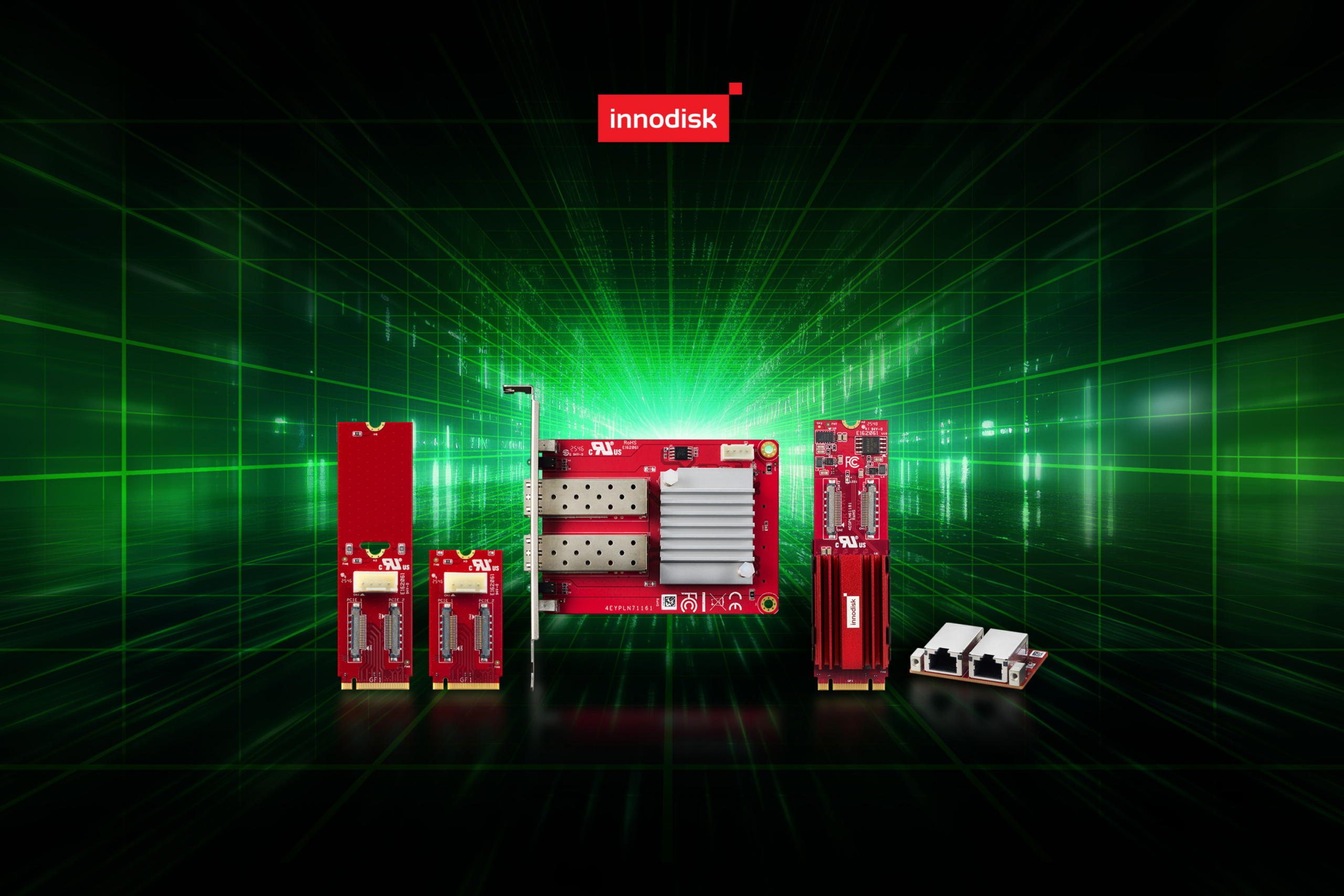
The portfolio includes M.2 and PCIe form factors, with M.2 2242, M.2 2280, and PCIe low-profile options for systems where board space, slot availability, thermal headroom, and enclosure constraints limit conventional networking upgrades. The modules use Intel E610 and X710 Ethernet controllers and support DPDK, PTP, and SR-IOV for packet processing, time synchronisation, and virtualised resource allocation.
Innodisk is targeting applications including edge inference, AGV and AMR coordination, smart factory vision, and NVR surveillance. These workloads are increasingly exposed to the limits of traditional 1GbE links, particularly where multiple cameras, sensors, or industrial endpoints need to exchange data with edge servers or local compute nodes in real time.
The series uses a daughterboard architecture with high-speed shielding cables, allowing network ports to be placed flexibly inside space-constrained systems. Selected models support wide-temperature operation from -40°C to 85°C, extending the portfolio into outdoor deployments, factory automation, and harsh embedded environments where standard commercial networking cards may not be suitable.
Two M.2 designs lead the range. The EGPL-T203 is a dual-port 10GbE LAN module with wide-temperature support in an M.2 form factor rated for -40°C to 85°C Ta. The EGPL-T2F1 adds an M.2-based SFP+ LAN option, supporting optical and direct-attached copper SFP+ modules for high-speed fibre connectivity. Additional models, including EGPL-T103, ELPL-T101, and ELPL-T201, broaden the available configurations across single-port, dual-port, M.2, and PCIe deployment needs.
Innodisk’s recent edge AI work has already moved across deployable systems and memory expansion, including AI systems for healthcare and mobility and a CXL 2.0 edge memory card. The 10GbE LAN Series addresses another part of the same deployment stack: moving data through constrained edge systems quickly enough for local AI to be useful.
Networking becomes a bottleneck because edge AI systems rarely operate on one clean data stream. A machine-vision node may combine several cameras, PLC data, motion control feedback, environmental sensing, and local storage. An AMR fleet needs low-latency coordination between vehicles, infrastructure, and supervisory systems. A surveillance platform may need to capture and process multiple high-resolution video streams while maintaining reliable storage and remote access.
DPDK support gives developers a route to faster packet processing by reducing kernel overhead, while PTP supports tighter time alignment across distributed sensors and endpoints. SR-IOV is useful where edge servers are running virtualised or containerised workloads and need to divide network resources efficiently between functions. These features are familiar in data-centre networking, but they are now moving into embedded systems with tighter physical constraints and harsher operating conditions.
Edge AI is borrowing requirements from both industrial control and server design. Systems need ruggedness, long lifecycle, and flexible mounting, while also requiring bandwidth, virtualisation support, and packet-processing performance. Innodisk’s 10GbE LAN Series sits directly in that overlap, providing a networking upgrade path for edge platforms where compute and storage have already moved beyond the limits of 1GbE connectivity.

