
IN Brief:
- Allegro MicroSystems will demonstrate wide-bandgap power design technologies at PCIM 2026.
- The demonstrations focus on high-bandwidth current sensors and isolated gate drivers for SiC and GaN systems.
- AI data centres and 800V EV platforms are increasing demand for faster switching, tighter protection, and higher power density.
Allegro MicroSystems will use PCIM 2026 in Nuremberg to demonstrate current-sensing and isolated gate-driver technologies for silicon carbide and gallium nitride power designs.
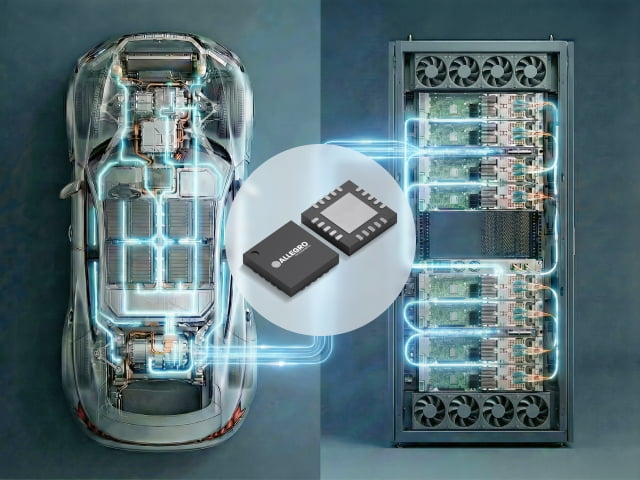
The company’s demonstrations will focus on high-bandwidth current sensors and isolated gate drivers for systems where switching speed, protection response, and power density are closely linked. Target applications include AI data centres and 800V electric-vehicle architectures, two markets where conversion efficiency and thermal performance now sit alongside compute, battery, and charging requirements.
SiC and GaN devices can switch faster and operate more efficiently than conventional silicon power devices in many high-voltage or high-frequency applications. Their practical performance, however, depends heavily on the surrounding electronics. Gate-drive timing, isolation, current-sense bandwidth, protection loops, layout parasitics, and bias-supply design can all restrict what the power stage can safely deliver.
Allegro’s PCIM programme is therefore focused on the control and sensing layer around the wide-bandgap switches. High-bandwidth current sensing supports faster transient detection and tighter control loops, while isolated gate drivers need to deliver clean drive signals across challenging voltage domains. In high-density converters, those functions must also avoid adding unnecessary board area, component count, or qualification burden.
AI infrastructure has turned power conversion into a front-line design problem. Higher rack power, denser accelerator boards, and increased current demands are pushing server power stages towards more efficient topologies and shorter delivery paths. Electric-vehicle platforms are following their own version of the same trend, with 800V architectures supporting faster charging, lower current for a given power level, and reduced cable mass.
The GaN ecosystem is also becoming easier to design into production systems as device availability and supporting components improve. Wider access to EPC GaN power devices through distribution, covered in Mouser’s addition of EPC’s GaN portfolio, shows how wide-bandgap adoption is becoming less specialised. Control, sensing, layout, and validation now determine how quickly those devices move from evaluation boards into repeatable platforms.
PCIM has become a useful marker for that transition. The most useful wide-bandgap discussions now centre on implementation: how protection behaves under real transients, how gate-drive isolation performs over lifetime, how thermal paths are managed in compact modules, and how current sensing can support both fast switching and safety requirements.
Industrial electrification is pulling the same technologies across motor drives, grid interfaces, energy storage, EV chargers, and high-density server supplies. If a current sensor or gate driver forces a slower loop, a larger board, or a conservative thermal design, some of the advantage gained from SiC or GaN is lost elsewhere in the product.
Allegro will exhibit at Hall 4A, Booth 207, from June 9 to 11. The demonstrations point towards the next phase of wide-bandgap power design, where sensing, isolation, and control integration are becoming as decisive as the headline properties of the switches themselves.

