
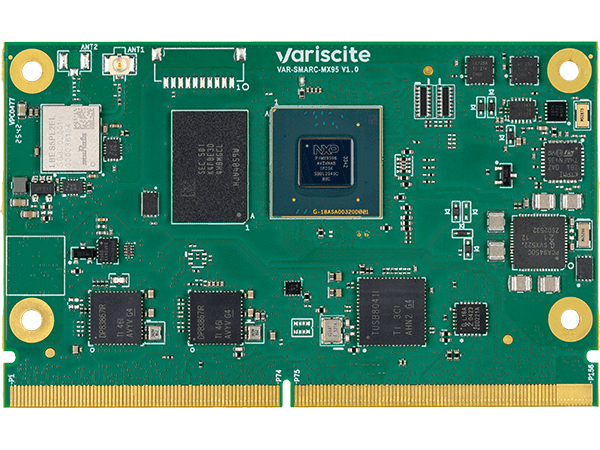
IN Brief:
- Variscite is preparing the VAR-SMARC-MX95 system-on-module around NXP’s i.MX 95 applications processor.
- The module combines Cortex-A55 processing, Cortex-M7 and Cortex-M33 real-time coprocessors, and eIQ Neutron NPU acceleration.
- Industrial automation, medical imaging, building management, and energy infrastructure are pushing SMARC modules towards safety, security, and edge AI.
Variscite is expanding its SMARC-compliant system-on-module roadmap with the VAR-SMARC-MX95, a module built around NXP’s i.MX 95 applications processor for industrial IoT, edge AI, and safety-oriented embedded systems.
The module will feature up to six Arm Cortex-A55 cores running at up to 2.0 GHz, supported by Cortex-M7 and Cortex-M33 real-time coprocessors for deterministic control tasks. An integrated eIQ Neutron NPU provides 2 TOPS of AI/ML acceleration, while dual MIPI CSI-2 interfaces support embedded vision applications.
Variscite is also building the module around functional-safety and security requirements. The i.MX 95 platform includes an independent Safety Island architecture, and the SMARC module adds an on-module TPM 2.0 chip with FIPS 140-3 Level 2 compliance. The company is targeting industrial automation, medical imaging, building management systems, energy infrastructure, and other applications where compute, control, and security are converging.
The VAR-SMARC-MX95 uses the 82mm x 50mm SMARC form factor with 314 pins and joins Variscite’s VAR-SMARC Pin2Pin family. Existing designs based on the VAR-SMARC-MX8M-PLUS can therefore move towards i.MX 95 performance without a carrier-board redesign, giving embedded developers a migration route across processor generations.
Embedded systems are now being asked to combine functions that once lived on separate boards. Application processing, real-time control, AI inference, image handling, secure connectivity, and long-lifecycle software support increasingly sit inside the same industrial or medical product. A module-based approach allows those requirements to be absorbed at subsystem level while keeping the carrier board, I/O mix, enclosure, and certification strategy under product-team control.
The SMARC family expansion follows Variscite’s i.MX 8M Plus SMARC module, which gave developers a lower-power route into vision and edge AI workloads. The i.MX 95 version raises the ceiling with stronger application processing, dedicated AI acceleration, real-time coprocessors, and safety architecture in the same standards-based format.
Medical imaging gives one example of the design pressure. Vision processing, local AI, display output, data handling, and cybersecurity can sit inside one device, yet the system may also need predictable control behaviour and a route through regulatory evaluation. Industrial automation creates a related challenge, where machine vision, sensor fusion, edge analytics, and deterministic control have to coexist in equipment expected to run for many years.
Security is becoming a stronger selection factor as well. The EU Cyber Resilience Act and sector-specific requirements are raising expectations around secure boot, cryptographic support, identity, and update integrity. By placing TPM hardware and processor-level security features on the module, Variscite is moving some of that work into the platform foundation rather than leaving it entirely to carrier-board design.
The VAR-SMARC-MX95 reflects a practical shift in embedded design. Processor roadmaps, AI requirements, safety expectations, and cybersecurity rules are moving faster than many industrial hardware cycles. Modular compute platforms give long-life products a way to adopt newer silicon without repeatedly rebuilding the whole embedded architecture.

