IN Brief:
- Advantech has introduced industrial edge AI systems based on Qualcomm’s Dragonwing IQ-9075 processor.
- The portfolio includes a SMARC module, robotic controllers, and a fanless edge AI system.
- The launch reflects the move from machine vision hardware toward embedded platforms capable of local inference and coordinated control.
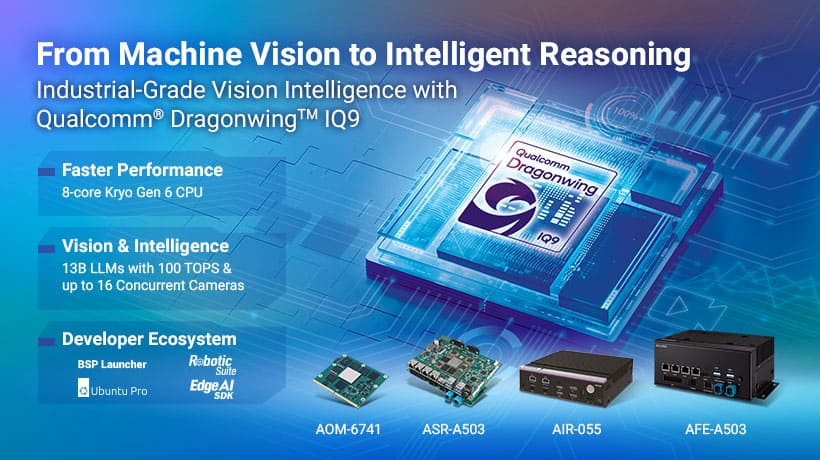
Advantech has expanded its industrial edge AI portfolio with a new family of systems based on Qualcomm’s Dragonwing IQ-9075 processor, targeting robotics, machine vision, automation, and real-time visual intelligence.
The line-up includes the AOM-6741 SMARC module, the ASR-A503 and AFE-A503 robotic controllers, and the AIR-055 fanless edge AI system. The processor is specified for up to 100 TOPS of dense AI performance, or 200 TOPS for sparse workloads, and can support up to 16 concurrent camera streams. That combination gives the platform a defined role in systems where high-volume image input must be processed locally rather than passed to a remote server.
Built around an Arm-based heterogeneous compute architecture, the Dragonwing IQ-9075 combines a Qualcomm Kryo Gen 6 CPU with multimedia processing, AI acceleration, and real-time control resources. Advantech is also offering software support through its BSP Launcher, Edge AI SDK, and Robotics Suite, with ROS 2-based tools intended to shorten the path from module evaluation to deployable robotics and automation systems.
Multi-camera edge AI is becoming a larger design category as robotics, autonomous material handling, inspection systems, and smart manufacturing equipment move beyond simple sensing. A modern machine vision system may ingest several camera feeds, recognise objects, classify defects, detect human presence, and maintain deterministic control responses within a fixed power and thermal envelope. That workload is difficult to support cleanly with a conventional embedded controller and a separate accelerator added late in the design cycle.
Advantech’s approach also shows how embedded computing is being pulled toward complete platform engineering. Industrial edge AI is no longer defined only by accelerator performance. Camera interfaces, board support packages, long-term availability, thermal behaviour, mechanical robustness, and update handling all influence whether a platform can move from prototype to field deployment. Compute performance without that surrounding structure rarely shortens a real development programme.
Recent consolidation in edge AI reinforces the same direction. onsemi’s move to acquire Synaptics would bring together power, sensing, compute, connectivity, HMI, and edge AI capability under one supplier. Advantech is operating from the embedded systems and industrial platform side, but the engineering direction is similar: suppliers are assembling more of the stack before the customer begins integration.
Vision sensing is also becoming more tightly coupled with embedded compute. STMicroelectronics’ compact 3D LiDAR module brought depth sensing into a small-format module for robotics, healthcare, automation, and smart buildings. Advantech’s Dragonwing-based systems sit further along the same chain, where perception data must be converted into decisions quickly enough to control a machine.
The design challenge is balancing inference performance with deterministic behaviour. Robotics and automation workloads cannot be treated as general AI applications running opportunistically in the background. Safety zones, motion control, inspection timing, communications, and user interaction all compete for resources. Platforms that consolidate AI, camera input, and control functions need careful software partitioning, thermal validation, and lifecycle planning before they become production equipment.
Advantech’s expanded portfolio gives developers a more direct route into that architecture. Its strength will depend on how effectively hardware, software, camera support, and industrial deployment requirements can be joined into repeatable designs, rather than leaving each customer to assemble the edge AI stack from separate components.