IN Brief:
- STMicroelectronics has introduced the VL53L9 direct Time-of-Flight 3D LiDAR module for embedded depth sensing.
- The module delivers high-zone depth data in a compact reflowable package with MIPI CSI-2 and I3C interfaces.
- Robotics, automation, smart buildings, and healthcare systems are pushing more perception workloads into edge hardware.
STMicroelectronics has introduced the VL53L9 direct Time-of-Flight 3D LiDAR module, extending its FlightSense portfolio into compact embedded systems that require depth data without the compute burden of larger vision architectures.
The module is designed to deliver three-dimensional distance information for systems built around small microcontrollers or application processors. Target applications include robotics, industrial automation, smart buildings, augmented and virtual reality, healthcare equipment, presence detection, collision avoidance, and spatially aware human-machine interfaces.
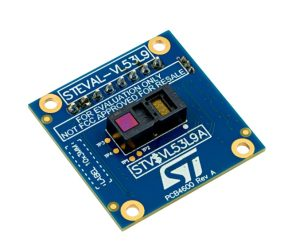
The VL53L9CX variant is an all-in-one direct ToF 3D LiDAR sensor in a miniature reflowable package measuring 12.8 x 6.1 x 4.6mm. It offers up to 2.3k sensing zones and supports MIPI CSI-2 and I3C interfaces, allowing structured depth data to be passed into host systems without requiring a full machine-vision stack. The device uses 1.2V and 3.3V rails, with ST also offering the STEVAL-VL53L9 and X-NUCLEO-53L9A1 boards for evaluation.
Depth sensing has moved well beyond experimental robotics. Industrial equipment, medical devices, access systems, smart lighting, and building controls increasingly need short-range spatial awareness that is reliable, low-power, and unobtrusive. In many of those systems, the design objective is not to reconstruct an entire scene. It is to determine distance, movement, occupancy, gesture, or object position quickly enough for the control system to respond.
The compact module format reduces some of the integration burden that has traditionally slowed optical sensing projects. Optical-path design, window material, calibration, ambient light, reflectivity, mounting geometry, and enclosure contamination still shape the final result, especially in factory or healthcare environments. Even so, a packaged ToF module gives engineers a more defined starting point than a discrete receiver, emitter, and analogue front-end assembled from scratch.
ST has already been building a stronger robotics and physical AI ecosystem around its sensing portfolio. Its work with NVIDIA on simulated robotics environments and sensor-aware development flows has linked the VL53L9CX into a broader hardware and software evaluation chain through multi-sensor modules and sim-to-real workflows. The new module moves the component part of that story closer to production design, where package size, interfaces, power rails, and evaluation hardware determine how quickly a sensor can be assessed.
Healthcare electronics provide one of the clearer use cases. Contactless sensing can support gesture input, proximity detection, patient presence monitoring, and assistive interfaces where touch-based controls are undesirable or difficult. In building systems, depth data can help distinguish static objects from people, refine occupancy detection, and improve energy management without making cameras the default sensing method.
In robotics and automation, short-range depth sensing can add a useful layer between simple proximity switches and more compute-heavy vision systems. A compact ToF module can support obstacle detection, docking, hand detection, bin presence, and local mapping functions where latency, power, and system cost matter. The ability to feed structured depth data into a host processor also helps when perception functions are being split between deterministic control logic and AI-assisted classification.
The industrial challenge remains environmental robustness. Optical sensors can be affected by dust, vapour, vibration, surface reflectivity, and mechanical misalignment, all of which become more demanding outside a clean development bench. Successful adoption will depend on system-level design as much as sensor specification, with mechanical, optical, firmware, and test considerations handled together from the start.
Production shipments are expected to begin in early July 2026, giving developers a near-term route to evaluate the module in depth-aware edge systems. As embedded platforms acquire more local perception, compact ToF sensors are becoming part of the standard toolbox for designs that need spatial intelligence without escalating straight to full camera-based machine vision.