IN Brief:
- Phlux Technology has opened beta sample availability for its Apex 200µm InGaAs APD receiver module.
- The PX02200-TO module targets 900nm to 1700nm detection and is optimised for 1550nm sensing applications.
- Low-noise infrared receiver modules are becoming more important for LiDAR, defence sensing, analytical instruments, and industrial detection.
Phlux Technology has opened beta sample availability for its Apex 200µm Noiseless InGaAs avalanche photodiode receiver module, targeting high-sensitivity infrared sensing across LiDAR, rangefinding, defence, security, gas sensing, and analytical instrumentation.
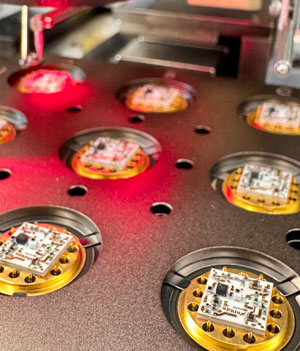
The PX02200-TO module integrates Phlux’s Aura avalanche photodiode technology with low-noise pre-amplifier circuitry in a TO-8, 12-pin package. It operates across the 900nm to 1700nm spectral range and is optimised for 1550nm systems, a wavelength widely used in eye-safe LiDAR, long-range optical sensing, and specialist infrared instrumentation.
Specified with a noise-equivalent power of 35fW/√Hz, 100MHz bandwidth, and responsivity of 600kV/W at 1550nm, the 200µm module is the first Apex family device available for beta sampling. Phlux is also preparing 80µm and 30µm versions, with the smaller-area devices intended to provide higher bandwidth while retaining the receiver module format.
Infrared receiver design often becomes a balancing act between sensitivity, bandwidth, noise, optical area, gain, packaging, and temperature behaviour. A more sensitive detector can support longer range, lower emitter power, or greater margin in difficult conditions, but those gains only translate into system performance when the optical path, analogue front end, digitisation, filtering, and signal processing are designed around the receiver’s behaviour.
By combining the APD and low-noise pre-amplifier inside a packaged module, Phlux is reducing some of the early integration work normally attached to high-performance optical receivers. The approach gives developers a defined electrical and mechanical starting point for evaluation, while still leaving room for system-specific optimisation around optics, filtering, mechanical alignment, temperature compensation, and firmware.
The company’s Aura APD technology uses an antimony alloy structure and is designed to provide internal gain above 120. Phlux has also stated that the detectors meet MIL-STD-883 and Telcordia GR-468 reliability requirements, which is significant in markets where optical receivers may be deployed in aerospace, defence, industrial, or telecoms environments with long service expectations.
Work on high-speed infrared sensing is also accelerating in adjacent defence and aerospace systems. Event-based infrared camera development for target tracking has shown how optical sensors are being pushed towards faster response and lower data overhead in dynamic environments, with infrared detection moving closer to real-time decision chains. Phlux is operating at component and module level, but the pressure is the same: cleaner signals, faster response, and more usable data from difficult scenes.
The 1550nm focus gives Apex a clear role in LiDAR and rangefinding systems. Eye-safety limits can allow higher emitted power at 1550nm than at shorter wavelengths, depending on the final design and regulatory conditions, which makes the band attractive for longer-range sensing. InGaAs detectors are well suited to that wavelength region, although cost, dark current, packaging, and integration complexity have traditionally shaped adoption.
Gas sensing and analytical instrumentation add a different set of requirements. Rather than measuring distance, those systems may need to detect weak optical absorption signatures, low-intensity returns, or small changes in signal level over time. Receiver stability and noise behaviour can become as important as peak sensitivity, particularly when the system is expected to operate outside tightly controlled laboratory conditions.
Phlux’s progress also strengthens the UK’s specialist photonics and compound semiconductor base. The Sheffield company emerged from university research and is now moving its detector technology into packaged modules that can be evaluated directly by system developers. That middle step between device physics and deployable hardware is often where promising sensor technologies either become commercially useful or remain confined to laboratory performance tables.
Beta sampling will give customers the chance to test the Apex receiver in real optical and electrical environments before committing to design integration. For LiDAR, defence sensing, gas detection, and instrumentation platforms, that evaluation stage will determine whether the module’s detector-level performance can be converted into a measurable system advantage.