IN Brief:
- Nearfield Instruments has secured €330m in Series D funding, valuing the Dutch semiconductor metrology company at €1.4bn.
- The investment will support production expansion, system development, and wider deployment of high-resolution semiconductor inspection equipment.
- Advanced packaging, AI accelerators, and leading-edge logic are increasing pressure on process-control tools used to protect yield.
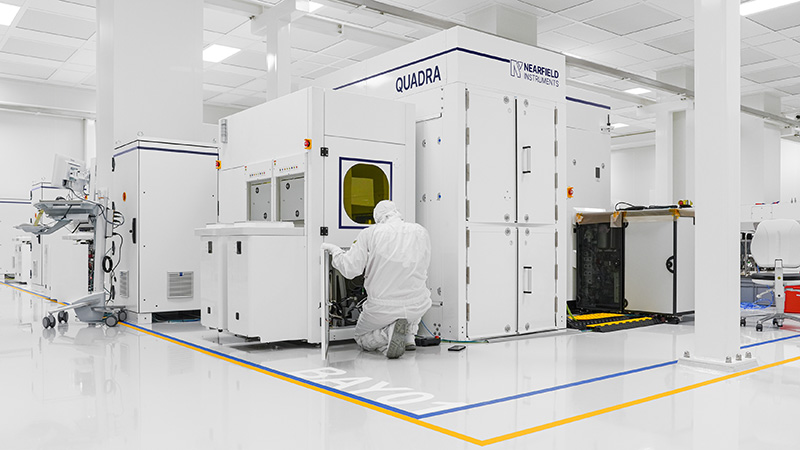
Nearfield Instruments has raised €330m in Series D funding to accelerate production of its semiconductor metrology systems, giving the Rotterdam-based company a valuation of €1.4bn.
The round places Nearfield among Europe’s most closely watched semiconductor equipment companies, with fresh capital now directed towards manufacturing capacity, product development, and international deployment. Its systems are used to measure semiconductor structures during wafer processing, where process drift, dimensional variation, and hidden defects can undermine yield long before a finished device reaches electrical test.
Founded in 2016 as a spin-out from TNO, the Netherlands Organisation for Applied Scientific Research, Nearfield develops inspection technology for advanced chip manufacturing environments that require both high resolution and production-level throughput. CEO Hamed Sadeghian said: “Nearfield is no longer an emerging player; we’re building a global technology company.”
As semiconductor devices move deeper into three-dimensional structures, stacked memory, advanced logic, heterogeneous integration, and multi-die packages, the economics of inspection are becoming more exacting. A single wafer can carry devices worth far more than previous process generations, while each additional layer, interface, and package-level connection creates another opportunity for failure. Metrology no longer sits politely at the edge of the fab. It is one of the systems that determines whether the rest of the manufacturing line can be trusted.
Nearfield’s growth strengthens a European semiconductor equipment base that is already central to global chip production. The Netherlands has an established position through lithography and precision mechatronics, while the wider European supply chain contributes optics, materials, compound semiconductors, power devices, metrology, and advanced packaging capability. Nearfield’s funding adds weight to the argument that Europe’s semiconductor role is not restricted to wafer capacity. Much of the strategic value sits in the tools that allow advanced devices to be produced repeatedly and profitably.
The same pressure is visible across the design chain, where physical effects are now too interconnected to be treated as late-stage clean-up work. In EDA, Synopsys’ move to bring timing, power, thermal, electromagnetic, analogue, photonic, and multi-die analysis into a common environment reflects the same manufacturing reality from the design side. Devices that combine dense logic, high-speed memory, advanced packaging, and tighter power budgets need earlier evidence that the physical implementation will behave as intended.
Metrology investment follows that logic into the fab. Inspection tools do not increase transistor density by themselves, but they provide the feedback needed to keep aggressive processes inside acceptable limits. As AI accelerators, automotive compute modules, RF systems, and high-bandwidth memory devices become larger and more complex, a missed defect can carry a much higher financial penalty than in simpler commodity production.
Europe’s wider push to connect research, process development, and commercial manufacturing also gives the Nearfield raise a strategic dimension. The UK’s work around the Rapidus semiconductor centre agreement has already pointed towards deeper collaboration on advanced process capability, and Nearfield’s expansion sits within that same industrial frame. Greater control over the measurement, validation, and qualification chain gives European companies more influence over how future devices are made, even where leading-edge wafer production remains globally distributed.
Advanced packaging will sharpen the requirement further. Multi-die systems bring together logic, memory, RF, photonics, and power functions in closer proximity, making electrical and thermal behaviour more dependent on package assembly, interconnect integrity, and process consistency. Faults can emerge through mechanical stress, local heating, alignment tolerances, or interface behaviour that is difficult to infer from conventional wafer inspection alone.
Nearfield’s new funding gives it a stronger platform to scale into that manufacturing environment. As chip production becomes more expensive, more distributed, and more dependent on precise physical control, the companies able to see and measure hidden variation will carry increasing industrial weight.