IN Brief:
- Integrals Power is validating sustainably produced iron phosphate precursor and LFP cathode material with the University of St Andrews.
- Early cell-level results show more than 153mAh/g specific capacity using the company’s UK-produced material.
- The work strengthens the technical case for Western LFP supply chains as China continues to dominate global production.
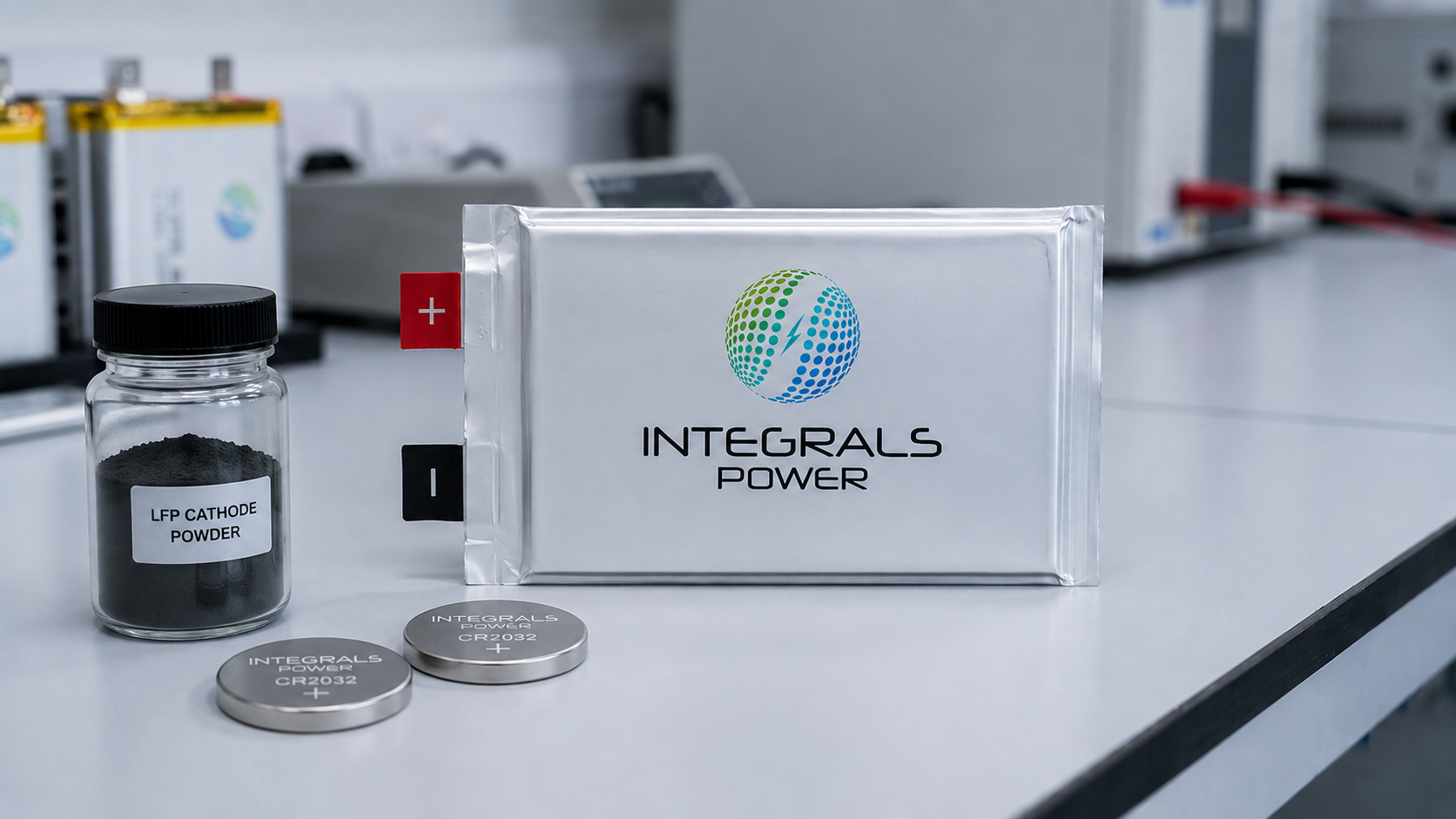
Integrals Power has validated its sustainably produced iron phosphate precursor and lithium iron phosphate cathode active material through external cell-level testing with the University of St Andrews, marking a further step towards a domestic LFP supply chain.
The Milton Keynes battery materials company is working with the university to assemble early-stage cell prototypes using Integrals Power’s LFP cathode material alongside standard commercial anodes and liquid electrolyte. The cells are being put through hundreds of cycles, with testing focused on capacity retention, rate capability, and long-term cycling stability.
Initial results show more than 153mAh/g specific capacity, placing the UK-produced material on a direct performance level with leading Chinese LFP cathode materials. China currently dominates global LFP production, with Integrals Power citing a share of around 90%, leaving vehicle, energy storage, and industrial battery supply chains heavily exposed to a narrow materials base.
The material is produced at Integrals Power’s UK pilot plant in Milton Keynes using raw materials sourced from European and North American suppliers. That sourcing route is intended to provide clearer material traceability and reduce exposure to geopolitical risk, while giving future customers a more transparent basis for qualification and procurement decisions.
Cell-level validation is a practical threshold for cathode material adoption. Powder characterisation and process data can indicate potential performance, but commercial qualification requires evidence from working cells under repeated charge and discharge conditions. Capacity retention, rate behaviour, cycling stability, and failure modes all influence whether a material can move beyond pilot production into larger pouch or prismatic formats.
Founder and CEO Behnam Hormozi said: “The battery industry has long been told that matching Chinese LFP performance from a Western supply chain is an ambition rather than a reality. This collaboration with the University of St Andrews is about converting that ambition into independently verified evidence within one of the most credible testing environments available. Cell testing is the foundation on which commercial confidence is built. By working with a world-class academic institution and using its advanced facilities to rigorously evaluate our materials, we can provide customers and partners with the impartial, technically robust data they need to make procurement and qualification decisions with confidence.”
The University of St Andrews work follows a broader push by the company to industrialise UK cathode material production. Earlier scale-up backing for Integrals Power, including work through DRIVE35-funded Project CATMAN, set out a path from pilot output towards demonstration and future commercial-scale manufacturing through a UK cathode manufacturing programme. Independent cell testing now adds the electrochemical evidence needed to support that scale-up route.
LFP chemistry has become strategically important because it avoids nickel and cobalt, provides strong cycle life, and can offer cost advantages where maximum energy density is not the sole design objective. Its use in electric vehicles, stationary storage, industrial power systems, and battery-backed infrastructure has expanded as manufacturers seek safer and more durable chemistries for high-volume applications.
Battery materials also shape electronics beyond the cell itself. Predictable cathode behaviour supports more accurate state-of-charge estimation, thermal modelling, balancing, lifetime prediction, and protection strategies in battery-management systems. Cell chemistry, pack architecture, power electronics, embedded control, and charging behaviour are becoming increasingly interdependent as electrification spreads through transport, industry, and grid-connected storage.
Supply-chain rules are tightening at the same time. Battery origin, material traceability, embedded carbon, and rules of origin are becoming commercial factors rather than afterthoughts, particularly in Europe. A UK-produced LFP material using European and North American raw materials would offer a different qualification profile from conventional supply routes, provided performance and cost can hold as production scales.
The next stage will be larger-format testing and repeatability across batches. Early-stage cells can show the direction of the chemistry, but commercial adoption will depend on process control, consistency, cost, impurity management, and performance in formats closer to production. The St Andrews programme gives Integrals Power a stronger technical base for that transition, with LFP increasingly treated as a supply-security technology as much as a battery chemistry.