IN Brief:
- APEM and Alps Alpine Europe are working together on integrated industrial HMI platforms across Europe.
- The initial focus is material handling, with expansion planned into off-highway vehicles and industrial machinery.
- Industrial HMI design is moving toward more functional integration, combining ergonomics, sensing, connectivity, electronics, and ruggedisation.
APEM and Alps Alpine Europe have strengthened their collaboration in Europe to develop integrated human-machine interface systems for industrial equipment manufacturers.
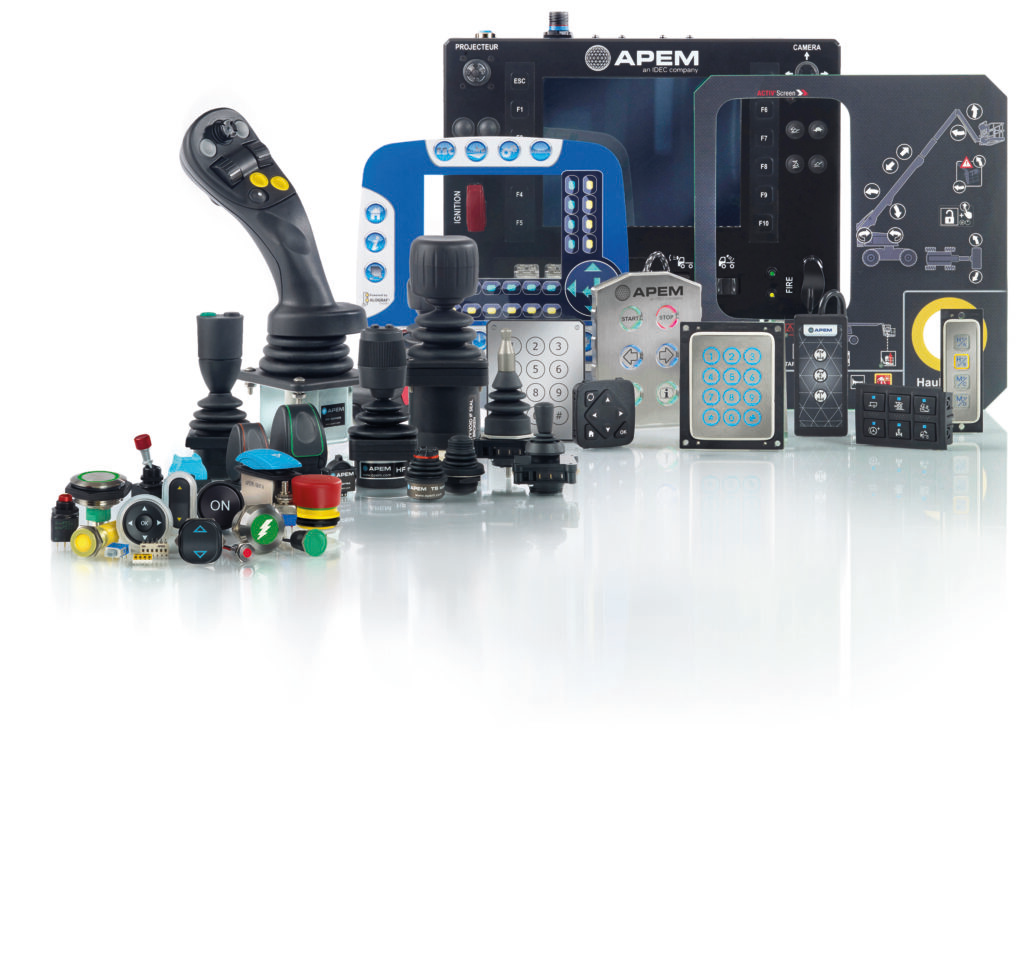
The collaboration combines APEM’s rugged HMI experience and industrial application knowledge with Alps Alpine Europe’s automotive-grade electronics, software, automated production, and industrialisation capability. Material handling will be the initial focus, followed by off-highway vehicles, industrial machinery, and other equipment categories where controls are becoming more connected, ergonomic, and software-enabled.
The companies are targeting complete HMI systems rather than individual switches, displays, or control devices. Armrests, cockpits, dashboards, tiller heads, and modular interface panels are among the intended applications, bringing mechanical design, electronics, sensing, connectivity, software, and operator usability into a more consolidated development process.
A joint team from both companies will work with customers to identify projects and support integrated HMI platforms ahead of industrial launch. The two businesses already share a relationship through an existing joint venture in Japan, giving the European collaboration an established technical and operational base.
Industrial interfaces are carrying more functions as machines become more automated and data-rich. A control panel or joystick assembly is increasingly part of the wider control architecture, handling safety status, diagnostics, alerts, access, machine state, connectivity, and operator feedback alongside basic input functions.
That shift has narrowed the gap between industrial HMI and automotive cockpit engineering. Material handling vehicles, mobile machinery, and industrial equipment must remain usable in dust, moisture, vibration, impact, gloves, temperature variation, and long-service environments, while also supporting more digital interaction and higher functional density.
The same consolidation is visible deeper in the control system. Virtualised control work from congatec and CODESYS points to a machine architecture in which control, visualisation, safety functions, and data services move onto more flexible computing platforms. A more integrated HMI gives the operator side of the machine a similar direction of travel.
Material handling is a practical starting point because the sector combines high equipment volume with fast operational change. Warehouses, logistics hubs, and distribution centres are adding automation while still depending on manually operated and semi-automated equipment. Forklifts, reach trucks, pallet trucks, AGVs, and mobile work platforms need controls that support productivity, safety, and fleet data without making the operator environment confusing.
Functional integration can reduce supplier complexity, but it also raises the burden on the HMI platform itself. A complete interface module must preserve mechanical robustness, environmental protection, electrical reliability, software maintainability, safety behaviour, and long-term supply support. Once displays, buttons, joysticks, sensors, haptics, and connectivity are integrated, validation has to cover the whole subsystem rather than individual parts.
That validation work stretches across the mechanical and electronic domains, from ingress protection and connector retention to firmware behaviour, EMC, human factors, and service replacement. The more functions an HMI module absorbs, the more closely its testing has to mirror the behaviour of the complete machine.
European manufacturing support adds another commercial factor. Industrial machinery programmes often run for many years, and late-stage changes can be expensive once tooling, certification, cabling, enclosures, and training are established. Regional engineering and production capacity can shorten design loops and reduce exposure to long supply chains during prototype and early production phases.
HMI systems are moving away from assembled control surfaces and toward engineered operator subsystems. The interface is becoming part of machine intelligence, where ergonomics, electronics, sensing, and software all shape how equipment is controlled, monitored, and serviced. APEM and Alps Alpine Europe are aligning around that shift, with material handling acting as the first industrial test bed.