IN Brief:
- Mouser is stocking ams OSRAM OSLON UV 3535 LEDs with 265nm and 275nm peak germicidal wavelengths.
- The LEDs use an industry-standard 3535 ceramic package and target surface, air, and water treatment systems.
- UV-C LED design is moving towards scalable solid-state platforms as mercury-based systems face environmental and lifecycle pressure.
Mouser Electronics is now stocking the OSLON UV 3535 LED portfolio from ams OSRAM, adding UV-C emitters for surface disinfection, air treatment, water purification, agriculture, and horticulture systems.
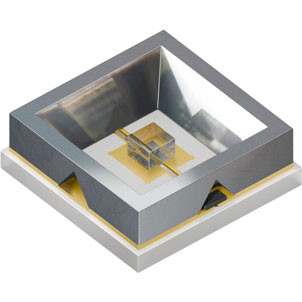
The OSLON UV 3535 devices provide peak germicidal wavelengths at 265nm and 275nm. The 265nm option aligns with the peak absorption region of microbial DNA and RNA, while the 275nm option balances radiant flux, wall-plug efficiency, and component lifetime. The LEDs are supplied in an industry-standard 3535 ceramic package, supporting layout scalability across different power levels and array designs.
The portfolio includes mid-power and high-power variants. Mid-power devices are suited to distributed illumination where uniform irradiance is needed across larger surfaces or air-treatment paths. High-power versions provide higher radiometric power density where more intense local UV-C dosage is required. The devices have an operational lifetime above 20,000 hours and generate no ozone, supporting mercury-free treatment systems with instant switching and lower maintenance requirements than lamp-based approaches.
Applications include point-of-use water treatment, HVAC and air purification modules, surface disinfection systems, medical sterilisation trays, autonomous disinfection equipment, and pathogen management in controlled agriculture. The 3535 ceramic package helps with thermal conduction and mechanical stability, both of which are important because UV-C output and lifetime are closely tied to junction temperature and package behaviour.
UV-C LED adoption is being driven by regulation, system design, and maintenance economics. Mercury lamps have been widely used in disinfection and treatment systems, but they bring warm-up times, fragile glass structures, hazardous material content, and disposal requirements. LEDs allow more compact, electronically controlled, and duty-cycled systems, although they demand careful thermal design, optical control, driver selection, and safety interlocks.
Mouser’s recent expansion of its industrial automation component line-up also points to the distributor’s growing role in connecting component availability with production-ready system design. The UV-C LED stocking update extends that role into treatment and sterilisation equipment, where emitter availability can influence how quickly products move from prototype to repeatable build.
Medical and industrial treatment systems impose different constraints from general illumination. Dose, uniformity, exposure time, shielding, interlocks, degradation, and monitoring all need to be controlled. UV-C radiation can damage materials and presents safety risks if exposure is unmanaged, so the LED, driver, optics, enclosure, sensors, and firmware all form part of the functional design. A compact emitter changes the implementation, but it does not remove the validation burden.
Solid-state UV-C also changes maintenance models. LED arrays can be segmented, monitored, switched instantly, and driven according to duty cycle. That allows equipment to apply UV-C only when needed, integrate with sensors, and use diagnostics to identify degradation or failure. In water or air treatment, those capabilities can support more precise control than a continuously driven lamp, provided the system is validated against the required pathogen-reduction performance.
Thermal management remains one of the central engineering constraints. UV-C LEDs are less efficient than visible LEDs, and maintaining radiant flux over life requires heat to be moved away from the die. PCB material, copper area, thermal vias, heat sinking, airflow, drive current, and enclosure design all affect final performance. The ceramic package helps, but system-level design determines whether the emitter meets its lifetime and output expectations.
Mouser’s stocking of the ams OSRAM OSLON UV 3535 range gives developers a specified route into mercury-free UV-C treatment equipment. Disinfection and sterilisation platforms are continuing to move towards electronically controlled, sensor-linked, and serviceable solid-state architectures, where the UV source becomes part of a wider electronics platform rather than a replaceable lamp alone.