IN Brief:
- IMRA America researchers have demonstrated an injection-locked THz source architecture.
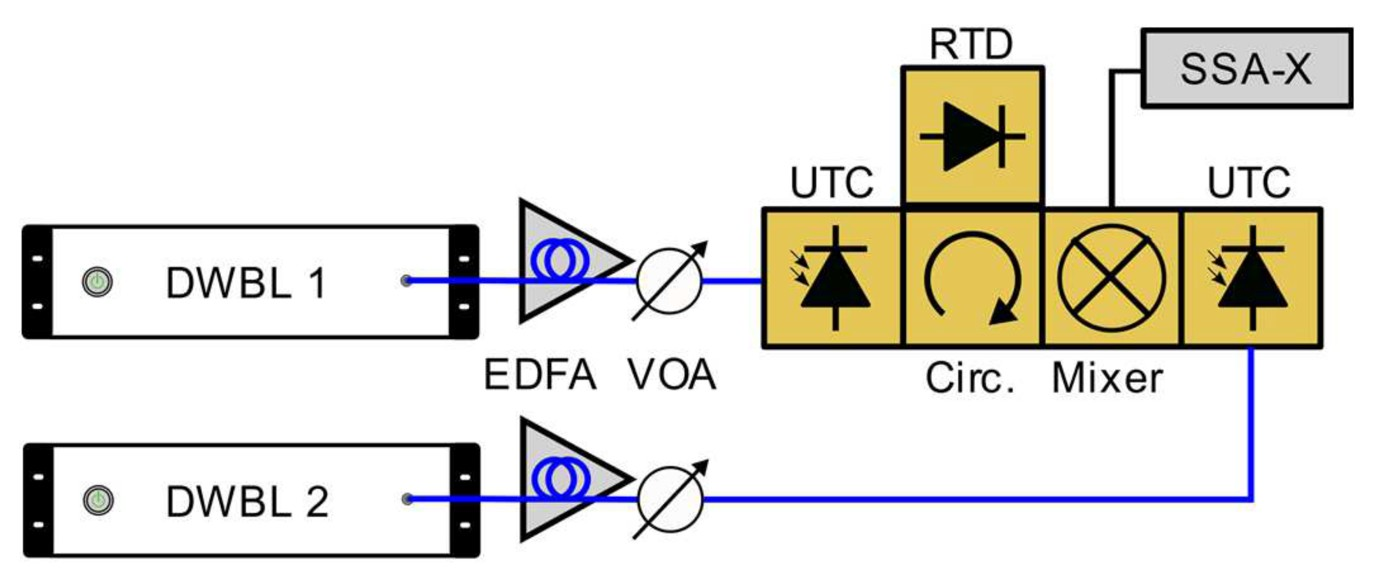
- The system combines a resonant tunnelling diode, photomixed Brillouin laser, and waveguide circulator.
- The proof of concept achieved more than 40dB gain at 260GHz.
IMRA America researchers have demonstrated a terahertz source architecture that combines a resonant tunnelling diode, a photomixed dual-wavelength Brillouin laser, and a low-loss waveguide circulator to improve output performance at 260GHz.
The proof-of-concept system achieved gain of more than 40dB for nanowatt-level input signals. It addresses a persistent trade-off in THz generation, where electronic oscillators can provide useful power but often face phase-noise limitations, while photomixing can offer strong spectral purity but limited output power.
Injection locking provides a route between those approaches. In the demonstrated architecture, the resonant tunnelling diode operates as a compact electronic oscillator, while the low-phase-noise photomixed source provides a reference that stabilises the output. The waveguide circulator manages the THz signal path so the locked oscillator can operate as an amplifier around the reference signal.
Terahertz systems occupy the difficult region between microwave electronics and infrared photonics, broadly spanning the 300GHz to 3THz range. The band is attractive for spectroscopy, non-destructive testing, high-resolution imaging, security screening, radio astronomy, materials characterisation, and future ultra-high-speed wireless communications, although practical deployment has been constrained by source power, efficiency, stability, packaging, calibration, and cost.
At these frequencies, the source architecture is only one part of the design problem. Semiconductor device behaviour, waveguide transitions, optical reference stability, biasing, packaging tolerances, thermal behaviour, and measurement repeatability all interact. Interconnects and mechanical features that would be treated as manageable parasitics at lower frequencies can dominate performance at THz frequencies.
Interest in higher-frequency electronics is rising as conventional RF, microwave, and millimetre-wave systems move toward new performance limits. Automotive radar, industrial inspection, 6G research, machine vision, and scientific instrumentation are all pushing into frequency bands where compact, stable, and repeatable source technology becomes increasingly useful.
The same convergence of physical design disciplines is appearing across high-speed electronics more broadly. Electromagnetic, thermal, package, and circuit behaviour are becoming difficult to separate, particularly in systems that operate at high frequencies or high switching speeds. A THz source brings that convergence into sharper form because small physical effects can quickly become system-level errors.
Resonant tunnelling diodes are attractive because they can operate at room temperature and generate compact THz oscillation through negative differential resistance. The harder task is producing a source that is stable, controllable, packageable, and compatible with application-level constraints. Injection locking improves the stability side of that equation without abandoning compact electronic generation.
The architecture remains research-led, although it strengthens the device and system base needed for more practical THz electronics. Progress in this field is unlikely to come from a single breakthrough component; it will come from source structures that combine semiconductor output, optical reference quality, package control, and repeatable measurement in a form that engineers can build around.