IN Brief:
- HydraForce has launched the EVDR-1206A valve driver for mobile machinery.
- The unit provides 12 current-controlled PWM outputs and six configurable inputs.
- The controller supports CAN integration, HF-Impulse 2.0 configuration, and IP67/IP69K protection.
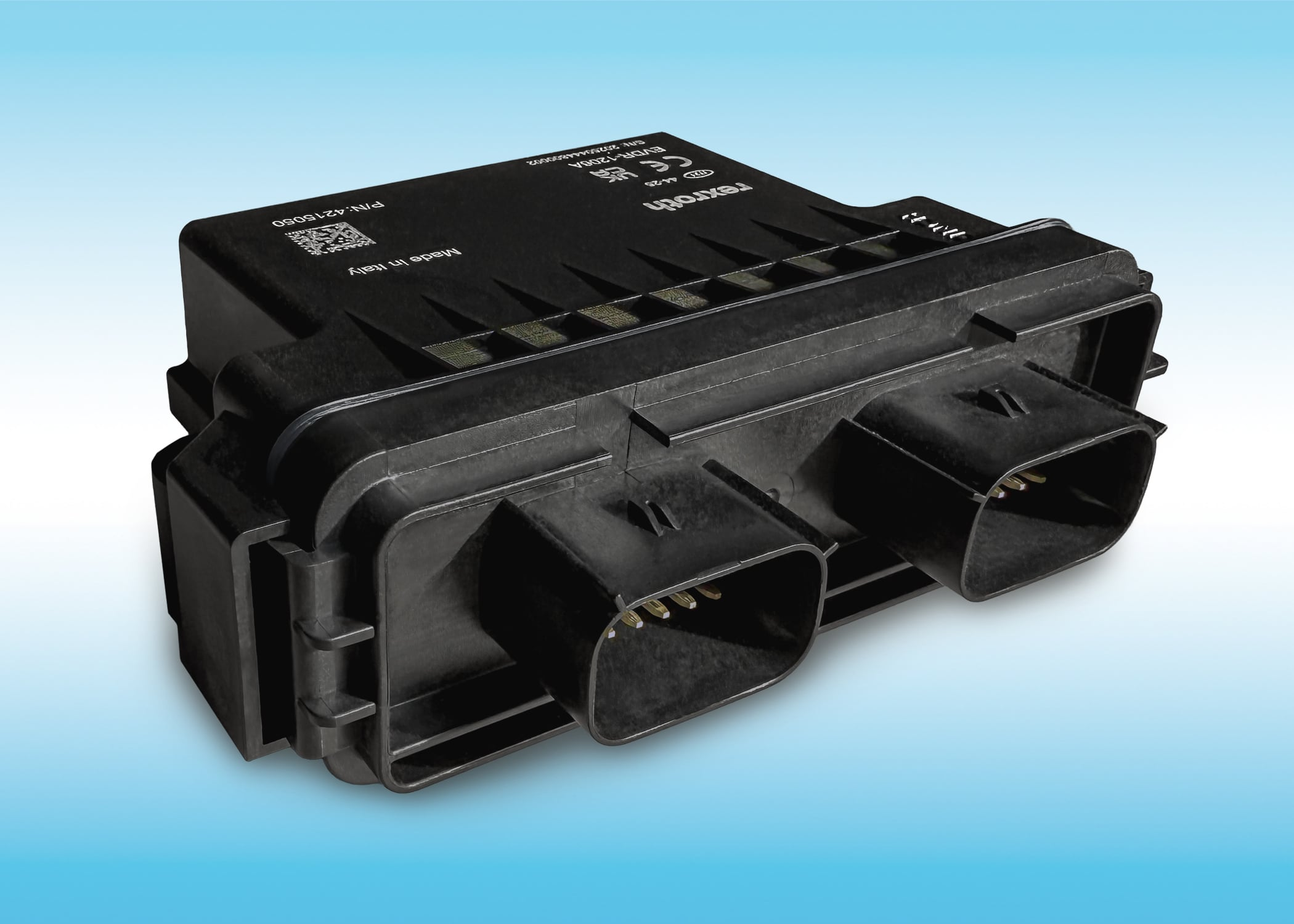
HydraForce has launched the EVDR-1206A, a high-channel-count valve driver for hydraulic proportional valve applications in mobile and off-highway equipment.
The CE-qualified controller is designed for directional-type valve systems and extends the company’s EVDR valve driver family with 12 current-controlled high-side PWM outputs and six configurable inputs. A single compact unit can provide closed-loop current control for six proportional directional valves, reducing the need for multiple discrete control modules.
The outputs support 0–2.4A operation at 50–1000Hz, while the inputs can be configured for 0–5V, 0–32V, or ratiometric signals. The EVDR-1206A accepts SAE J1939 CAN input or an independent voltage signal, with a CAN 2.0B communication port for integration into electrohydraulic control architectures.
An Arm Cortex-M4 processor running at 128MHz provides the controller’s processing base, supported by 512kB program flash, 128kB SRAM, and 8kB EEPROM. The unit supports 9–32Vdc supply operation across 12V and 24V vehicle systems and is rated to IP67 and IP69K for harsh operating environments. The specified temperature range is -40°C to 80°C.
Configuration is handled through HF-Impulse 2.0, HydraForce’s web-accessible configuration and programming software. Engineers can define metering profiles, ramp rates, and control parameters through the tool, with configuration carried out over CAN.
Mobile machinery continues to absorb more electronics as hydraulic systems become more software-defined. Hydraulics still provide the force density required in construction, agriculture, mining, materials handling, and specialist off-highway vehicles, but proportional control, diagnostics, operator feel, energy efficiency, and semi-automated functions increasingly depend on embedded control.
High-channel-count valve drivers help reduce wiring and hardware complexity by consolidating control functions that might otherwise sit across separate modules. They also make it easier to coordinate multiple hydraulic functions from a common electronics platform, which becomes important as machines add automation, remote diagnostics, richer human-machine interfaces, and more configurable operating modes.
The environmental ratings are central to the product’s role. Off-highway electronics face vibration, pressure washing, moisture, dust, temperature variation, and mechanical shock, often while installed close to valve manifolds or exposed machine structures. A controller operating in that environment has to be treated as rugged system hardware rather than cabinet electronics.
The EVDR-1206A also reflects the growing convergence of fluid power and embedded electronics. The hydraulic circuit provides the mechanical force, but software increasingly determines repeatability, response, tuning, diagnostics, and machine behaviour. That places more emphasis on configuration tools that can make control settings visible, adjustable, and repeatable across vehicle platforms.
Adoption will depend on integration work around machine safety architecture, connector strategy, service procedures, software validation, and platform tuning. As mobile equipment becomes more electronically controlled, products such as the EVDR-1206A show how control density is moving closer to the hydraulic actuation layer.