IN Brief:
- TÜV SÜD has certified Panasonic Industry’s development processes against IEC 62443-4-1.
- The standard covers secure design, implementation, verification, release, maintenance, and vulnerability handling.
- Manufacturers are strengthening product-security governance ahead of the EU Cyber Resilience Act’s full application.
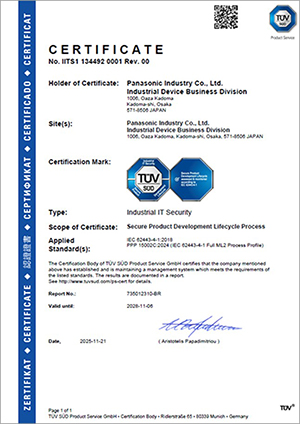
Panasonic Industry has obtained IEC 62443-4-1 certification for the development lifecycle used by its Industrial Devices Business Division, covering industrial automation and control-system products.
TÜV SÜD Product Service completed the third-party assessment, confirming that security-management processes across product design, development, verification, release, maintenance, and vulnerability handling conform to the international standard.
IEC 62443-4-1 evaluates the processes used to create and support secure products rather than certifying one device configuration in isolation. Its requirements cover security planning, definition of product requirements, secure design and implementation, verification, management of security-related issues, update procedures, and product end-of-life.
Cybersecurity performance changes throughout an industrial product’s service life. A controller may be adequately protected against known attack methods when released, yet later vulnerabilities can emerge within operating systems, communication libraries, processors, cryptographic implementations, development tools, or third-party code.
A repeatable response therefore depends on accurate product records, software inventories, disclosure routes, signing infrastructure, validation procedures, and clearly assigned support responsibilities. Preparing a patch is only one part of the process; affected products must first be identified, severity assessed, corrective action tested, and customers informed without disrupting operational safety.
Panasonic has also established a product-security information service covering policy, vulnerability handling, advisories, and reporting channels. Machine builders and industrial operators can use that service to track lifecycle information for automation products incorporated within larger control systems.
The certification precedes the full application of the EU Cyber Resilience Act, which introduces security obligations for products containing digital elements. Manufacturers placing connected hardware and software on the European market will need to address secure design, vulnerability handling, update support, technical documentation, and incident reporting.
Component roadmaps are already changing around those obligations. Microchip’s CRA-oriented device-security services combine secure elements, provisioning, key management, and lifecycle support. At both semiconductor and subsystem level, security functions are increasingly being designed around post-deployment maintenance rather than release-day protection alone.
Industrial equipment complicates the task because operational lifetimes frequently exceed those of its computing components. Machinery may remain in service for 15 or 20 years while processors, operating systems, and communications stacks move through several commercial generations. Update mechanisms must endure without undermining deterministic control, functional safety, or validated machine behaviour.
As controllers exchange data with supervisory systems, cloud platforms, remote-maintenance services, engineering workstations, and enterprise software, each interface introduces requirements for identity, authentication, encryption, access control, logging, and recovery. Connectivity improves visibility and serviceability, but it also removes many assumptions associated with isolated operational networks.
The hardware architecture must support the lifecycle process. Secure boot, protected key storage, hardware roots of trust, authenticated updates, debug control, memory protection, and tamper resistance can reduce exposure when integrated with software development and manufacturing. Arm’s extension of security functions across CPU designs shows how those controls are moving deeper into processor architecture.
Certification cannot secure an installation by itself. System configuration, network segmentation, remote-access policy, user accounts, firmware maintenance, and integration with third-party equipment remain the responsibility of machine builders and operators. A well-developed component can still be deployed with weak credentials, exposed interfaces, or unmanaged software.
Even so, IEC 62443 gives procurement and engineering teams a common basis for examining whether security has been embedded into ordinary development practice. Supplier assessment can move beyond a feature list towards governance, verification, vulnerability response, and long-term support.
Compliance evidence will increasingly depend on information moving through the component chain. Finished-product manufacturers need declarations, support periods, software details, vulnerability policies, and update commitments from suppliers before they can document how risk is controlled across the complete system.
Panasonic’s certification places cybersecurity alongside quality, safety, and reliability within industrial product development. Regulatory deadlines are accelerating adoption, although the underlying engineering requirement extends much further: connected automation products need support structures capable of lasting as long as the machinery they control.