IN Brief:
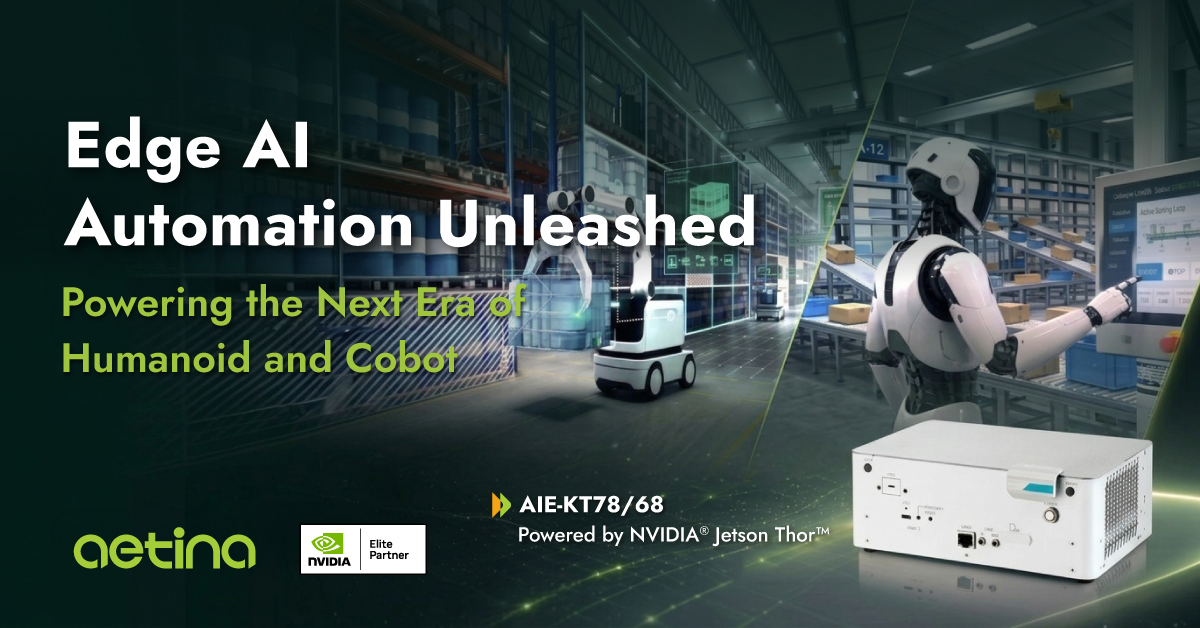
- AIE-KT78 delivers up to 2,070 FP4 TFLOPS from Jetson T5000 with 128GB LPDDR5X, while KT68 provides 1,200 FP4 TFLOPS from T4000.
- QSFP28, dual 10GbE, and up to eight GMSL2 cameras support high-bandwidth multi-sensor perception.
- A dedicated 1GbE EtherCAT master links local AI inference with robot motors, joints, sensors, and actuators.
Aetina Corporation has released two Jetson Thor edge systems combining high-performance multimodal AI processing with sensor aggregation and dedicated EtherCAT control for cobots, humanoid robots, industrial arms, and other autonomous machines.
The DeviceEdge AIE-KT78 uses NVIDIA’s Jetson T5000 module with 128GB of 256-bit LPDDR5X memory and provides up to 2,070 FP4 TFLOPS of AI performance. The AIE-KT68 uses the Jetson T4000 with 64GB of LPDDR5X and provides up to 1,200 FP4 TFLOPS, giving system integrators two compute levels within the same architecture.
Aetina has designed the systems for local execution of multimodal generative AI, large language models, vision-language models, and vision-language-action models. VLA models are particularly demanding in robotics because perception and language-derived context have to be converted into actions while sensor data continues to arrive and the machine remains under real-time control.
The platform therefore devotes substantial bandwidth to sensor input. QSFP28 provides up to four 25Gbps lanes depending on configuration, while two RJ45 10GbE interfaces provide additional high-speed connectivity. Up to eight GMSL2 camera inputs support distributed vision alongside LiDAR, radar, depth cameras, inertial sensors, and other industrial devices.
The specification moves beyond Aetina’s smaller Jetson Orin systems launched in August. Those platforms support four GMSL2 cameras and reach 100 TOPS, targeting compact mobile and industrial vision applications. The AIE-KT78/68 instead provides the compute and connectivity required for a more central role within a robot’s perception and control architecture.
A dedicated 1GbE EtherCAT connection operates as an independent EtherCAT master. High-level AI processing can therefore share a system with the field network carrying time-sensitive commands and feedback to motors, joints, sensors, and actuators, reducing the need to place all motion-control functions on a separate industrial computer.
The architecture does not make neural inference deterministic. Model execution time can vary with workload, and safety-related machine behaviour still depends on appropriately designed control loops, safety functions, fault handling, and validation. EtherCAT instead provides a deterministic communication layer for the devices beneath the AI application.
That division is central to practical robotics. A VLA model may interpret an image, understand an instruction, and select an action, but a physical robot still requires synchronised drive control, encoder feedback, current regulation, trajectory generation, interlocks, and predictable reaction to faults.
Putting those domains into one computing platform can reduce hardware count and interface complexity, although it places greater emphasis on software partitioning and scheduling. Intensive inference workloads cannot be allowed to compromise time-sensitive control, while control faults have to be contained without depending on the behaviour of a generative model.
Aetina has packaged the hardware for industrial deployment rather than development-bench use. The systems are 80mm thick, accept 9–48VDC input, and are specified to operate from −25°C to +55°C. USB 3.2, isolated digital I/O, and M.2 expansion provide additional interfaces for storage, communications, and application-specific hardware.
The software environment is Linux with NVIDIA JetPack 7 and the wider CUDA, TensorRT, DeepStream, Holoscan, and Isaac ROS stack. Those tools provide GPU acceleration, computer-vision processing, sensor pipelines, and robotics middleware while leaving the application developer responsible for the behaviour of the complete machine.
Richard Hung, Vice President of Product Division at Aetina, said: “The competitive edge for cobots and humanoid robots has shifted from the compute performance of a single model to whether a system can integrate perception, reasoning, decision-making, and action in real time in real-world environments.”
System performance remains constrained by more than AI throughput. Sensor latency, memory bandwidth, networking, thermal limits, control timing, mechanical response, and the scheduling of competing software workloads all influence how quickly a robot can turn perception into a physical action.
The same constraint applies to multi-camera systems. Eight GMSL2 inputs can provide broad visual coverage, but each stream adds image-processing and memory demand before the application begins running its higher-level models. QSFP28 and 10GbE give the platform additional routes for high-volume data, but the software pipeline still has to prioritise and process those inputs within the control cycle available.
The AIE-KT78 and AIE-KT68 are available to ship now. Their architecture combines Jetson Thor compute, high-bandwidth sensor connectivity, multi-camera input, and an EtherCAT control path in one industrial system, moving Aetina’s edge hardware towards machines where AI inference and physical control operate within the same computing platform.