IN Brief:
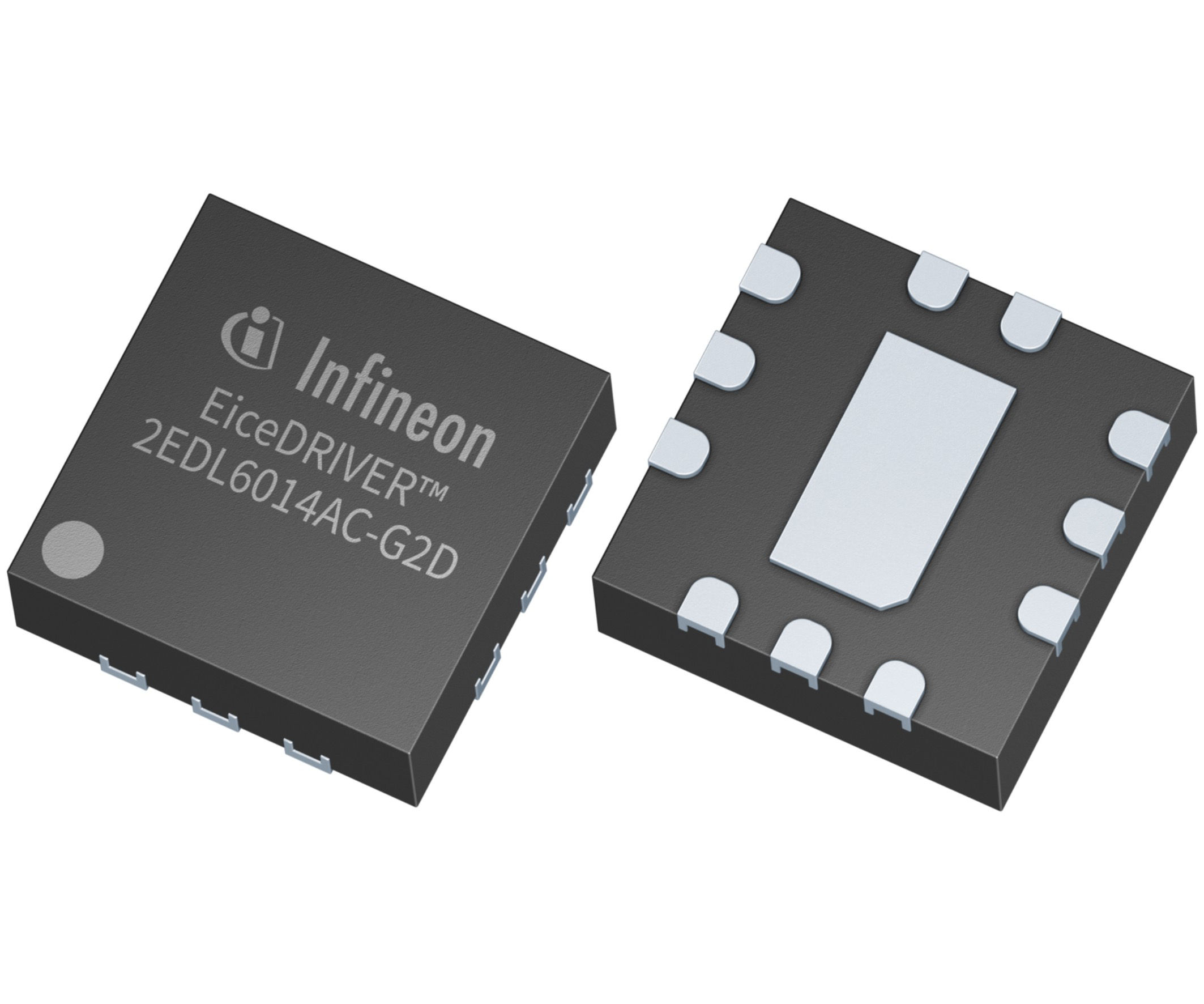
- EiceDRIVER 2EDL6014AC-G2D integrates two independent floating gate-driver channels in a 2.2 × 2.2mm WQFN package.
- Each channel can drive a high-side MOSFET to 120V, with 4A source and 6A sink capability.
- The device supports dual-high-side, dual-low-side, and half-bridge configurations for multilevel and switched-capacitor stages.
Infineon Technologies has introduced a 120V dual-channel floating gate driver for high-density silicon power conversion in AI data centres, placing two independently controlled channels inside a 2.2 × 2.2mm WQFN-12 package.
The EiceDRIVER 2EDL6014AC-G2D supports dual-high-side, dual-low-side, and half-bridge configurations, allowing the same IC to operate across switched-capacitor and multilevel converter topologies. Each floating channel can drive a high-side MOSFET operating at up to 120V and provides 4A source and 6A sink capability.
Separate INA and INB inputs provide independent control of the two channels, while the input stage accepts 3.3V and 5V logic and can reference directly to microcontroller ground. Infineon has also integrated deglitch filtering and undervoltage lockout on the floating output supplies, forcing an affected output low if its supply voltage falls below the operating threshold.
The device enters a server power architecture that is becoming increasingly distributed. High-performance accelerators require very high current at comparatively low core voltages, while the rack supply operates at much higher voltage. Several conversion stages are therefore used to move power efficiently from distribution rails towards processors and accelerator boards.
Intermediate buses, switched-capacitor converters, multilevel stages, and final point-of-load regulators divide that voltage transformation into manageable steps. Each stage has different requirements for switching frequency, efficiency, thermal density, control, and component footprint, leaving gate-drive performance as one part of a much larger conversion problem.
Infineon has already expanded its AI power portfolio closer to the processor with dual-phase smart power stages. Those devices integrate MOSFETs and drive electronics near the load, while the 2EDL6014AC-G2D provides flexible control for discrete silicon switching devices used elsewhere in the conversion chain.
AI power delivery is also spreading across several semiconductor technologies. Silicon MOSFETs remain useful where voltage, switching frequency, conduction loss, and cost favour them, while gallium nitride and silicon carbide are moving into stages where higher switching speed or voltage capability can offset higher device cost.
Gate-driver performance becomes increasingly sensitive to layout as switching density rises. Strong source and sink currents can charge and discharge MOSFET gates rapidly, reducing transition losses, but faster voltage and current edges also increase sensitivity to parasitic inductance, overshoot, ringing, and electromagnetic interference.
The 2.2mm WQFN footprint addresses board area, while an exposed pad provides a lower-impedance thermal path into the PCB. Thermal design remains important because a driver repeatedly charging and discharging MOSFET gate capacitance dissipates its own power, particularly at high switching frequency.
Noise immunity is another constraint inside dense server converters. Closely spaced switching nodes can generate fast common-mode transients and local ground disturbance, increasing the risk of unintended switching if signal routing and reference paths are poorly controlled. Independent inputs, filtering, and undervoltage protection provide additional protection at IC level, but PCB layout and grounding remain part of the final design.
The device also fits into the wider migration towards higher-voltage rack distribution. Infineon’s recent 800VDC protection work with SolarEdge addresses fault isolation further upstream, while the new gate driver sits closer to the intermediate conversion stages that ultimately feed accelerator hardware.
Those layers increasingly determine how much compute can be installed inside a rack. Higher processor power cannot be supported indefinitely by simply increasing current through existing conductors and conversion stages, because resistive loss, thermal density, connector capability, and PCB area all become limiting factors.
Samples of the EiceDRIVER 2EDL6014AC-G2D are available now. Its two independently floating channels, 120V capability, and compact package give designers another control device for multilevel and switched-capacitor architectures as AI server power delivery moves towards denser, more distributed conversion.